

As, however, its range of eyesight, like that of an Elephant, is limited to from thirty to forty yards it is generally fairly easy to avoid these attacks, provided the sportsman keeps his head, and is agile.
The Black Rhino feeds mostly on thorns, and like all game, especially in the hot dry season, he drinks nightly, so it is not difficult to pick up his spoor and follow him to his resting place which, in Nyasaland and Northern Rhodesia, is usually in the hills. As he makes for his daytime haunts he feeds as he goes along, and it is wonderful how he manages to get nutriment out of the hard and dry thorns he consumes, for although I am sure I have seen grass in his droppings he is certainly not a grazing animal by habit.
Of all the larger game he keeps furthest away from the habitations of man. In East Africa instead of being a plains-loving animal as formerly, constant persecution is, I believe, making him more of a bush-dweller. It is almost incredible how an animal of that size can manage to get any nutriment from the dry hard thorns which comprise its food, and which account for its prevalence in the dense thorn bush of Kenya. It is local in its habits and does not wander very far from one place. While water is apparently not a daily necessity it will drink every day or rather by night - if possible, and will be therefore found usually in the vicinity of a river or water hole.
At the present time it is probably most numerous in Kenya Colony in the neighbourhood of Voi and Tsavo
There are two distinct species of this animal, the 'White' (Rhinoceros simus), and the 'Black' (Rhinoceros bicornis), but this nomenclature is misleading, as actually there is very little difference in the colour. The chief difference lies in that the White is slightly the larger beast, subsists mainly upon grass and has a wide square mouth. The White species is reputed to be far less pugnacious than his halfbrother and the range of his habitat is much more local.
Like the White race they resort to one spot to drop their dung and then kick it about, so that the bushes near are sprinkled with it.
A point to be remembered with all game which has to be spoored up, is, that a very early start is essential, so the hunter should be away as the sun tips the horizon. This is even of importance when one goes out chance hunting, for early in the morning Antelopes, and game such as Buffaloes will be found in the open dambos (valleys). The sun begins to get stronger as time goes on, and about 3 pm. is the hottest time. Then all game will be in cover for the shade, except purely game of the plains, which will often go to clumps of trees, ant-hills or high grass to get shelter from the sun. In the dry season, often called the cold season in South Central Africa, the temperature can be quite nippy at dawn, and for an hour or so afterwards, so an old tweed jacket is quite useful. I always had the heel of my rifles finished in wood and no iron heelplate, which makes one's hands bitterly cold at such an hour and becomes burning hot in the sun. The main point in hunting Rhino is to keep the wind right, for he is a keen-scented animal. His eyesight and hearing are bad, and he is an excitable beast, which accounts for his strange behaviour in East Africa where he sometimes charges through a line of porters. He does this to get above the wind for he dislikes the smell of human beings, and his behaviour on such occasions is not due to ferocity, but to fear, and his dislike of the taint of mankind. Of all the larger game he keeps furthest away from the habitations of man. In East Africa instead of being a plains-loving animal as formerly, constant persecution is, I believe, making him more of a bush-dweller. In this way he may succeed in his struggle for survival. A good average horn will be about 20 inches on the front curve in South Central Africa, and one of 28 inches would, nowadays, be quite good in Kenya.
For its bulk it is extraordinarily quick on its feet and covers the ground at a great speed.
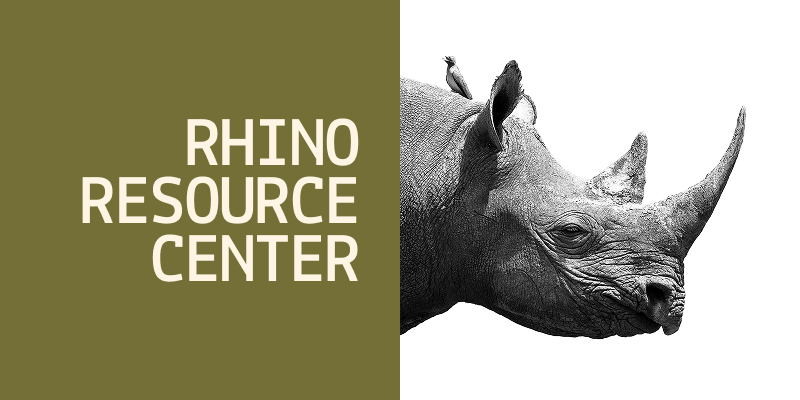
Black Rhino are as fond as the White species of wallowing in mud or rolling in dust, which gives their hides a variety of shades, from grey to red.
There are two distinct species of this animal, the 'White' (Rhinoceros simus), and the 'Black' (Rhinoceros bicornis), but this nomenclature is misleading, as actually there is very little difference in the colour. The chief difference lies in that the White is slightly the larger beast, subsists mainly upon grass and has a wide square mouth. The White species is reputed to be far less pugnacious than his halfbrother and the range of his habitat is much more local.
The Black Rhino feeds mostly on thorns, and like all game, especially in the hot dry season, he drinks nightly, so it is not difficult to pick up his spoor and follow him to his resting place which, in Nyasaland and Northern Rhodesia, is usually in the hills. As he makes for his daytime haunts he feeds as he goes along, and it is wonderful how he manages to get nutriment out of the hard and dry thorns he consumes, for although I am sure I have seen grass in his droppings he is certainly not a grazing animal by habit.
When on the move, the precedence of a family party reverses the order accepted by the White Rhino. With the Black variety the bull leads, the cow follows, and the calf brings up the rear.
It is quite a habit for a Rhino when seeking its daytime resting place to turn back parallel and to leeward of its trail before it lies down, and the hunter must always be on the alert for such a contingency when following its spoor.
The Black Rhino feeds mostly on thorns, and like all game, especially in the hot dry season, he drinks nightly, so it is not difficult to pick up his spoor and follow him to his resting place which, in Nyasaland and Northern Rhodesia, is usually in the hills.
Unlike the Elephant, which generally sleeps standing, the rhino lies down, although I have seen one asleep when on his legs.
The natives are certainly as much afraid of him as they are of the Elephant, although in the opinion of most hunters he is classed as the least dangerous of all the larger game. The probable reasons for the very different opinions as to the risks of shooting Rhino is that the nature of the beast itself differs according to locality. In the Baringo district, for example, I found them particularly pugnacious, while in French Equatorial Africa they would try to beat a retreat even when startled by sudden approach. When wounded the beast will often revolve in a circle before dashing madly away or dropping dead. Should it bear down on the sportsman it is wiser to try and turn it by a shot, for if it catches sight of a flying figure it will often take up the chase like a terrier after a rat. The moment a Rhino gets your wind its head and tail go up to the accompaniment of a loud grunting snort. For its bulk it is extraordinarily quick on its feet and covers the ground at a great speed. A cow with a calf is an exceptionally dangerous animal, and in approaching a Rhino the utmost care should be taken to spot it before it discovers you, a difficult matter in the dense country in which it is usually found.
Black Rhino are as fond as the White species of wallowing in mud or rolling in dust, which gives their hides a variety of shades, from grey to red.
Attack on train in Kenya The Black Rhino is pig-like both mentally and physically and little or no provocation is required to make it take the offensive. On at least one occasion in the earlier days of the Kenya-Uganda railway it charged an approaching train, meeting it obliquely near the front portion. As might be supposed the train got the better of the encounter and knocked the Rhino over. Nothing daunted, however, the enraged beast got on to his legs and made a second attack, with the same result, when, thoroughly disgruntled, he limped off into the bush.
Black Rhino are as fond as the White species of wallowing in mud or rolling in dust, which gives their hides a variety of shades, from grey to red.
A good average horn will be about 20 inches on the front curve in South Central Africa, and one of 28 inches would, nowadays, be quite good in Kenya.
A full-grown male stands upwards of five feet at the shoulder and weighs over a ton.
A full-grown male stands upwards of five feet at the shoulder and weighs over a ton.

