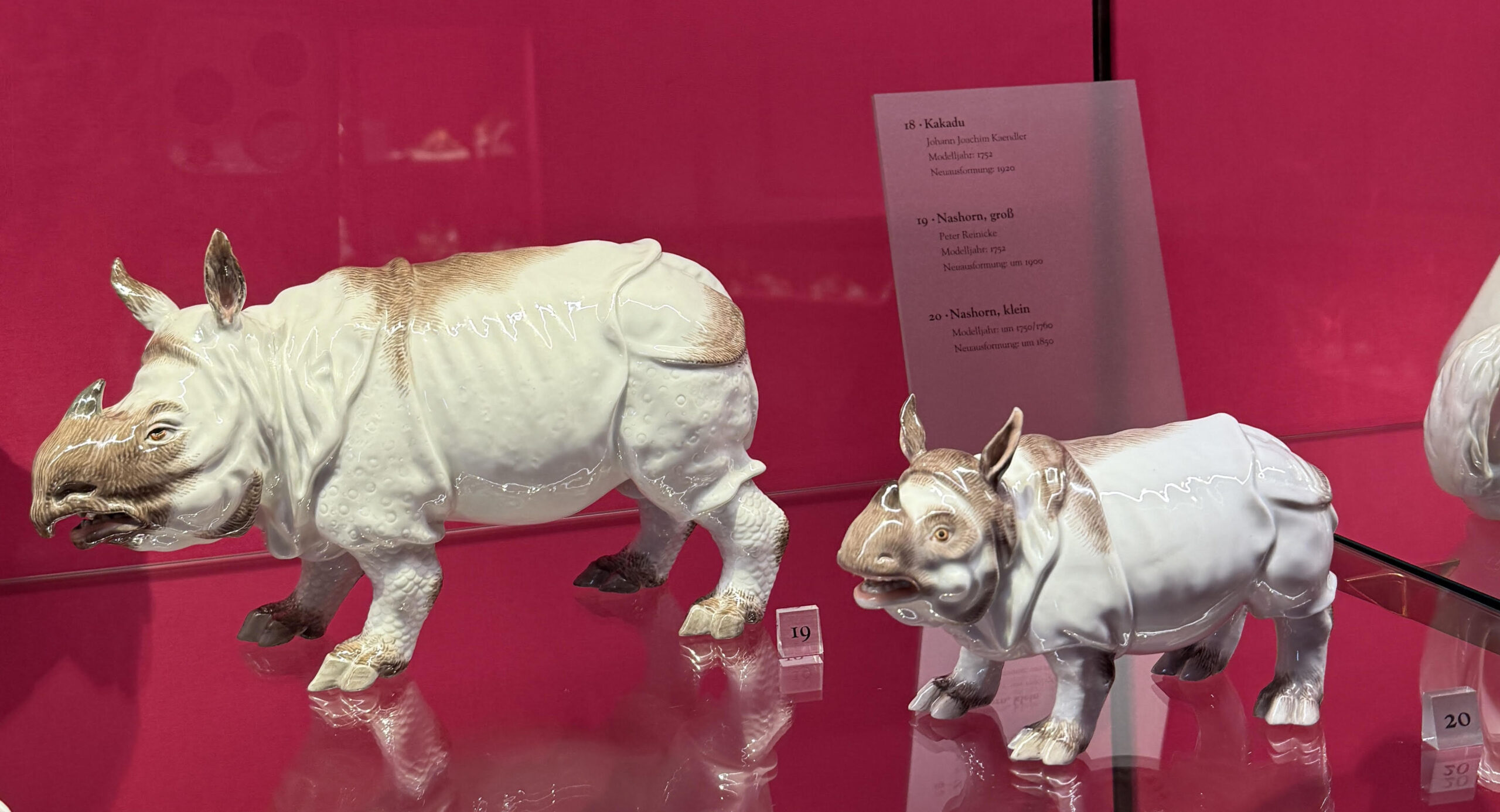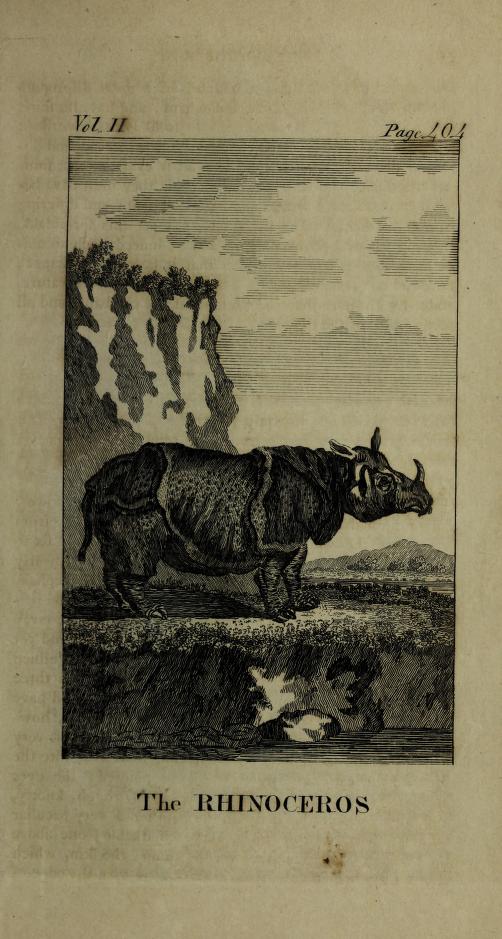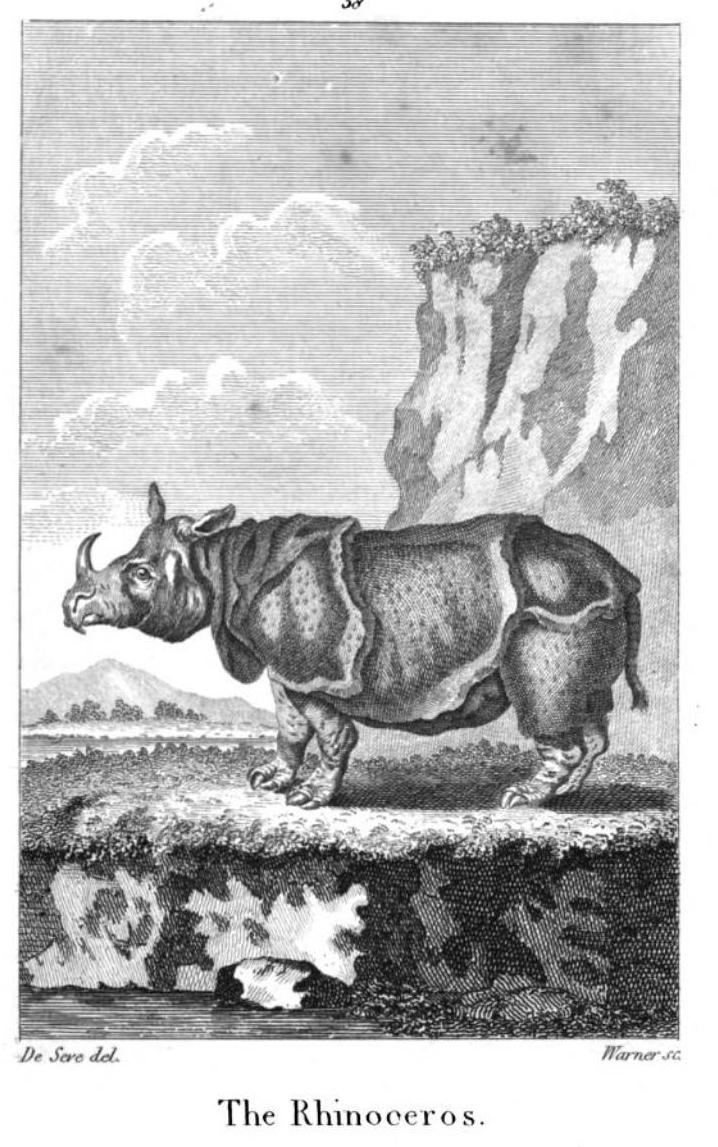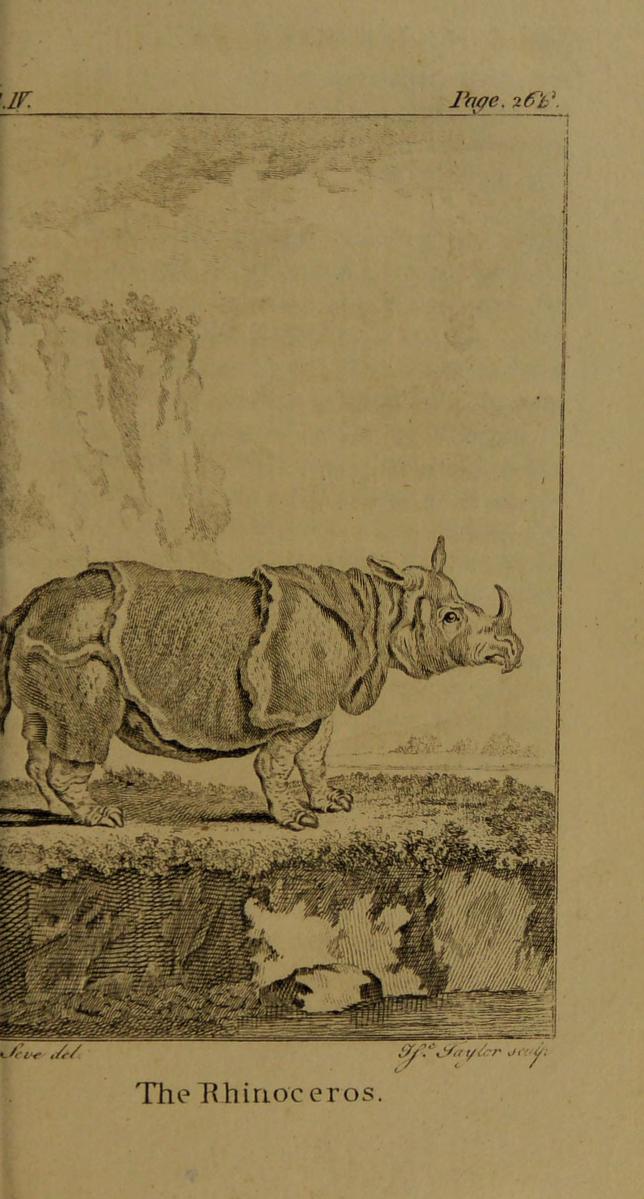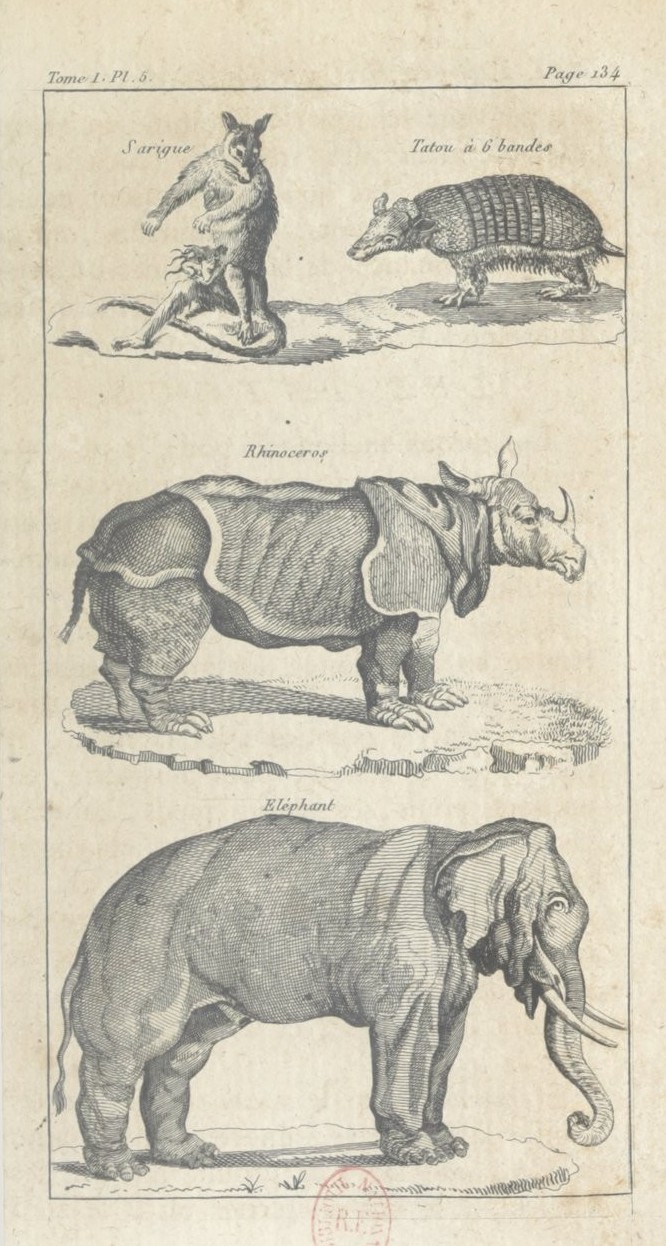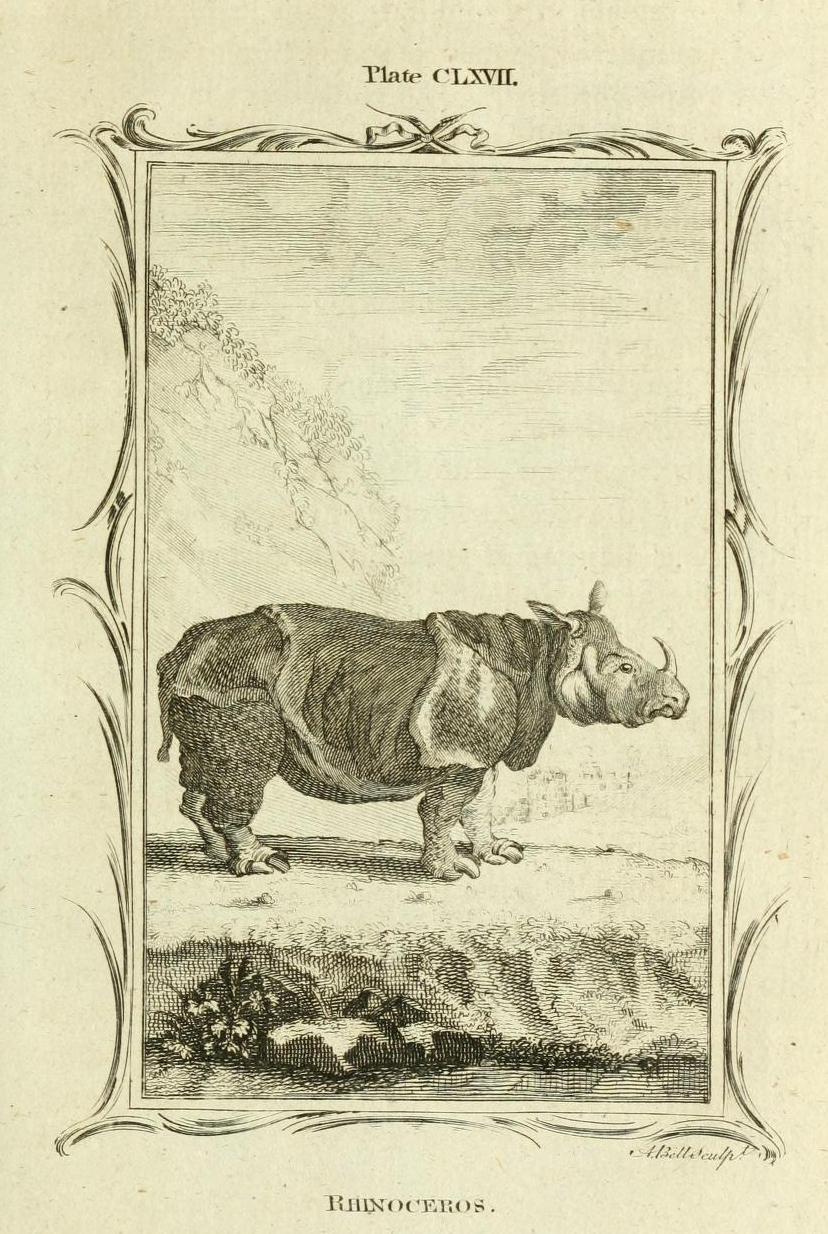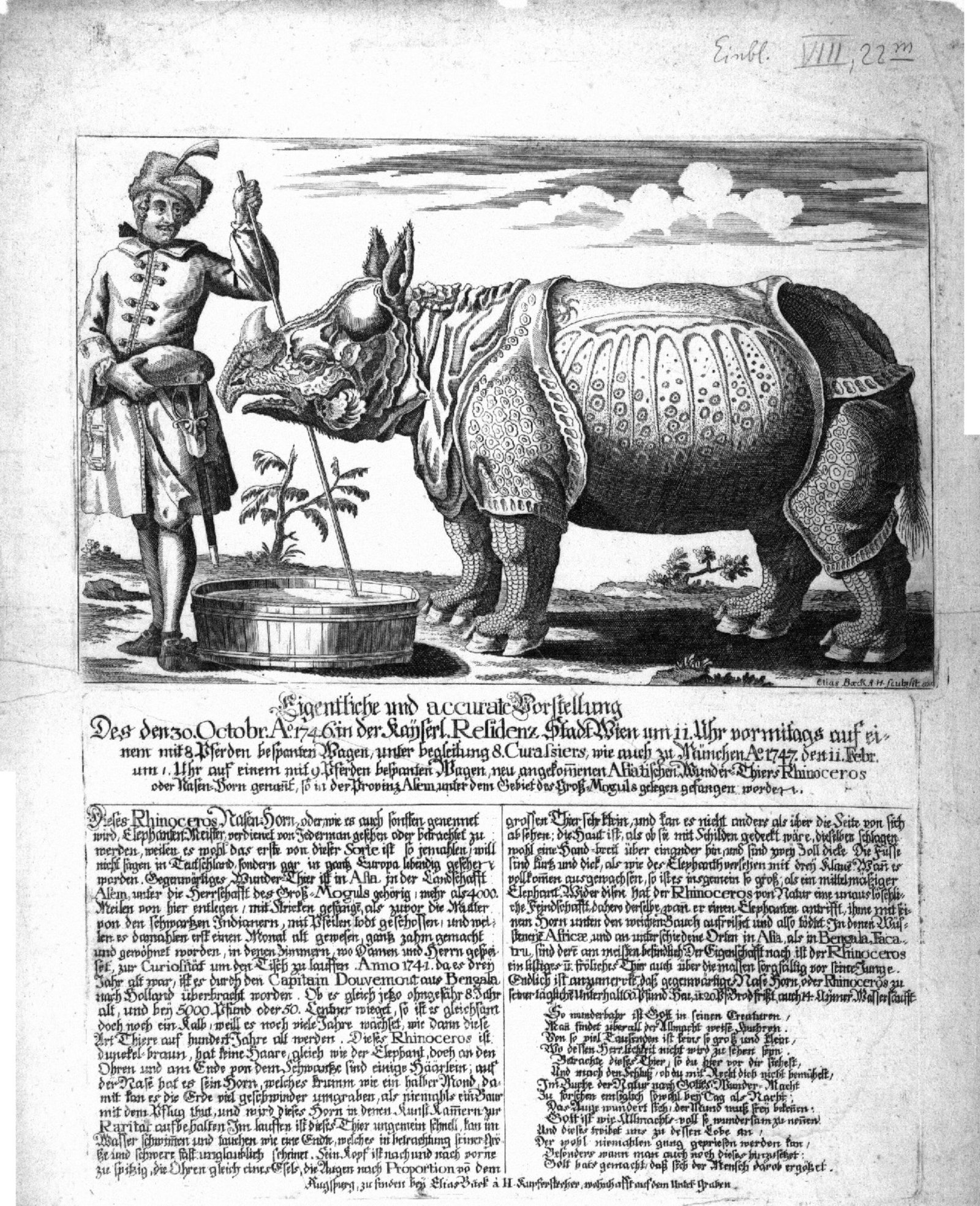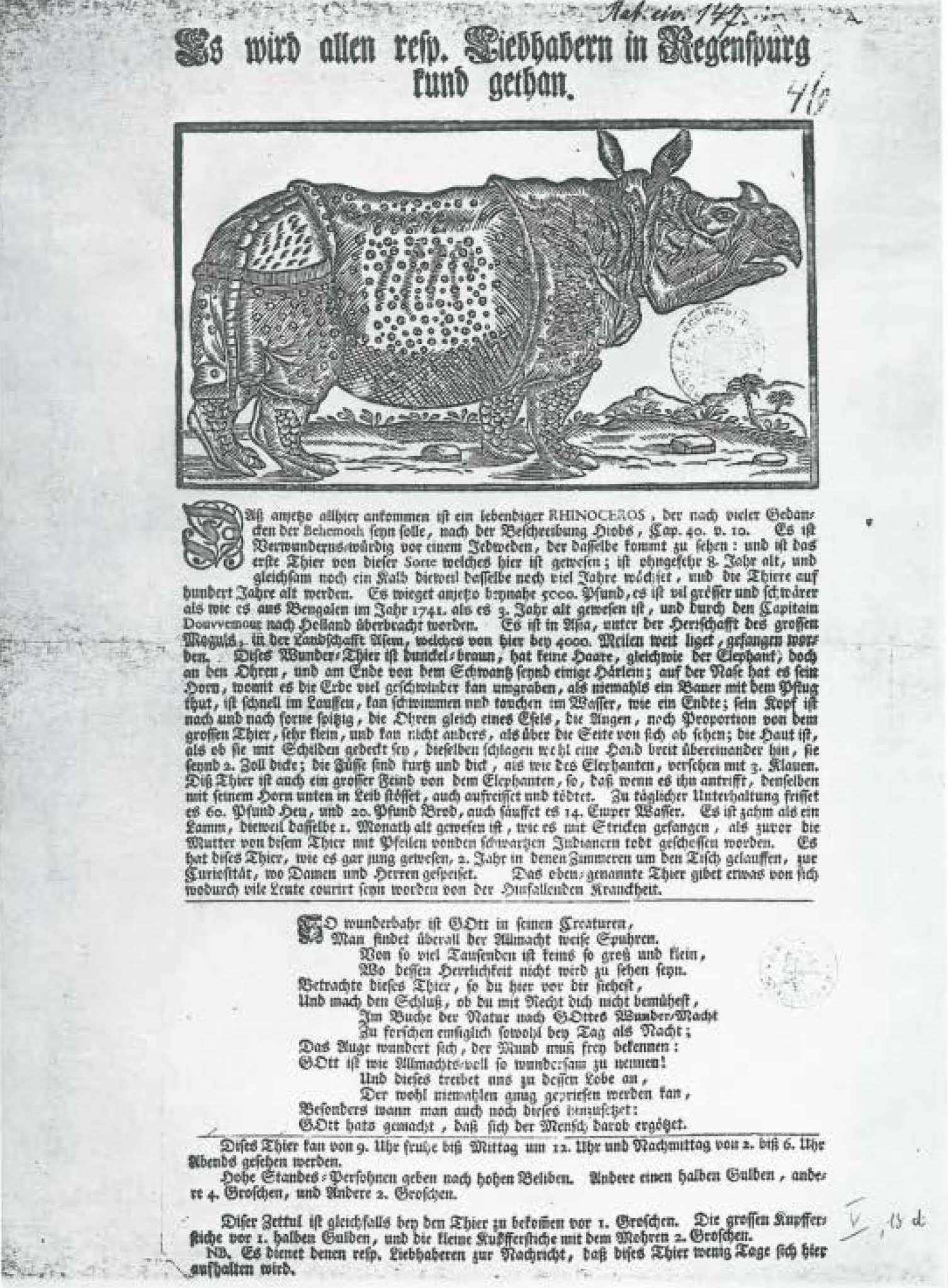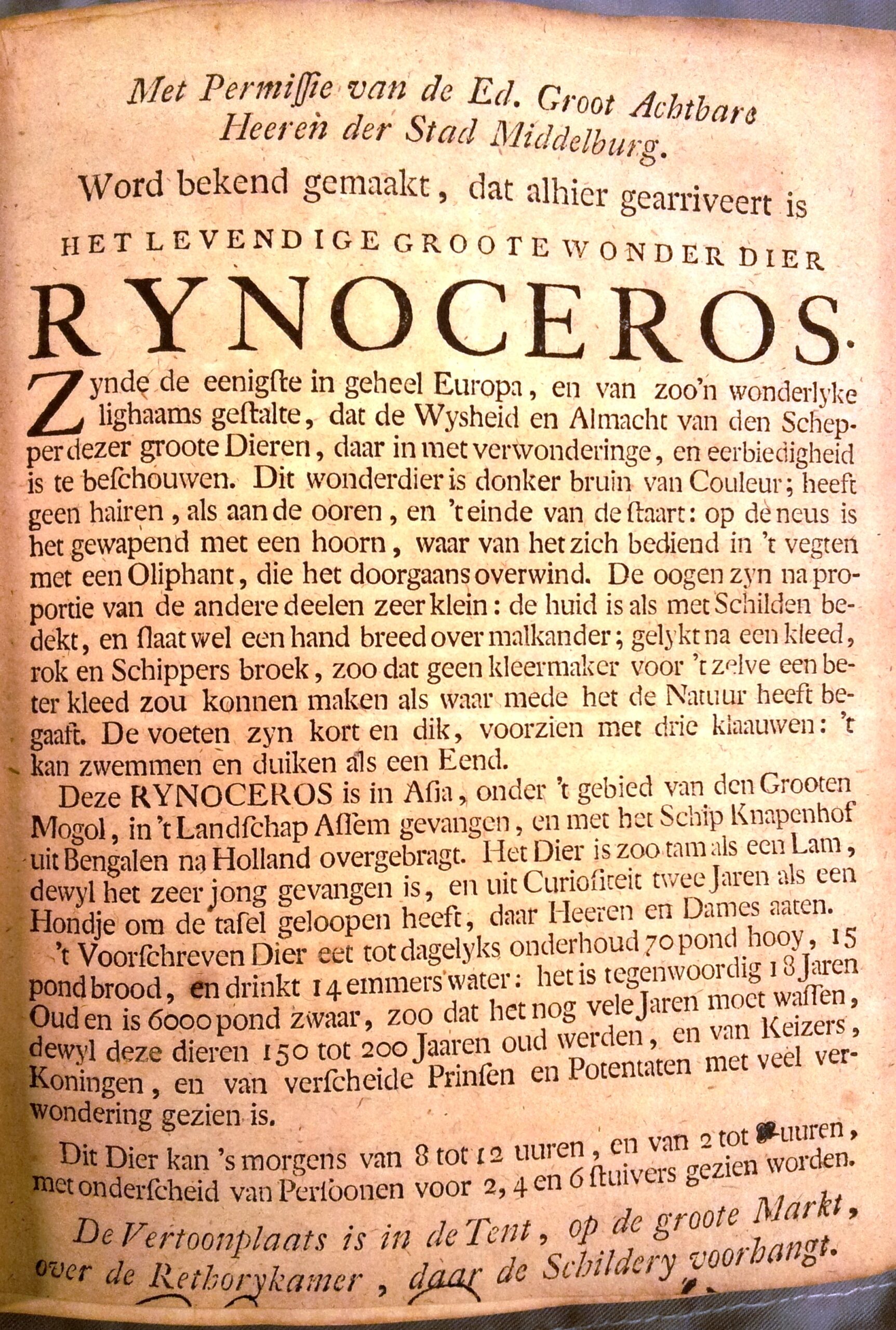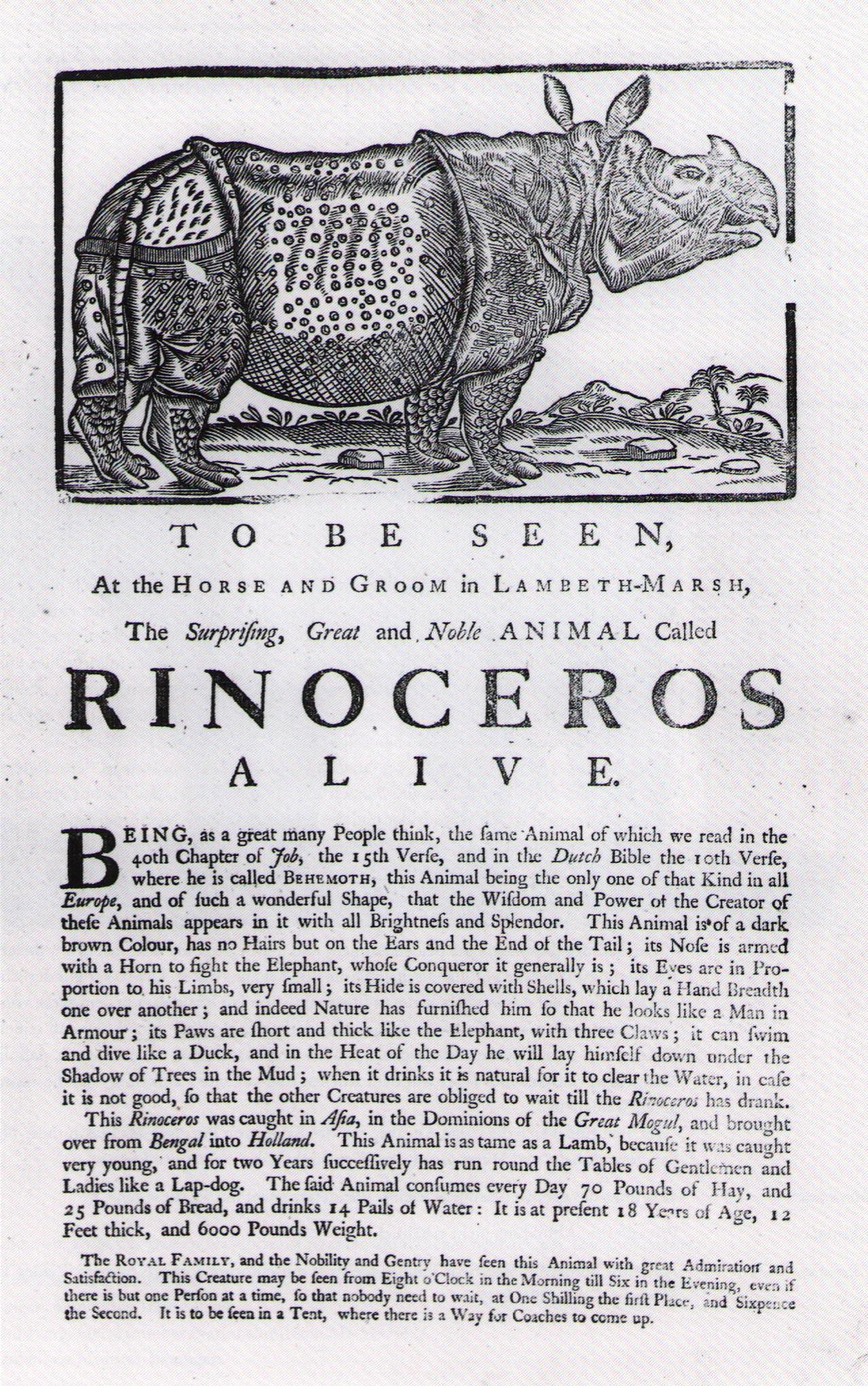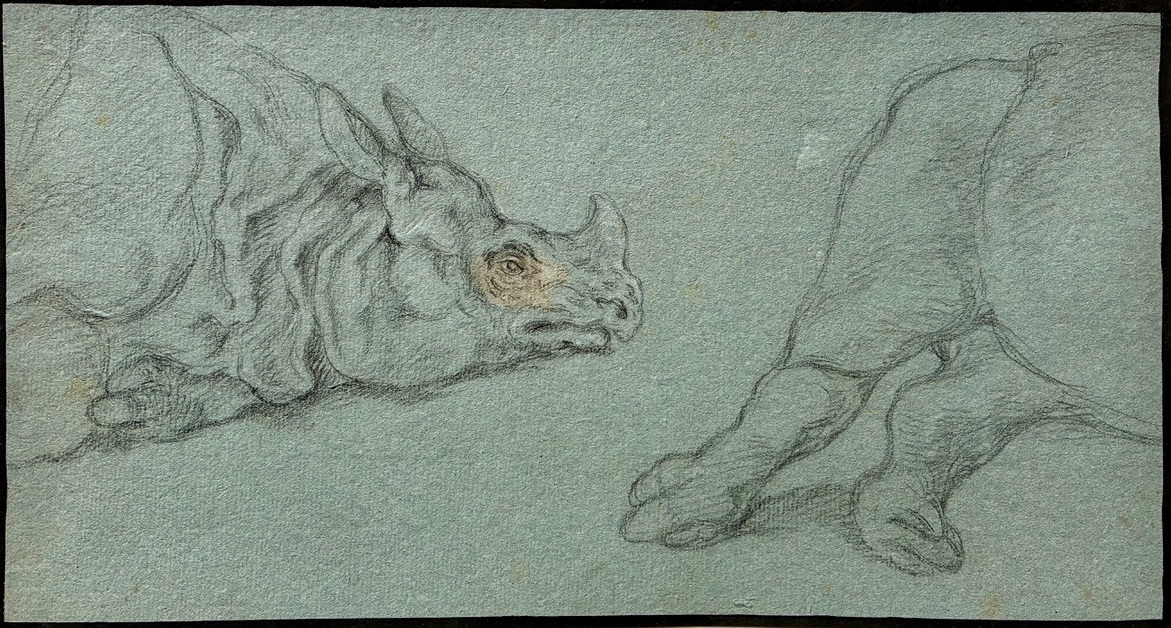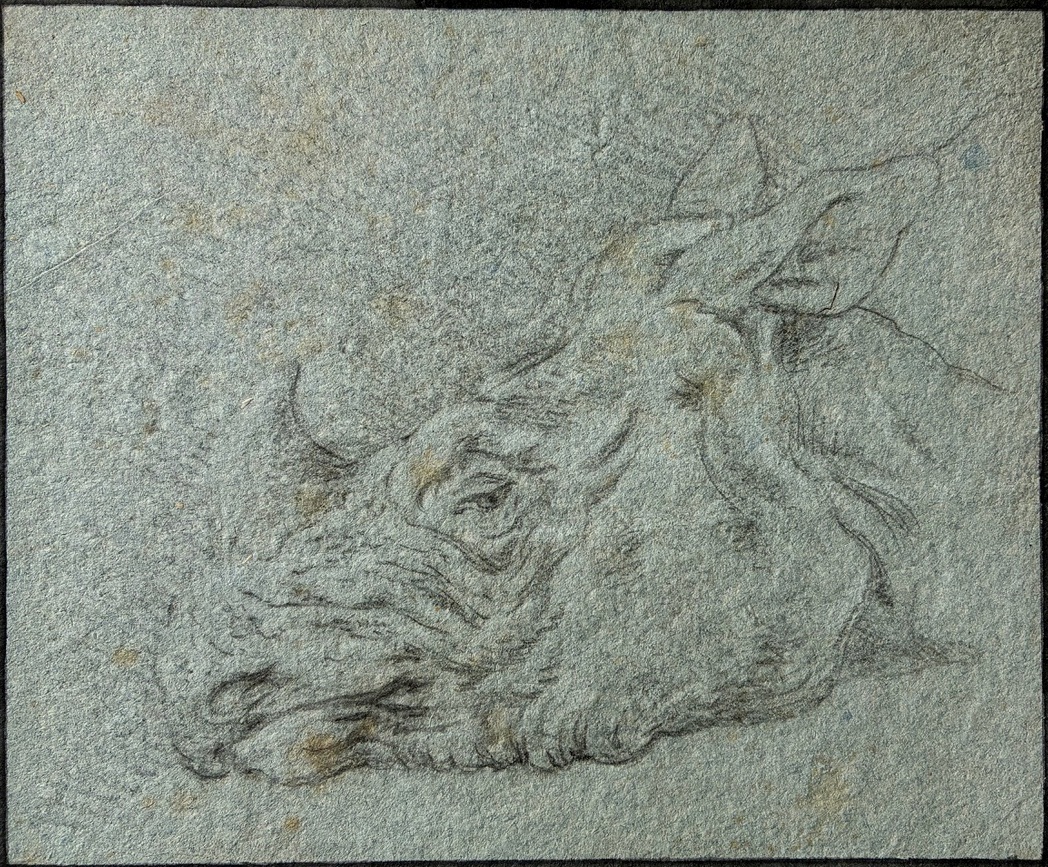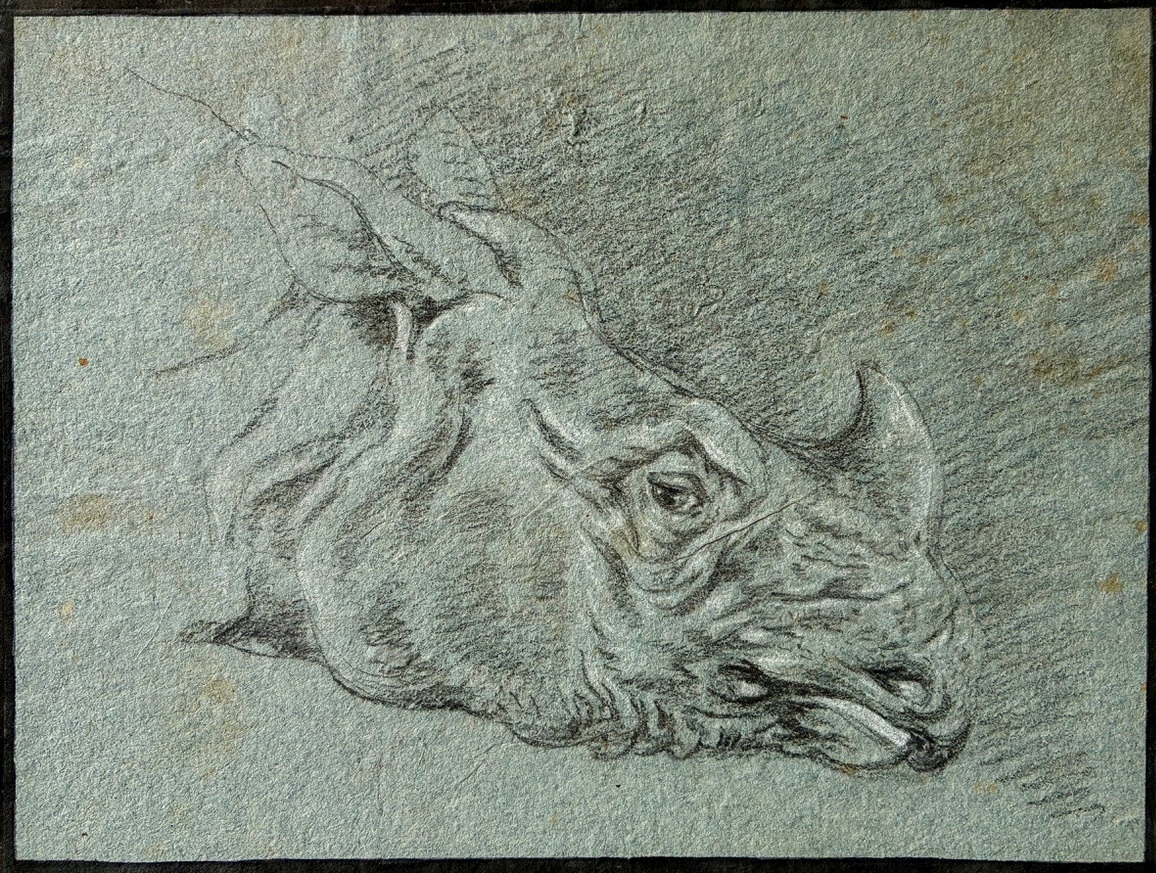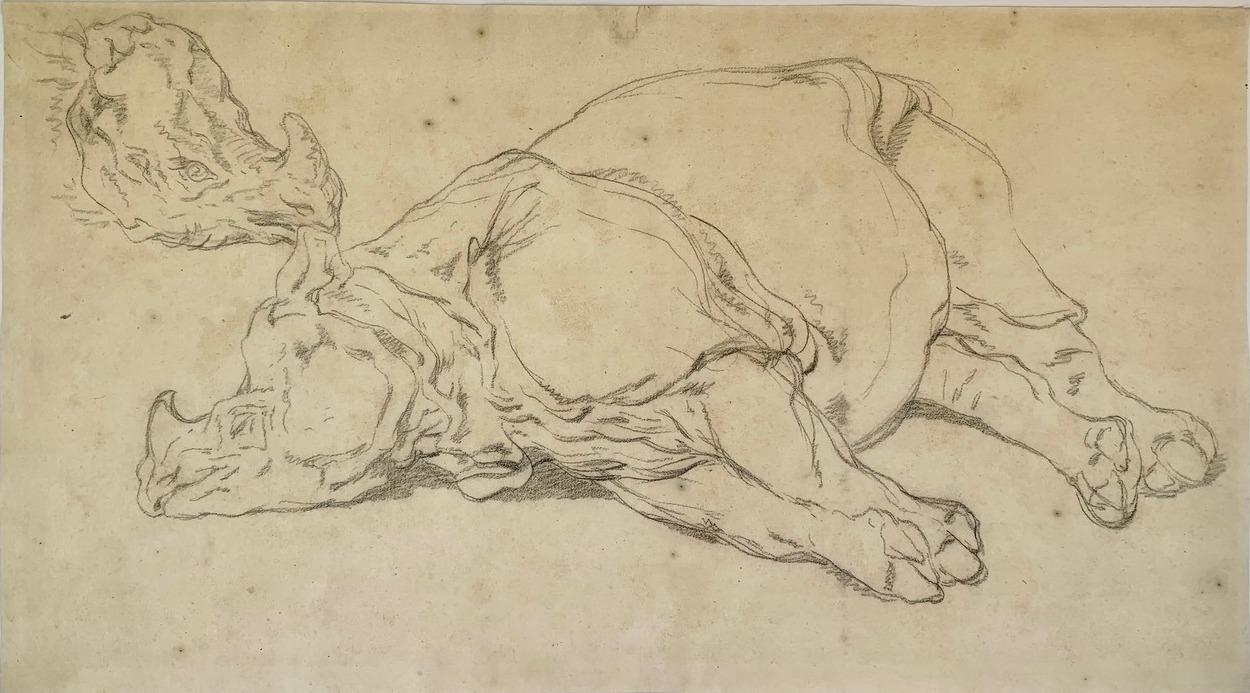


The exhibition of the rhinoceros at the Foire de Saint-Germain (Fair) was advertised in the Affiches de Paris on 27 January 1749 (source 4751A) and 3 February 1749 (source 4751B). Ladvocat measured the animal on 7–8 February and wrote a learned treatise on everything known about the rhinoceros (source 4752). The rhinoceros was recorded at the fair by Madame de Graffigny on 21 February 1749 (source 4753), in the Gazette of Amsterdam on 28 February 1749 (source 4754), by Barbier in March 1749 (source 4755). Adverts on 10 April 1749 announced the intended departure at the end of the month (source 4756). A baby with some features like a rhinoceros was born in 1749 (source 4757). Raynal said that the animal had died after leaving the fair (source 4758). Several broadsheets were available in Paris during the fair of 1749 (separate file)
Two influential treatises, one by DeMours published in 1760 (source 4760), and the other by the Comte de Buffon together with Daubenton published in 1764 recalled examining the animal in 1749. Daubenton contributed a lengthy and detailed description of Clara the rhinoceros with several measurements [apparently absent from later editions and translations] (source 4761).
The rhinoceros entered public life in 1749, in poems or theatrical production by Piron (source 4762), in a Cantatille (source 4763) and by Guiard de Servigné (source 4764). Fashion à la rhinocéros and different hairstyles became popular, as recorded by Coyer (source 4765; source 4766), Dash (source 4767), Marchand (source 4769), and their demise being applauded by Voltaire (source 4768).
Clara must have left at the end of April or beginning of May, as her death in Lyon was quoted on 30 May 1749 (source 4770) and she arrived at Dijon on 11 May 1749 (separate file).
There are references with an uncertain date, for Petrus Camper in 1749 after Clara left (source 4771), and by Davila for 1740 (source 4772), and Prevost for 1748 (source 4773).
Clara was again in Paris later, in 1752 (separate file) and in 1753 (separate file).
Information on broadsheets, another page
Information on drawings and paintings by Oudry and others, another page
Source 4751. Les Affiches de Paris
Literature:
- Heikamp 1980: 313–314
- Verheij 1989: 35
- Ham, G. van der 2022. Clara the rhinoceros, note 203
Source 4751A. Les Affiches de Paris, 27 January 1749
27 January 1749
De par le Roi, et M. le Lieutenant Général de Police. Messieurs et Dames, vous êtes avertis qu’il est arrivé depuis peu dans cette ville, un animal nommé Rhinocerot, animal qu’on a cru apocriphe jusqu’à présent. On le voit à Versailles au cheval rouge, rue de l’Orangerie, tous les jours depuis huit heures du matin jusqu’à midi, et depuis une heure jusqu’à six; les premières places sont de trois liv. les secondes de trente-six sols, et les troisièmes de douze sols.
Translation:
By the King, and the Lieutenant General of Police. Gentlemen and Ladies, you are informed that an animal named Rhinocerot has recently arrived in this city, an animal that has been believed to be apocryphal until now. It can be seen at Versailles at the red horse, rue de l’Orangerie, every day from eight in the morning until noon, and from one o’clock until six; the first places are three livres, the second thirty-six sols, and the third twelve sols.
Source 4751B. Les Affiches de Paris, 3 February 1749
3 February 1749
L’on voit actuellement le Rhinocerot au bas de la rue de Tournon, Cul-de-Sac de l’Opera Comique, rue des Quatre-Vents: on le montre depuis huit heures du matin jusqu’à huit heurres du soir. Les premières places sont de 3 liv. les secondes de 36 sols, et les troisièmes de 12 sols.
Translation:
The Rhinocerot is currently on display at the bottom of Rue de Tournon, the Cul-de-Sac of the Opera Comique, Rue des Quatre-Vents: it is shown from eight in the morning until eight in the evening. The first seats are 3 livres, the second 36 sols, and the third 12 sols.
* Note: Address “rue de Tournon, Cul-de-Sac de l’Opera Comique, rue des Quatre-Vents” is also found on the broadsheet sold by Berryer – see source 4801.
Source 4752. Ladvocat, Lettre sur le Rhinocéros
*Jean Baptiste Ladvocat (1709–1765), Librarian at the Sorbonne University from 1742
Ladvocat, J.B. 1749. Lettre sur le rhinoceros, a M.*** Membre de la Societe Royale de Londres. Paris, Thiboust. pp. 1-34, pls. 1-2. 8vo.
The identity of Mr. *** has not been established.
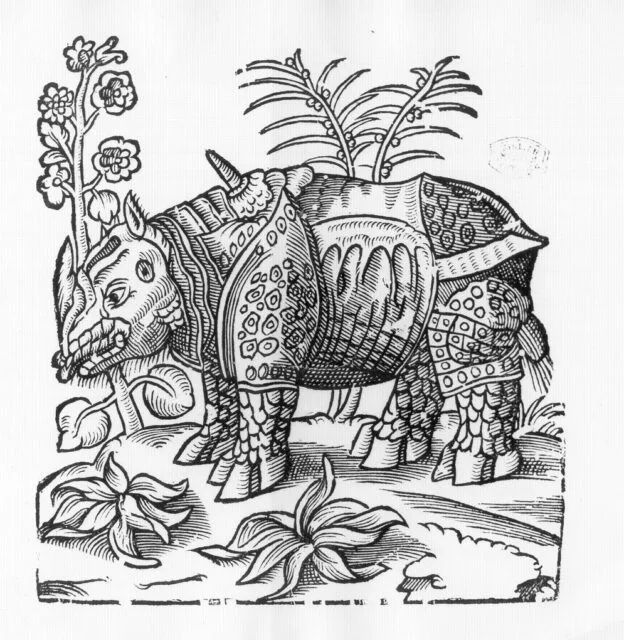
A plate found in some copies is often missing. It is not clear if the plate actually formed part when published.
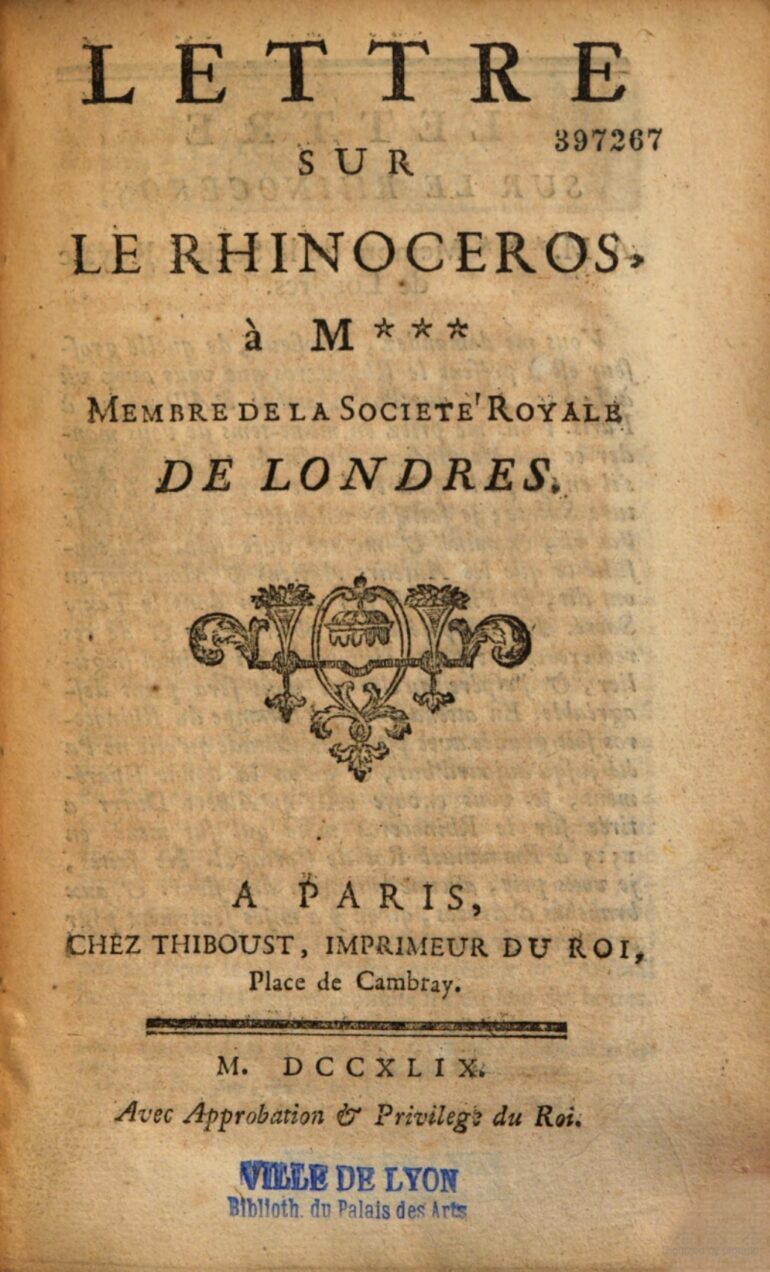
[p. 2] Vous me demandez, Monsieur, de quelle grosseur est à présent le Rhinoceros que vous avez vû à Londres, & que l’on a amené d’Allemagne à Paris. Vous me priez en même-tems de vous mander ce que les Anciens ont dit de cet Animal, & s’il en est parlé dans le Texte Original de l’Ecriture Sainte; je satisfais voluntiers à vos désirs. Je l’ai vû, examiné & mesuré avec soin.
[p. 3] Celui que l’on montre actuellement à Paris (c) n’a qu’un pied depuis les genoux jusqu’à terre.
Je l’ai vû & mesuré les sept & huit Février 1749.
[p. 6] Sa langue n’est point rude, ni couverte d’une membrane dentelée sembable à une lime, en sorte qu’il écorche ce qu’il veut lécher, comme l’ont assuré plusieurs Naturalistes (a); au contraire elle est mince & deliée comme celle d’un Chine, & si douce qu’on croiroit passer la main sur du velour. C’est ce que j’ai reconnu par ma propre expérience, lui ayant fait lécher la main. Je l’ai vu lécher aussi le visage d’un jeune Garçon du nombre de ceux qui en avoient la garde.
Translated in Goldsmith 1774:288 – “I have often felt it myself,” says Ladvocat, in his description of this animal; “it is smooth, soft, and small, like that of a dog; and to the feel it appears as if one passed the hand over velvet. I have often seen it lick a young man’s face who kept it; and both seemed pleased with the action.
[p. 10] Celui que l’on montre à Paris a été pris dans la Province d’Achem, qui fait partie des Etats du Roi d’Ava. Il a été amené en Hollande par mer. De-là en Allemagne, & d’Allemagne en France. Pour le transporter par terre on s’est servi d’une voiture couverte, trainée dans les mauvais chemins quelquefois par vingt Chevaux. A cause de la difference du climat de l’Europe, on a soin de le graisser souvent avec de l’huile de Poisson, pour empêcher sa peau de durcir & de se fendre. Il est apprivoisé, doux & même caressant. Il mage continuellement du foin, de la paille, du pain, des fruits, des legumes, & généralement de tout ce qu’on lui donne, excepté de la viande & du poisson, dont il n’a jamais voulu manger; il boit à proportion. Ceux qui en ont la garde assurent qu’il mange par jour soixante livres de foin & vingt livres de pain, & qu’il boit quatorze seaux d’eau. Il boit aussi de la Bierre & du Vin. Il aime extremement la fumée de Tabac, & ceux qui le montrent prennent plaisir à lui en souffler dans les narines & dans la bouche.
[p. 13] La corne du Rhinoceros femelle qui est à Paris, a neuf pouces de hauteur depuis la racine. De cette corne aux oreilles il y a quatorze pouces & neuf pouces jusqu’à la pointe du museau, lorsqu’il est en bec d’Aigle. Ainsi la tête en cet état a vingt-trois pouces de longueur. Cette corne est claire par en bas; mais le hait est d’un brun noirâtre comme la peau. Elle n’est pas tout-à-fait ronde. Elle est fort grosse, un peu recourbée vers le dos, & très-dure.
* horn 9 inches = 23 cm
[p. 17–18] Il est vrai que le Rhinoceros frotte sa corne non seulement contre les rochers, mais aussi contre les arbres & tous les corps durs, & qu’il semble l’aiguiser; mais ce n’est pas qu’il se prépare au combat. C’est un mouvement naturel. J’ai vu plusieurs fois celui qui est à Paris tourner ainsi sa tête en rond, & faire toucher sa corne le long d’une planche. On auroit dit qu’il vouloit l’aiguiser.
English translation
Translations of texts in Ladvocat 1749:
[p. 2] You ask me, Sir, how big is the Rhinoceros that you saw in London, and that was brought from Germany to Paris. You also ask me to tell you what the Ancients said about this Animal, and whether it is mentioned in the Original Text of Holy Scripture; I gladly satisfy your desires. I have seen it, examined it, and measured it carefully.
[p. 3] The one currently shown in Paris (c) has only one foot from the knees to the ground.
I saw and measured it on the seventh and eighth of February 1749.
[p. 6] The tongue is not rough, nor covered with a serrated membrane similar to a file, so that he scratches what he wants to lick, as several Naturalists have assured (a); on the contrary, it is thin and delicate like that of a China, and so soft that one would think one was passing one’s hand over velvet. This is what I recognized by my own experience, having made him lick my hand. I also saw him lick the face of a young boy among those who had charge of him.
[p. 10] The one shown in Paris was taken in the Province of Achem, which is part of the States of the King of Ava. It was brought to Holland by sea. From there to Germany, and from Germany to France. To transport it by land, a covered carriage was used, sometimes pulled over bad roads by twenty horses. Because of the difference in the climate of Europe, care is taken to grease it often with fish oil, to prevent its skin from hardening and cracking. It is tame, gentle and even caressing. It continually eats hay, straw, bread, fruit, vegetables, and generally everything that is given to it, except meat and fish, which it has never wanted to eat; it drinks in proportion. Those who keep him assure that he eats sixty pounds of hay and twenty pounds of bread a day, and that he drinks fourteen buckets of water. He also drinks beer and wine. He is extremely fond of tobacco smoke, and those who show him take pleasure in blowing it into his nostrils and mouth.
[p. 13] The horn of the female Rhinoceros in Paris is nine inches high from the root. From this horn to the ears there are fourteen inches and nine inches to the tip of the snout, when it is in the form of an Eagle’s beak. Thus the head in this state is twenty-three inches long. This horn is light below; but the top is a blackish brown like the skin. It is not quite round. It is very large, a little curved towards the back, and very hard.
[p. 17–18] It is true that the Rhinoceros rubs its horn not only against rocks, but also against trees and all hard bodies, and that it seems to sharpen it; but it is not that it is preparing for combat. It is a natural movement. I have seen the one in Paris several times turn its head in circles like this, and touch its horn along a board. One would have said that it wanted to sharpen it.
Source 4753. Correspondence of Madame de Graffigny, February 1749
On Friday 21 February she mentions the rhinoceros seen at the Foire.
* Madame de Graffigny – Françoise d’Issembourg d’Happoncourt (1695–1758)
* François-Antoine Devaux (1712-1796), French poet
Showalter, English. 2004. Correspondance de Madame de Graffigny, vol. 9. 11 mars 1748–25 avril 1749, lettres 1217–1390. Oxford, Voltaire Foundation
vol. 9, p. 430–433
Letter 1363 To Devaux. Paris, vendredi 21 fevrier 1749.[Friday 21 February 1749]
Had supper with the banker Jean André, who wrote about it to Mareil. Although the food was bad, Andre sang its praises. “La lettre étoit ecrite comme du rinoceros [sic] qui, habitant la foire, nous envoioit de ce que l’on y trouve de meileur. Cela a ete tres joli et tres bien reçu.”
Showalter p.431 is reproduction of Clara picture 1751 Longhi in National Gallery
Source 4754. Gazette d’Amsterdam, 28 February 1749
Douwe Mout 1749. Rhinoceros in France. Gazette d’Amsterdam Vendredi 28 Fevrier 1749 (Friday 1749 February 28)
Litterature:
- Heikamp 1980, p. 314
- Verheij 1989: 39 – Dutch translation
[p.4]
Il est arrivé depuis peu à Paris un Capitaine de Vaisseau Hollandois, qui a amené de Regale un Animal trèes curieux, nommé Rhinoceros, qu’on avoit cru jusqu’ici apocryphe: ce Monstre pese 5000. livres & mage chaque jour 20. livres de Pain, 60 livres de Foin & boit [60] sceaux d’eau. Comme il fait l’admiration de tout le monde dans la Foire St. Germain, le Maitre de cet animal avertit qu’il partira dans peu pour Rome, où il espere d’arriver avant le 20. Decembre de cette année 1749, et qu’il le fera voir sur la route: Il s’arrêtera à Dijon, à Genève, à Lyon, à Avignon, à Aix et à Marseille.
English translation
A Dutch ship captain has recently arrived in Paris, who has brought from Regale a very curious animal, named Rhinoceros, which until now had been believed to be apocryphal: this monster weighs 5000 pounds and eats 20 pounds of bread, 60 pounds of hay every day and drinks 60 buckets of water. As it is admired by everyone at the St. Germain Fair, the owner of this animal has announced that it will soon leave for Rome, where it hopes to arrive before December 20 of this year 1749, and that it will be shown on the road: it will stop at Dijon, Geneva, Lyon, Avignon, Aix and Marseille.
Source 4755. Barbier, Chronique
Edmond-Jean-François Barbier (1689–1771)
Barbier, E.J.F. 1851. Journal historique et anecdotique du regne de Louis XV. Paris, Jules Renouard. vol. 3 – on pp. 68-69
Barbier, E.J.F. 1857. Chronique de la regence et du regne de Louis XV (1718-1763) ou Journal de Barbier, avocat au parlement de Paris, vol 4 (1745-1750). Paris, Charpentier – vol 4, p. 356.
[1857, vol. IV, p. 356]
Mars 1749
On voit à la foire Saint-Germain un animal rare et curieux que l’on n’a jamais vu en France, c’est un rhinocéros. Il a été amené des Indes à grands frais par un capitaine d’un vaisseau hollandois qui l’a eu fort jeune. C’est une femelle; cet animal est doux, fort gras, noir, extraordinaire par sa peau qui est par écailles et fort dure. Les places sont à trois livres, une livre, et douze sols. Il y a peu de gens qui ne le voient par curiosité et le capitaine hollandois doit gagner beaucoup. On dit que le Roi vouloit acheter cet animal, mais que le capitaine en vouloit cent mille écus. Depuis qu’il l’a débarqué, il l’a montré dans plusieurs endroits, et il est arrivé d’abord à Versailles où toute la cour l’a vu. On le conduit par terre dans une espèce de caisse qui est montée sur quatre roues et tirée par six ou huit chevaux. Cet animal mange par jour, cinquante livres de foin, quinze livres de pain et boit quinze seaux d’eau. Je l’ai vu aussi manger des pelures d’oranges qu’on lui jetait dans un très-grand gosier. Il n’a, à ce que l’on dit, que onze ans et doit encore grossir beaucoup.
C’est animal est l’ennemi juré de l’éléphant, il lui présente la tête basse pour lui donner dans le poitrail un coup de la corne qu’il a sur le nez, corne cependant qui n’est pas pointue et qui n’a pas un pied de long et un peu couchée le long de sa tête. Les mâles ont une seconde corne sur le dos et les femelles n’en ont qu’une sur le nez.
English translation
At the Saint-Germain fair, we see a rare and curious animal that has never been seen in France: it is a rhinoceros. It was brought from the Indies at great expense by a captain of a Dutch ship who got it when it was very young. It is a female; this animal is gentle, very fat, black, and extraordinary for its skin, which is scaly and very hard. The prices are three livres, one pound, and twelve sols. There are few people who do not see it out of curiosity, and the Dutch captain must earn a lot. It is said that the King wanted to buy this animal, but that the captain wanted one hundred thousand crowns for it. Since he landed it, he has shown it in several places, and it first arrived at Versailles, where the entire court saw it. It is taken by land in a kind of crate mounted on four wheels and pulled by six or eight horses. This animal eats fifty pounds of hay, fifteen pounds of bread, and drinks fifteen buckets of water a day. I have also seen it eat orange peels that were thrown into its very large throat. It is said to be only eleven years old and must still be growing a lot.
This animal is the sworn enemy of the elephant, it presents its head low to give it a blow in the chest with the horn it has on its nose, horn however which is not pointed and which is not a foot long and a little flat along its head. The males have a second horn on the back and the females have only one on the nose.
* “Je l’ai vu aussi manger des pelures d’oranges qu’on lui jetait dans un très-grand gosier.”
Found in more recent literature that Madame de Pompadour was feeding oranges to the rhino, see:
- Mishra, 2009. Soul of the rhino, p. 139
- Prothero, 2002. Horns, tusks and flippers, p .280
- Martin, 1982. Run, rhino run, p. 15
Sale for 100,000 écus:
- Loisel, 1912, Menageries, vol. 2, p.279 – states: Versailles. Louis XV voulut l’acheter pour sa menagerie mais il recula devant le prix enorme qu’en demanda son propietaire, 100.000 écus. [Loisel doesn’t appear to give a source]
Source 4756. Les Affiches de Paris, 10 April 1749
Douwe Mout 1749. Avis divers: Rhinoceros [exhibited at the Foire S. Germain in Paris]. Affiches de Paris, Avis Divers etc. No. 28, Jeudy 10 avril 1749: 4.
De par le Roi, et M. le Lieutenant Général de Police: le public est averti que le Capitaine Hollandois, maitre du Rhinoceros, pour faire plaisir au public, demeurera encore ici deux ou trois semaines, et fera voir pendant ce tems-là cet animal au même endroit de la foire S. Germain: les premieres places sont de 24 f. les secondes de 12 f. & les troisiemes de 6 f. les domestiques payeront leur place.
English translation
By the King, and the Lieutenant General of Police: the public is informed that Captain Hollandois, master of the Rhinoceros, to please the public, will remain here for two or three weeks, and will show this animal during this time at the same place of the S. Germain fair: the first places are 24 f. the second 12 f. and the third 6 f. the servants will pay for their place.
Source 4757. Historischer Nachrichten 1749
Child resembling rhinoceros when born
Douwe Mout 1749. Newborn child resembling rhinoceros in Paris. Kurtz-gefasster historischer Nachrichten zum Behuf der neuern europäischen Begebenheiten 1749 (33) für August 1749, p. 656
(p. 656) Zu Paris ist ohnlängst die Frau eines Vergulders mit einem Kind niederkommen, welches sehr ungestaltet ist. Es gleichet dassenble in verschiedenen Stücken einem natürlichen Rhinoceros, welche Bildung der unglücklichen Neubegierde zugeschrieben wird, welches die Mutter gehabt hat, den Rhinoceros zu sehen.
English translation
In Paris, the wife of a gilder recently gave birth to a child that was very misshapen. It resembled a natural rhinoceros in several respects, a development that was attributed to the mother’s unfortunate curiosity to see the rhinoceros.
Source 4758. Fieux de Mouhy, Critique
* Charles de Fieux de Mouhy (1701–1784), French novelist
Fieux de Mouhy, C. de 1750. La Bigarure 3 (9): 65-72.
In a letter dated 23 April 1750, the writer mentions the living Rhinoceros seen at the Foire de S. Germain.
[p. 67] et quoique ce Animal soit mort depuis ce tems, on n’a pas laisse de courir encore, pendant la derniere Foire pour aller voir sa figure & sa peau que son Maitre a fait remplir de paille, & avec laquelle il a tire encore beaucoup d’argent de nos bons Parisiens.
English translation
… and although this Animal has since died, people still run during the last Fair to see its face and its skin which its Master had filled with straw, and with which he still made a lot of money from our good Parisians.
Source 4759. Raynal, Correspondance littéraire
* L’abbé Guillaume-Thomas Raynal (1713–1796)
Tourneux, M. 1877. Correspondance littéraire, philosophique et critique par Grimm, Diderot, Raynal, Meister etc. revue sur les textes priginaux comprenant outre ce qui a été publiés à diverses époques les fragments supprimés en 1813 par la censure, edited by Maurice Tourneux. Paris, Garnier freres. vol. 1, pp. i, i-vii, 1-502.
This contains transcript of a manuscript “Nouvelles Littéraires” written by Raynal
Chap. XLIII – [Review of Ladvocat, Lettre sur le rhinoceros]
[272]
Tout Paris, qui s’enivre assez aisément de petits objets, est maintenant occupé d’une espèce d’animal apellé rhinocéros. M. Ladvocat, bibliothecaire de Sorbonne, a recueilli à cette occasion tout ce que les naturalistes, les voyageurs et les historiens disent de cet animal. Cet écrivain dit que le rhinocéros est le plus grand des animaux après l’éléphant. On prétend que celui qu’on montre à Paris pèse 5,000 livres.
[273]
Il est certain qu’il a dix pieds de longueur depuis les oreilles jusqu’au fondement, et dix de circonférence en le mesurant par le milieu du corps; sa hauteur est de cinq pieds quatre pouces. Les Etats du grand Mogol sont ceux où il se trouve le plus de rhinocéros. Celui qui est à Paris a été pris dans la province d’Achem, qui fait partie des Etats du roi d’Ava. Il a été amené en Hollande par mer, delà en Allemagne, et d’Allemagne en France. Pour le transporter par terre on s’est servi d’une voiture couverte trainée quelquefois par vingt chevaux. Il mange par jour jusqu’à soixante livres de foin et vingt livres de pain, et il boit quatorze seaux d’eau. Il aime tout, excepté la viande et le poisson. Il parait que le rhinocéros n’a pas été d’une grande utilité. Les Romains se servaient de la corne de cet animal, qui est fort grande, pour y conserver les huiles et les parfums qui leur servaient pour leur bains. Les Indiens regardent toutes les parties du rhinocéros comme un antidote souverain contre le poisson et le venin; c’est leur thériaque. Avant que Pompée donnât au peiple romain le spectacle du rhinocéros, on n’en avait point vu en Europe. Dans la suite on en fit souvent paraitre dans le cirque. Le premier dont il est parlé depuis la décadence de l’empire romain est celui qui combattit à Lisbonne contre un éléphant, en 1515. On en fit voir un à Londres en 1684, mais il ne parait pas qu’on en ait jamais mené en Allemagne ni en France avant celui qu’on montre actuellement à Paris.
[284]
On a trouvé la tragedie de Catalina écrite d’un style gothique. Ce jugement, qui s’est trouvé assez général, a donné lieu à la plaisanterie suivante, qui a beaucoup couru:
Un rhinocéros à Paris arriva;
On y court, on aime le bizarre;
En même temps parut Catalina,
Et chacun dit que cet animal-là
Est plus commun, mais beaucoup plus barbare.
* Raynal’s description mentioned:
Gutman, Robert W. 2011. Mozart, a cultural biography. London, Pimlico – in footnote 24
* Catalina, a Tragedy
First performed in Paris on 20 December 1748.
nla.gov.au
Crebillon, M. de (Prosper Jolyot), 1674–1762
Catalina, tragedie, par M. De Crebillon, de l’Academie Francoise. Representee par les Comédiens ordinaires du Roi pour la premiere fois, le 20. Decembre 1748. A Paris : Se vend a Genes, chez Giraud, 1749
Source 4760. De Mours, addition to description of rhinoceros by Parsons
* James Parsons (1705–1770), London physician
* Pierre Demours (1702–1795) was a French physician, zoologist and translator
Translation of James Parsons, Lettre contenant l’histoire du Rhinoceros [with information on the rhinoceros exhibited in London in 1739.]
Parsons, J. 1743. Lettre a M. Martin Folkes, Ecuyer, President de la Societ Royale, contenant l’histoire du rhinoceros. Lue le 20 Juin 1743. Transactions Philosophiques 42 (470): 237-254, pls. I, I*, II, III. [translated by DeMours]
De Mours is identified as translator in Buffon, 1764 – and on title-page. Date 1760 is on title page
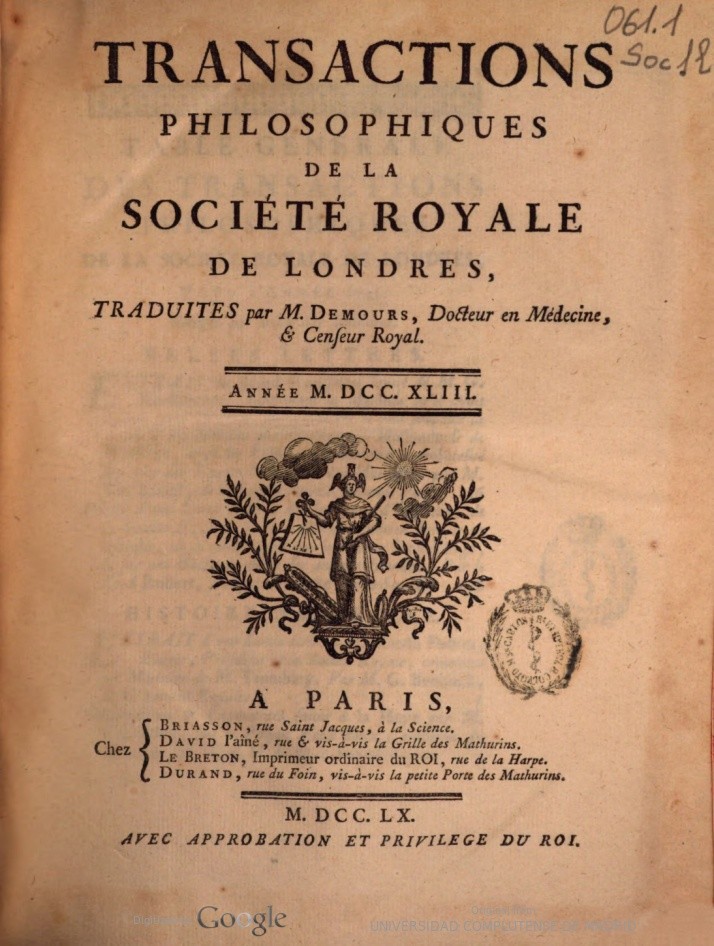
Here is added a plate numbered I* and a note at the end
This note by Demours of 1760 is also included as a footnote in the editions of Buffon, Histoire Naturelle, vol. 11 (1764), pp. 179–181 and later ones.
[p. 254]
La figure du Rhinoceros que M. Parsons a ajoûtée à son Memoire, & qu’il a dessinée lui-même d’après le naturel, est si différente de celle qui fut gravée à Paris en 1749, d’après un Rhinoceros qu’on voyoit alors à la Foire S. Germain, qu’on auroit de la peine à y reconnoitre le même animal. Celui de M. Parsons est plus court, & les plis de la peau en font en plus petit nombre, moins marqués, & quelques-uns placés un peu différemment. La tête sur-tout ne ressemble presqu’en rien à celle du Rhinoceros de la Foire S. Germain. On ne sçauroit cependant douter de l’exactitude de M. Parsons, & il faut chercher dans l’âge & le sexe de ces deux animaux, la raison des différences sensibles qu’on apperçoit dans les Figures que l’on a données de l’un & de l’autre. Celle de M. Parsons a été dessinée d’après un Rhinoceros mâle qui n’avoit que deux ans. Celle que j’ai cru devoir ajouter ici l’a été d’après le Tableau du célèbre M. Oudry, le Peintre des Animaux, & qui a si forte excellé en ce genre. Il a peint de grandeur naturelle & d’après le vivant le Rhinoceros de la Foire S. Germain, qui étoit une femelle & qui avoit au moins 8 ans. Je dis au moins 8 ans, car il est dit dans l’inscription qu’on voit au bas de l’Estampe de Charpentier, qui a pour titre Véritable portrait d’un Rhinoceros vivant que l’on voit à la Foire S. Germain à Paris, que cet animal avoit trois ans quand il fut pris en 1741 dans la Province d’Assem, appartenant au Mogol; & huit lignes plus bas il y est dit qu’il n’avoit qu’un mois quand quelques Indiens l’attraperent avec des cordes, après en avoir tué la mere à coup de flèches. Ainsi il avoit au moins huit ans, & pouvoit en avoir dix ou onze. Cette différence d’âge est une raison vraisembable des différences sensibles que l’on trouvera entre la Figure de M. Parsons & celle de M. Oudry, dont le Tableau fait par ordre du Roi, fut alors exposé au Salon de Peinture, ou même celle de Charpentier. Je remarquerai seulement que M. Oudry a donné à la défense de son Rhinoceros plus de longueur que n’en avoit la corne du Rhinoceros de la Foire S. Germain, que j’ai vu & examiné avec beaucoup d’attention, & que cette partie est rendue plus fidélement dans l’Estampe de Charpentier. Aussi est-ce d’après cette Estampe qu’on a dessiné la corne de cette figure, qui, pour tout le reste, a été dessinée & réduite d’après le Tableau de M. Oudry. L’animal qu’elle représente avoit été pesé environ un an auparavant à Stouquart dans le Duché de Wittemberg, & il pésoit alors 5000 livres. Il mangeoit, selon le rapport du Capitaine Douwemout Wander-Meer qui l’avoit conduit en Europe, 60 liv. de foin & 20 liv. de pain par jour. Il étoit très-privé & d’une agilité surprenante, vû l’énormité de sa masse & son air extremement lourd.
Planche I*. Le Rhinoceros vu de coté.
English Translation:
The illustration of the rhinoceros that Mr. Parsons added to his Memoir, and which he himself drew from life, is so different from the one engraved in Paris in 1749, based on a rhinoceros then on display at the Saint-Germain Fair, that it would be difficult to recognize the same animal. Mr. Parsons’s rhinoceros is shorter, and the folds of skin are fewer in number, less pronounced, and some are placed slightly differently. The head, in particular, bears almost no resemblance to that of the rhinoceros at the Saint-Germain Fair. However, one cannot doubt the accuracy of Mr. Parsons’s work, and the reason for the noticeable differences observed in the illustrations of each must be sought in the age and sex of the two animals. Mr. Parsons’ drawing was based on a male rhinoceros that was only two years old. The one I felt I should add here was based on the painting by the celebrated Mr. Oudry, the painter of animals, who excelled so greatly in this genre. He painted, life-size and from life, the rhinoceros at the Saint-Germain Fair, which was a female and at least eight years old. I say at least eight years old because the inscription at the bottom of Charpentier’s print, entitled “True Portrait of a Live Rhinoceros Seen at the Saint-Germain Fair in Paris,” states that this animal was three years old when it was captured in 1741 in the Province of Assem, belonging to the Mughal Empire; and eight lines below, it says that it was only one month old when some Indians caught it with ropes, after having killed its mother with arrows. Thus, it was at least eight years old, and could have been ten or eleven. This difference in age is a likely reason for the noticeable differences found between Mr. Parsons’s figure and that of Mr. Oudry, whose painting, commissioned by the King, was then exhibited at the Salon, or even that of Charpentier. I will only note that Mr. Oudry gave the horn of his rhinoceros more length than the horn of the rhinoceros at the Saint-Germain Fair, which I saw and examined with great attention, and that this part is rendered more faithfully in Charpentier’s print. It was from this print that the horn of this figure was drawn, which, for everything else, was drawn and reduced from the painting by Mr. Oudry. The animal it represents had been weighed about a year earlier at Stouquart in the Duchy of Wittenberg, and it then weighed 5,000 pounds. According to the report of Captain Douwemout Wander-Meer, who had led it to Europe, it ate 60 pounds of hay and 20 pounds of bread per day. It was very frugal and surprisingly agile, given its enormous size and extremely heavy appearance.
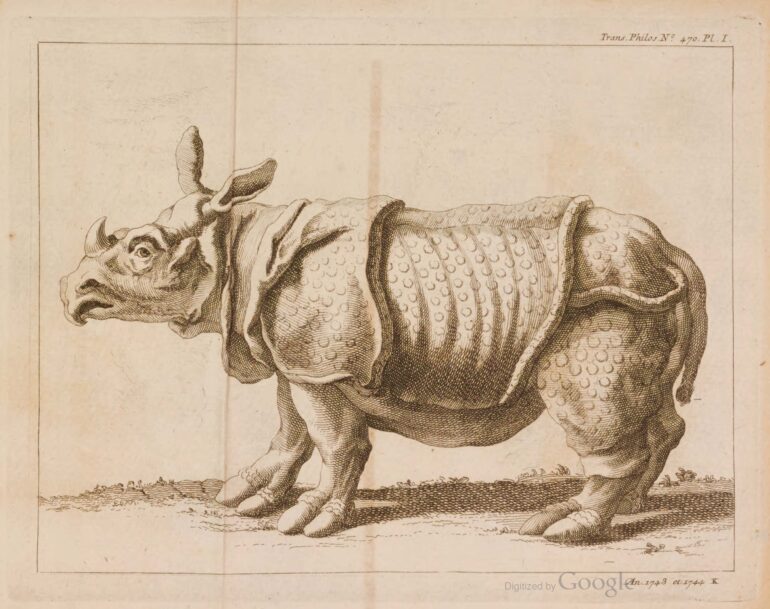
(top right) Transact. Philos. No. 470. Pl. I. (lower right) An. 1743 et 1744. K. [this inscription also found on the original Parsons plates copied by Demours]
Says copied from Oudry, but there the horn is too long, so the horn after broadsheet Charpentier
Source 4761. Buffon and Daubenton, Histoire Naturelle 1764
* Buffon – Georges-Louis Leclerc, Comte de Buffon (1707–1788)
* Louis Jean-Marie Daubenton (1716–1800), French naturalist
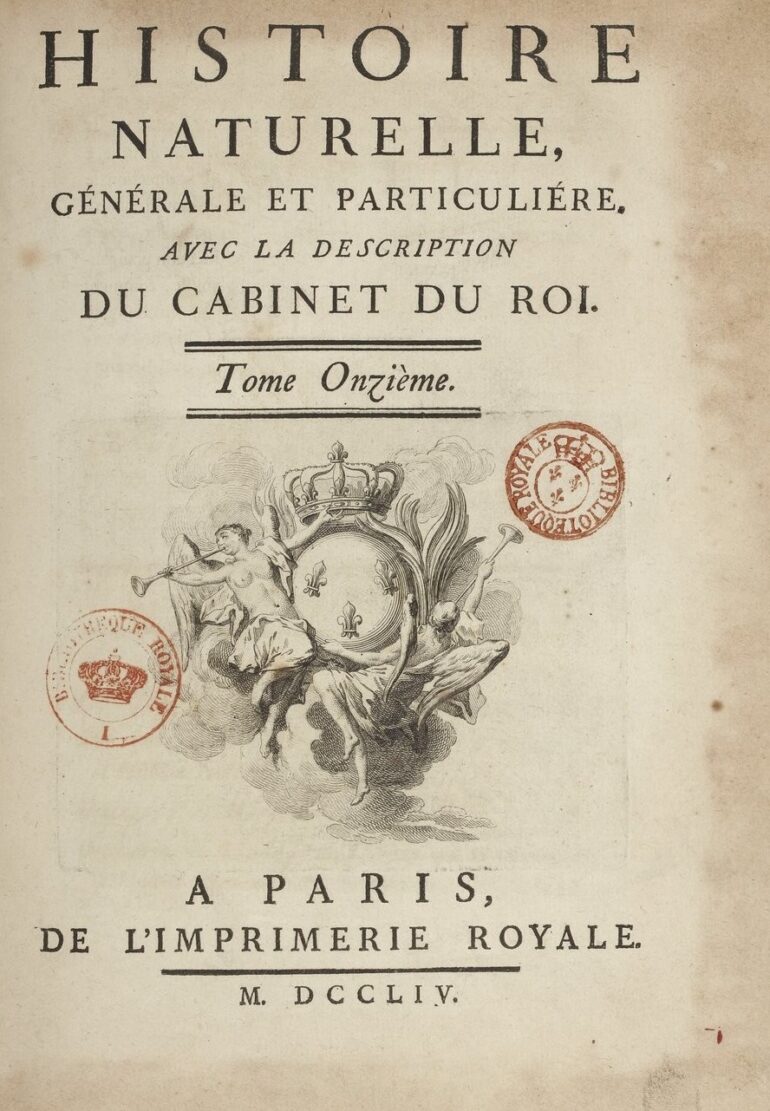
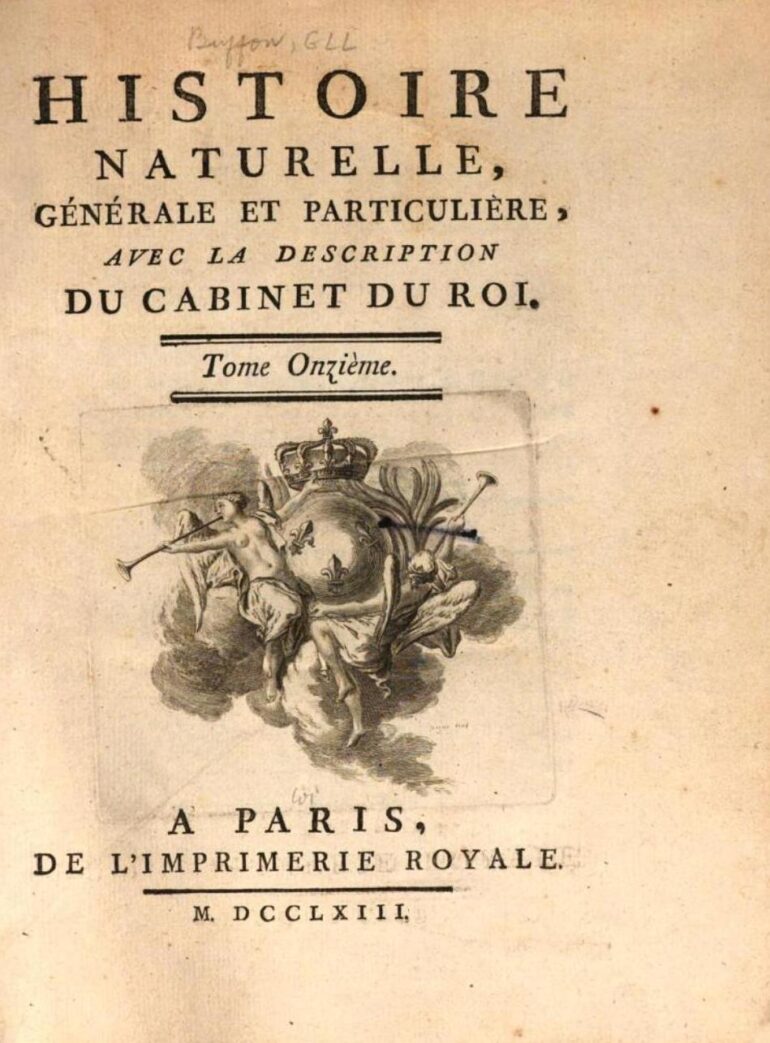
Daubenton, L.J.M. 1764. Description du rhinocéros. In: Buffon & Daubenton, Histoire naturelle, generale et particuliere, avec la description du Cabinet du Roi. Paris, Imprimerie Royale. pp. 198-203, pls. 7, 8. 4to [dated 1754 MDCCLIV on title-page, actually this should read 1764]
The first section pp. 174–197 on “Le Rhinocéros” is by Buffon.
The second section pp. 198–203 “Description du Rhinocéros” is by Daubenton
The third section pp. 204–242 “Description de la partie du Cabinet qui a rapport à l’Histoire Naturelle du Rhinocéros” is by Daubenton.
The Histoire Naturelle, vol. 11 is dated on the title-page M. DCCLIV (=1754). This is out of sequence in relation with the other volumes of the series. I have always believed that the date is a misprint, and should read 1764.
There is also a title-page with the M. DCCLXIII (1763), which is probably closer to the truth, but the source of the volume is unclear.
This needs further research, but here are some snippets;
A. Gazette de France, no. 27, Lundi 2 April 1764
Notice with following text:
Panckoucke, Libraire, rue de la Comedie Francoise, est actuellement charge de la vente de l’Histoire Naturelle du Cabinet du Roi, par les sieurs de Buffon & d’Aubenton. Le dixieme & le onzieme Volumes in-4o de cette Ouvrage vont être publiés.
Translation:
Panckoucke, Bookseller, rue de la Comédie Françoise, is currently handling the sale of the Natural History of the King’s Cabinet, by Messrs. de Buffon and d’Aubenton. The tenth and eleventh quarto volumes of this work are about to be published.
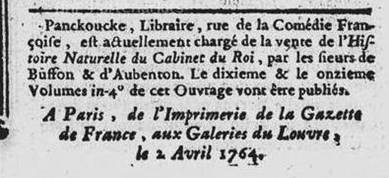
B. Letter by Grimm to a German friend, dated 1 July 1764.
Friedrich Melchior, Baron von Grimm (1723–1807) was a German-born French-language journalist, art critic, diplomat.
Grimm, J.F.C.; Diderot, D. 1813. Correspondance littéraire, philosophique et critique, adressée à un souverain d’Allemagne, depuis 1753 jusqu’en 1769. Première partie, tome 4. Paris.
He wrote:
[p. 142] En lisant les deux nouveaux volumes que MM. de Buffon et Daubenton viennent de publier et qui font le dixième et le onzième de leur ouvrage, vous aurez occasion de vous confirmer dans toutes ses idées.
[p.142] By reading the two new volumes that Messrs. de Buffon and Daubenton have just published, which make up the tenth and eleventh volumes of their work, you will have the opportunity to confirm all your ideas.
Later in the letter he confirms that this 11th volume contains the descriptions of elephant, rhinoceros, camel and others.
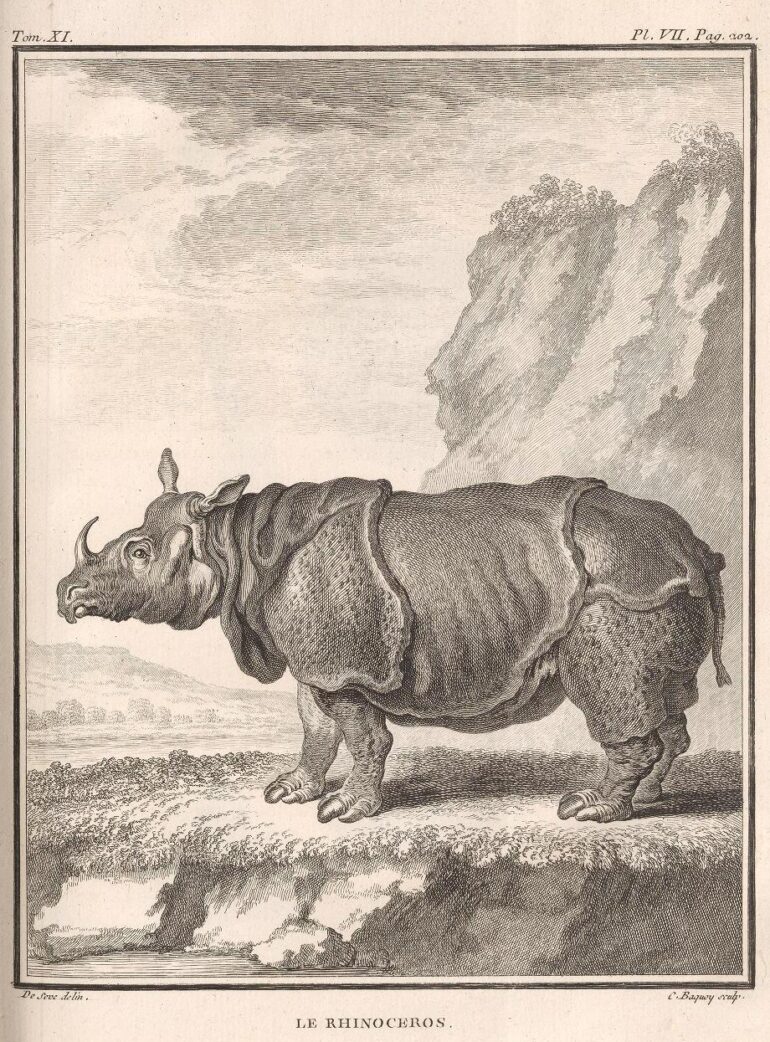
Female rhinoceros exhibited in Paris in 1749 (Daubenton states 12 years ago). – Rhinoceros then at least 11 years old. Long description of external appearance and long list of dimensions
Buffon 1764: 175 (note) writes (referring to Edwards):
The Rhinoceros. Gleanings of natural History, by George Edwards, London, 1758, pag. 24, Pl. cottée au bas 221. La figure est très-bonne & a été faite d’après l’animal vivant en 1752; c’est le même Rhinocéros femelle que nous avons vû & fait dessiner à Paris en 1749.
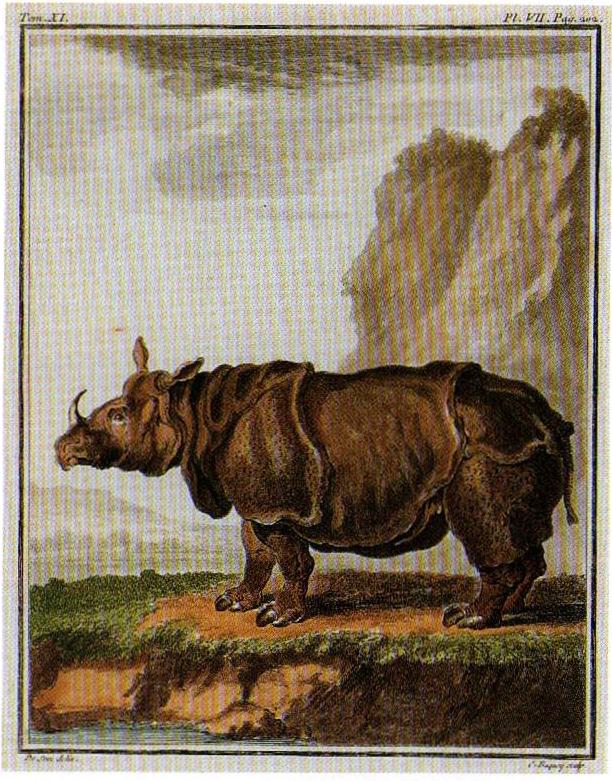
Plate VII is drawn by De Sève, and engraved by different engravers in the different editions.
Buffon reprinted multiple times in 18th and 19th centuries, also translated.
Text by Daubenton with desription:
[p. 198]
Description du Rhinocéros
Le Rhinocéros (planche VII) est réputé le plus gros des quadrupèdes après l’éléphant; cependant il y a lieu de croire que l’hippopotame est au moins aussi grand que le rhinocéros, & on ne peut pas douter que la vache-marine n’ait plus de longueur. Le rhinocéros a quelque rapport à l’éléphant par la masse informe de son gros corps, mais ses jambes sont beaucoup plus courtes, & il en diffère autant que des autres quadrupèdes, car il a plusieurs caractères qui lui sont particuliers. Celui qui a servi de sujet pour cette description (pl. VII), étoit à Paris il y a douze ans; il n’avoit pas la moitié de la hauteur d’un grand éléphant, car il n’etoit haut que de cinq pieds, comme on le verra par ses dimensions rapportées dans la table suivante. Il étoit femelle & n’ávoit au plus qu’onze ans. Le bas de son ventre n’étoit qu’à un pied & demi au dessus de la terre; la longueur de son corps, depuis le bout du museau jusqu’à l’origine de la queue, avoit le double de sa hauteur, tandis que dans l’éléphant la longueur & la hauteur sont presqu’égales.
Ce rhinocéros avoit la tête aplatie sur les cotes, & élevée au sommet en forme de gibbosité, sur laquelle les oreilles se trouvoient placées fort près l’une de l’autre*. La lèvre du dessus étoit plus
* M. Parsons a donné dans les Transactions philosophiques, année 1743, la description & la figure d’un rhinocéros mále, qui diffère à plusieurs égards de celui qui est représenté planche VII, principalement par la figure de la tête; car le rhinocéros de M. Parsons a le front beaucoup plus enfoncé & le nez plus élevé: mais il y a lieu de croire que ces différences ne viennent que de l’áge; car ce rhinocéros, n’ayant que deux ans, étoit beaucoup plus jeune que l’autre.
[199]
avancée que celle du dessous & terminée par une pointe mobile qui s’alongeoit, se raccourcissoit & prenoit différéntes inflexions au gré de l’animal: la lèvre inférieure sembloit être coupée quarrément en devant. Les ouvertures des narines étoient placées de chaque côté au dessus de la lèvre supérieure; elles formoient chacune une double sinuosité, comme une S renversée & s’étendoient en arrière jusqu’au dessus des coins de la bouche. Les yeux étoient très-petits, placés presqu’aussi loin des oreilles que du bout du museau. Les oreilles étoient droites, longues & pointues; leur base se trouvoit entourée par un pli de la peau. II y avoit au milieu du chanfrein, à distance presqu’égale des yeux & du bout du museau, une corne de figure conique, recourbée en arrière; elle n’avoit pas un pied de longueur, sa base formoit un ovale d’un pied de circonférence, dont le grand diamètre suivoit la longueur de la tête (a).
Cet animal avoit le cou fort gros & très-court, le corps étossé & renflé sur ses côtés. La queue étoit courte, & n’avoit de crins qu’à l’extrémité (b). Les jambes étoient grosses & courtes: il m’a paru que le poignet formoit dans les jambes de devant une eminence saillante en arrière, à peu près comme le talon dans les jambes de derrière: il y avoit trois ongles ou sabots à chaque pied, celui du milieu étoit plus gros que les deux autres.
La peau formoit de grosses rides très-saillantes, comme des bourrelets ou des plis. Plusieurs de ces plis s’étendoient autour du cou du rhinocéros qui a servi de sujet pour cette description; il y avoit deux plis qui environnoient le cou en entier comme
(a) Le rhinocéros de M. Parsons a les oreilles plus larges que celui dont il s’agit ici, les yeux & la corne placés plus près du bout du museau, car la corne est au dessus des narines. On peut croire que ces différences viennent de celles de l’age ou du sexe.
(b) Voyez la desciption d’une queue de rhinocéros, sous le nr. MLV.
[200]
des colliers; ils se réunissoient au desous & pendoient comme un fanon; deux autres plis traversoient la partie supérieure & postérieure du cou, & aboutissoient par chacune de leurs extrémités à un pli qui s’étendoit obliquement depuis le devant de l’épaule jusque vers le garrot. Il se trouvoit derrière le garrot un pli qui descendoit de chaque côté derrière l’épaule, le bras & la partie supérieure de l’avant-bras, il se courboit & se prolongeoit en avant sur cette partie de l’avant-bras. Il y avoit au dessus de la croupe un autre pli qui descendoit de chaque côté sur le flanc jusqu’au devant du genou, & plus bas, en se courbant en avant sur le ventre. Un autre pli s’étendoit en travers sur le haut de la cuise depuis le flanc jusqu’à l’origine de la queue; & enfin il y en avoit un autre qui étoit placé transversalement sur la partie inférieure de la jambe au dessus du talon; ces plis avoient jusqu’à trois ou quatre pouces de hauteur. La peau du rhinocéros est fort épaisse & très-dure, mais elle cède aux mouvémens de l’animal á l’endroit des plis qu’elle forme, aussi, la pluspart se trouvent placés & disposés de façon à suivre les mouvemens de la tête & des jambes; la peau est douce, unie & de couleur rouge-pale dans la profondeur des plis, & sous les parties antérieure & postérieure du ventre; le reste de la peau est rude, brune, parsemée de tubercules plats qui resemblent à des croûtes & qui sont de différentes grandeurs; les plus grands sont sur les épaules, sur les côtés du corps, sur la croupe & sur les jambes*. M. de Jussieu m’a fait voir un morceau de peau de rhinocéros dessèchée qui avoit jusqu’à cinq lignes d’épaisseur; le diamètre de ses tubercules étoit d’environ un demi-pouce (pl. VIII, fig. 1). L’épiderme avoit peu d’épaisseur, il était brun & il se séparoit aisément de la peau.
* Voyez la description de ces tubercules dans celle de la partie du Cabinet qui a rapport au rhinocéros, à l’article d’un foetus de cet animal.
[201]
Les tubercules (fig. 2) sont déjà très-apparens sur la pean du foetus du rhinocéros.
La substance de la corne du rhinocéros est de même nature que les cornes du taureau, du bélier, du bouc, des gaselles, &c. Autant que j’ai pû juger de la grandeur & de la figure de cette corne, par celles qui sont au Cabinet du Roi, il paroit qu’elle a jusqu’à quatre pieds de longueur & peut-être plus (a). Sa forma approche de celle d’un core plus ou moins alongé (pl. VIII, fig. 3, 4 & 5); sa base est ronde ou ovale (A B, fig. 3 & 4); le grand diamètre de celles qui sont ovales suit la longueur du chanfrein: il y a sous cette base une concavité (C, fig. 4), dont la profondeur est au plus d’un pouce huit lignes. La corne se recourbe en arrière à quelque distance au dessus de son extrémité inférieure; cette courbure (C, fig. 3; D, fig. 4; & A, fig. 5) subsiste jusqu’à 1’extrémité supérieure dans la pluspart de ces cornes, mais la plus grande de celles qui sont au Cabinet du Roi (fig. 5) a l’extrémité supérieure (B) recourbée en avant (b). Il y a sur plusieurs de ces cornes un fillon longitudinal (D E, fig. 3; & C D, fig. 5). Elles sont toutes de couleur olivâtre cendrée ou noiratre. La concavité de leur base est recouverte d’une sorte d’écorce; lorsqu’elle est enlevée, on aperçoit sur les parois de la concavité de petits orifices qui sont placés les uns contre les autres & qui ont de la profondeur. La corne étant coupée transversalement, & le plan de cette coupe étant poli, on y voit à l’oeil nu, mais plus distinctement, à l’aide d’une loupe, de petits disques (fig. 6), placés très-près les uns des autres; on distingue, au milieu de chacun de ces disques, un petit
(a) Voyez la description de la partie du Cabinet qui a rapport au rhinocéros.
(b) M. Parsons a aussi donné la figure d’une corne de rhinocéros, longue de deux pieds huit pouces, qui est aussi recourbée en avant par son extrémité supérieure.
[202]
espace qui paroît creux, & qui semble correspondre aux orifices de la base. Lorsque l’on a coupé la corne longitudinalement, on distingue sur le plan de cette coupe, après l’avoir poli, des fibres longitunales (fig.7) très-apparentes. La corne étant usée à l’extérieur; il reste sur quelques endroits de sa surface des fibres roides, flexibles & serrées comme les soies d’une brosse (EF, fig. 4); on aperçoit aussi ces soies sur le plan de la coupe transversale près de la base; de façon qu’il y a lieu de croire que la corne du rhinocéros est composée de soies réunies en faisceau & adhéréntes les unes aux autres très-fortement, mais pas assez intimement pour qu’elles ne puissent se séparer, puisqu’on les voit sur la surface extérieure de la corne aussi distinctes que les foies d’une brosse. Ayant découvert cette structure de la corne du rhinocéros, j’ai tâché de voir celle des cornes du boeuf & des autres animaux qui ont des cornes à peu prés de même substance; j’ai aussi aperçû leur structure; mais je l’ai trouvée différente de celle de la corne du rhinocéros.
[measurements in pieds. pouc. lignes – see translation below]
Longueur du corps entier, mesuré en ligne droite depuis le bout du museau jusqu’à l’anus 10 – 0 – 0
Hauteur du train de devant 5 – 0 – 0
Hauteur du train de derrière 5 – 0 – 0
Circonférence du museau, price au dessous des yeux 3 – 8
Circonférence de la tête entre les yeux & les oreilles 4 – 4
Longueur des oreilles 1 – 0 – 0
Distance entre les deux oreilles, prise dans le bas 0 – 6 – 0
Circonférence du corps, prise à l’endroit le plus gros 10 – 6 – 0
Longueur de la queue 2 – 0–0
Circonférence de la queue à l’origine du tronçon 1–0 – 0
[203]
Ce rhinocéros avoit vingt-huit dents, quatre en avant, une de chaque coté de la partie antérieure de chacune des mâchoires, & six molaires, aussi de chaque coté des mâchoires; la première des molaires étoit fort éloignée de la dent de devant. Il y avoit deux mamelles sur le ventre.
Measurements – with French ‘pied’ at 32.48 cm
Length of entire body, measured in a straight line from the tip of the snout to the anus 325 cm
Height of forequarters 162 cm
Height of hindquarters 162 cm
Girth of snout, measured below the eyes 119 cm
Girth of head between eyes and ears 140 cm
Length of ears 32 cm
Distance between the two ears, measured at the base 16 cm
Girth of body, measured at the largest point 341 cm
Length of tail 65 cm
Girth of tail at the base of the stump 32 cm
NOTE: It seems that this description of the rhinoceros was never found in the English translations of Buffon’s works in the century after appearance.
This needs verification …
Van der Ham 2022: 164 refers to Daubenton’s descriptions, stating that this was usually omitted in later editions.
The section is present in the first Dutch translation, but without any indication that the same animal had been seen earlier in The Netherlands
Buffon, G.L. Leclerc de 1779. Beschryving van den rhinoceros. In: De algemeene en byzondere natuurlyke historie met de beschryving van des Konings Kabinet. Amsterdam, J.H. Schneider. vol. 11. pp. 117-120.
English Translation (omitting the footnotes)
Description of the Rhinoceros [by L.J.M. Daubenton]
The rhinoceros (Plate VII) is considered the largest of the quadrupeds after the elephant; however, there is reason to believe that the hippopotamus is at least as large as the rhinoceros, and there can be no doubt that the sea cow is even longer. The rhinoceros bears some resemblance to the elephant in the shapeless mass of its large body, but its legs are much shorter, and it differs from the elephant as much as from other quadrupeds, for it has several characteristics that are unique to it. The one that served as the subject for this description (Plate VII) was in Paris twelve years ago; it was not half the height of a large elephant, for it was only five feet tall, as will be seen from its dimensions given in the following table. It was female and at most eleven years old. The lower part of its belly was only one and a half feet above the ground; The length of its body, from the tip of its snout to the base of its tail, was twice its height, whereas in the elephant the length and height are almost equal.
This rhinoceros had a flattened head on the sides, raised at the top in the form of a hump, on which the ears were set very close together*. The upper lip projected further than the lower and ended in a movable point that lengthened, shortened, and took on different inflections as the animal pleased; the lower lip appeared to be cut squarely in front. The nostrils were located on each side above the upper lip; each formed a double curve, like an inverted S, and extended backward to above the corners of the mouth. The eyes were very small, set almost as far from the ears as from the tip of the snout. The ears were erect, long, and pointed; their base was surrounded by a fold of skin. In the middle of the muzzle, almost equidistant from the eyes and the tip of the nose, there was a conical horn, curved backwards; it was not a foot long, its base formed an oval a foot in circumference, the larger diameter of which followed the length of the head.
This animal had a very thick and very short neck, a bony and swollen body. The tail was short and had hair only at the tip (b). The legs were thick and short: it seemed to me that the wrist formed a prominent bulge in the front legs, much like the heel in the hind legs. There were three nails or hooves on each foot, the middle one being larger than the other two.
The skin formed large, very prominent wrinkles, like rolls or folds. Several of these folds extended around the neck of the rhinoceros that served as the subject of this description; there were two folds that encircled the entire neck like necklaces; they met underneath and hung down like a dewlap. two other folds crossed the upper and rear part of the neck, and ended at each of their ends in a fold which extended obliquely from the front of the shoulder to the withers.
Behind the withers was a fold that ran down each side behind the shoulder, the upper arm, and the upper part of the forearm, curving and extending forward along this part of the forearm. Above the croup was another fold that ran down each side of the flank to the front of the knee, and lower, curving forward over the belly. Another fold extended across the upper thigh from the flank to the base of the tail; and finally, there was another that ran transversely across the lower part of the leg above the heel; these folds were up to three or four inches high. The rhinoceros’s skin is very thick and very tough, but it yields to the animal’s movements at the folds it forms; thus, most of these folds are positioned and arranged to follow the movements of the head and legs. The skin is soft, smooth, and pale red in the depths of the folds and under the front and back parts of the belly. The rest of the skin is rough, brown, and covered with flat tubercles that resemble scabs and are of varying sizes. The largest are on the shoulders, the sides of the body, the rump, and the legs.* Mr. de Jussieu showed me a piece of dried rhinoceros skin that was up to five lines thick; the diameter of its tubercles was about half an inch (pl. VIII, fig. 1). The epidermis was thin, brown, and easily separated from the skin.
The tubercles (fig. 2) are already very apparent on the skin of the rhinoceros fetus.
The substance of the rhinoceros horn is of the same nature as the horns of the bull, ram, goat, gaselle, etc. As far as I could judge the size and shape of this horn, from those in the King’s Cabinet, it appears to be up to four feet long and perhaps more (a). Its shape resembles that of a more or less elongated heart (pl. VIII, fig. 3, 4 & 5); its base is round or oval (AB, fig. 3 & 4); the greater diameter of those that are oval follows the length of the chamfer: there is a concavity under this base (C, fig. 4), the depth of which is at most one inch and eight lines. The horn curves backward some distance above its lower end; This curvature (C, fig. 3; D, fig. 4; & A, fig. 5) persists to the uppermost point in most of these horns, but the largest of those in the King’s Cabinet (fig. 5) has its upper end (B) curved forward (b). Several of these horns have a longitudinal groove (D E, fig. 3; & C D, fig. 5). They are all ash-olive or blackish in color. The concavity of their base is covered with a kind of bark; when this is removed, small, deep, closely spaced openings are visible on the walls of the concavity.
When the horn is cut transversely, and the surface of this cut is polished, small discs (fig. 6), very close to one another, can be seen with the naked eye, but more distinctly with a magnifying glass. In the middle of each of these discs, a small space appears hollow and seems to correspond to the openings at the base. When the horn is cut longitudinally, very apparent longitudinal fibers (fig. 7) are visible on the surface of this cut after polishing. The horn being worn on the outside, stiff, flexible fibers remain in some places on its surface, like the bristles of a brush (EF, fig. 4). These bristles are also visible on the surface of the transverse cut near the base. So that there is reason to believe that the rhinoceros horn is composed of bristles joined in bundles and adhering very strongly to one another, but not intimately enough to prevent them from separating, since they appear on the outer surface of the horn as distinct as the bristles of a brush. Having discovered this structure of the rhinoceros horn, I tried to observe that of the horns of the ox and other animals that have horns of roughly the same substance; I also perceived their structure; but I found it different from that of the rhinoceros horn.
[measurements]
This rhinoceros had twenty-eight teeth, four in front, one on each side of the front part of each jaw, and six molars, also on each side of the jaws; the first molar was quite far from the front tooth. There were two teats on its belly.
Source 4762. Alexis Piron, Epigramme
* Alexis Piron (1689–1773)
Piron, A. 1776. Oeuvres complètes d’Alexis Piron, publiées par M. Rigoley de Juvigny, conseiler honoraire au Parlement de Metz. Amsterdam, Marc-Michel Rey. vol. 8.
en.wikipedia.org
Semiramis was play by Voltaire shown in theatres at the same time
First performed 29 August 1749 (but written in 1746)
* Voltaire (1694–1778)
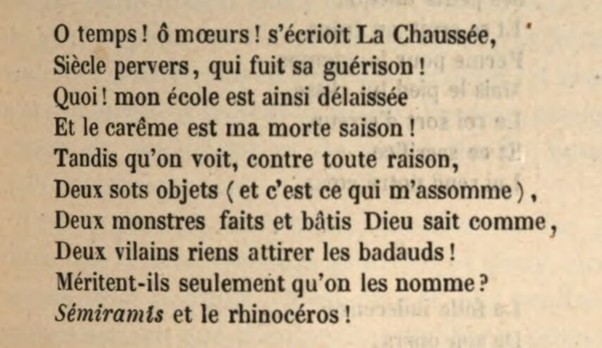
[p.140] Epigramme: [on the Foire Saint-Germain du Prés, 1749]
Epigramme
Ô temps ! Ô mœurs ! s’écriait La Chaussée,
Siècle pervers qui fuit sa guérison!
Quoi ! mon école est ainsi délaissée
Et le carême est ma morte saison !
Tandis qu’on voit contre toute raison
Deux sots objets (et c’est ce qui m’assomme),
Deux monstres faits et bâtis Dieu sait comme,
Deux vilain riens attirer les badauds !
Méritent-ils seulement qu’on les nomme ?
Sémiramis et le rhinocéros !
Also introduced and reproduced in:
Colle, C.; Bonhomme, H. 1868. Journal et mémoires de Charles Collé sur les hommes de lettres, les ouvrages dramatiques et les événements les plus mémorables du règne de Louis XV (1748-1772). Nouvelle Edition. Paris (edited by C. Bonhomme). vol. 1, p. 63
Source 4763. Rhinocéros: Cantatille Nouvelle
Anonymous 1749. Le rhinoceros: cantatille nouvelle, mise en musique par M***. Mercure de France, April 1749, pp. 83–84.
[83]
Le Rhinocéros.
Cantatille nouvelle,
mise en musique par M.***.
Récitatif
Des ténébreux déserts de l’Afrique sauvage,
Le fier Rhinocéros, amené dans Paris,
Rassemble au tour de lui, sur ce charmant rivage,
Autant de spectateurs que les jeux & ris.
AIR
Plaisirs, volez sur nos traces;
Quelque forme que vous preniez,
Vous aurez toujours des graces,
Pourvu que vous nous amusiez.
[84]
Que d’une figure agréable
On ne vante plus les attraits;
Ce phénoméne rend croyable
Le triomphe de tous les traits.
Plaisirs, volez, &c.
Récitatif
Mais que vois je? . . . Quel est le désir curieux
De ces jeunes Beautés qui viennent en ces lieux
Ont-elles oublié, ces belles imprudentes,
Qu’autrefois le Maitre des Dieux
Pour toucher les indifferentes,
Sous mille formes differentes,
Eut l’art de déguiser ses feux?
AIR
L’amour n’est jamais sans mistere,
Sous les traits d’un monstre odieux,
Le malin Enfant de Cythere
Peut se dérober à nos yeux.
Son pouvoir est inévitable;
Comment défendre sn coeur
Moins on le craint, ce doux vainqueur,
Et plus il est redoutable:
L’Amour n’est jamais, &c.
Source 4764. Guiard de Servigné, poem
* Jean-Baptiste Guiard de Servigné (1723–1780)
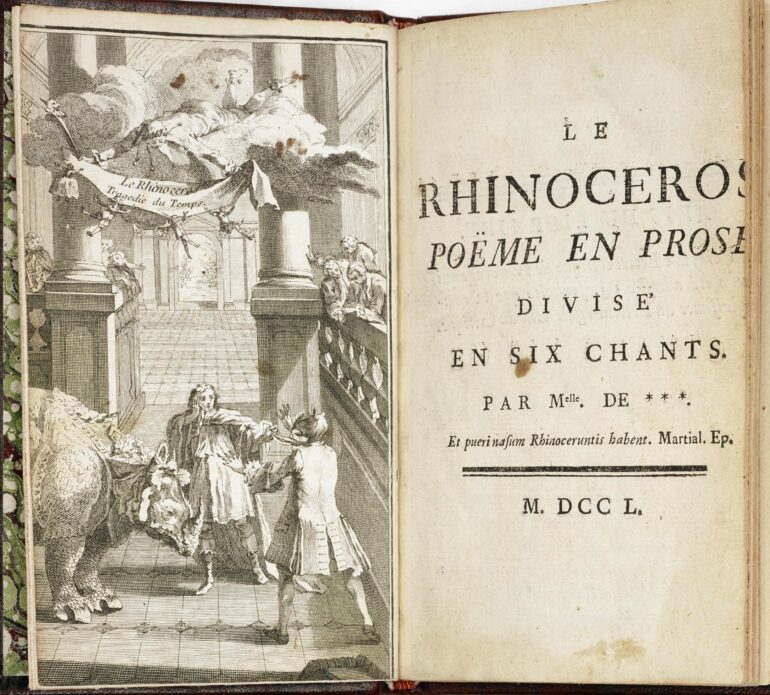
Guiard de Servigne, J.B. 1750. Le rhinoceros, poeme en prose divise en six chants, par M.elle de ***. Paris, [no publisher]. pp. i-xvi, 17-28, 1-80.
This is a satirical poem, not designed to provide information about the rhino.
gallica.bnf.fr
Rhinoceros after Dürer shown on frontispiece
Illustrated in Heikamp 1980, figs. 13–14
Frontispiece made by François Antoine Aveline (1727–1780) and engraved by Jean-Jacques Flipart (1719–1782)
Rhinoceros after Dürer, front part only, facing right
In banner above animal: Le Rhinoceros, Tragedie du Temps
[p. 23] L’arrivée du Rhinoceros à Paris a intéressé la curiosité de tant de personnes, & donné lieu à tant d’évenemens dans l’Empire de l’Amour, qu’on a crû pouvoir en faire la matière d’un Poëme.
Le Rhinoceros, qui a été vû de presque tout l”univers, qui a étonné les yeux autant par sa rareté, que par sa prodigieuse stature, & changé tout à coup la face du Pays des Modes.
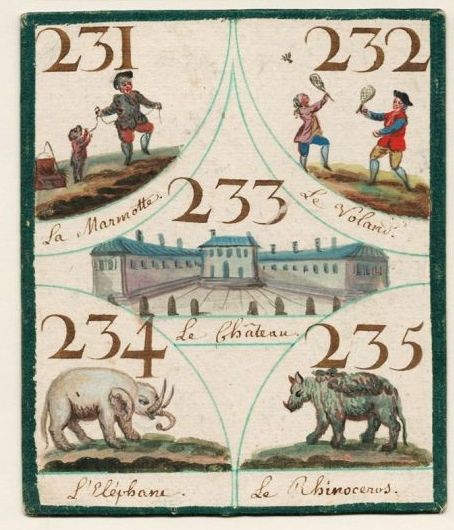
Un Marquis de Biribi a même déjà donné le projet d’un jeu à la Rhinoceros.
English translation
[p. 23] The arrival of the Rhinoceros in Paris has interested the curiosity of so many people, and given rise to so many events in the Empire of Love, that it was thought possible to make it the subject of a Poem. – The Rhinoceros, which has been seen by almost the entire universe, which has astonished the eyes as much by its rarity, as by its prodigious stature, and suddenly changed the face of the Land of Fashions. – A Marquis de Biribi has also already planned a game in the Rhinoceros style.
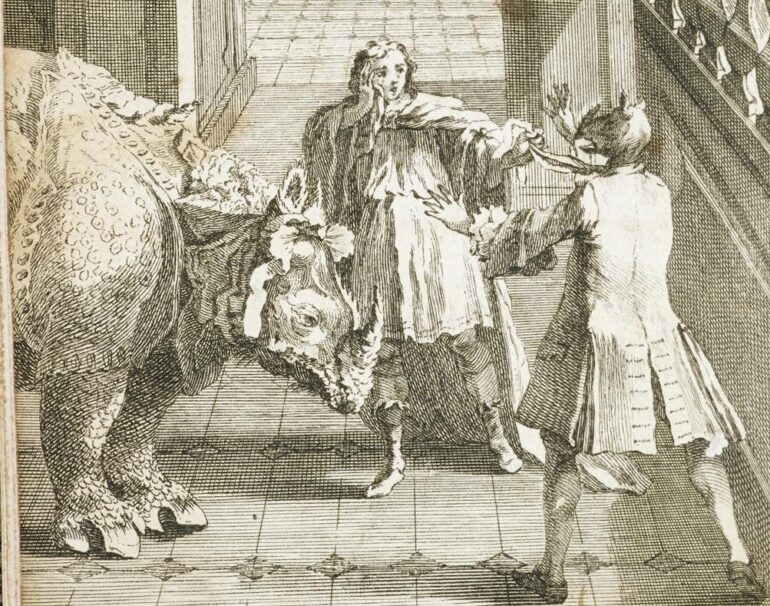
BIRIBI GAME
The game mentioned by Guiard as planned by the Marquis of Biribi was invented around that time in Genoa. It was known as Biribi (or Biribissi), or more common as Cavagnole. It was a gambling game of chance, popular for some years especially in Italy and France, played on a board of cards with various illustrations. Several examples are known where a rhinoceros is depicted on the board or on the cards. An obvious portrait of Clara is not clearly identified on the known examples.
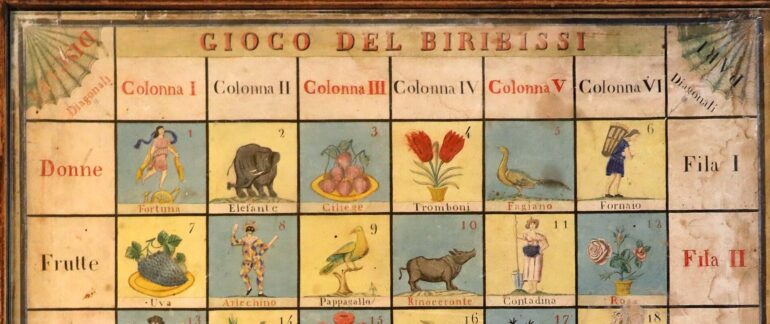
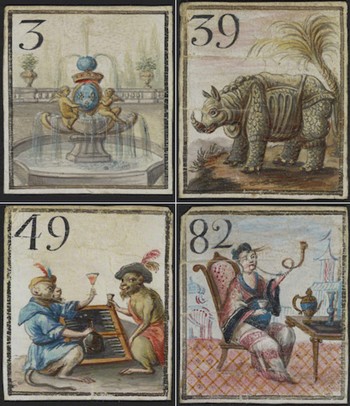
https://sharonlathanauthor.com/cavagnole/
https://blogs.getty.edu/iris/paris-gamblers-gaming-in-18th-century-france/
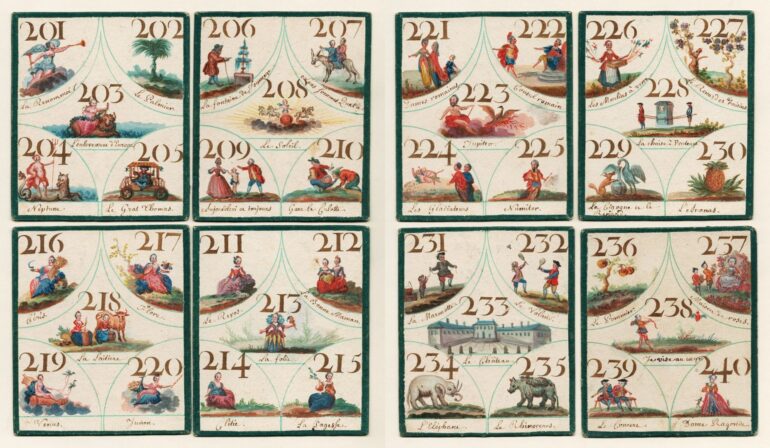
ca. 1765
Source 4765. Coyer, Bagatelles Morales
L’Abbé Gabriel-François Coyer (1707–1782)
fashion à la Rhinocéros
Coyer, G.F. 1749. Lettre a une jeune dame nouvellement mariée. Paris. pp. 1-8, 4to. [Date p.8. A Paris le 7. Aout 1749]. – p.6 coëffée en rhinocéros
Coyer, G.F. 1749. Lettre a une jeune dame nouvellement mariée. Bigarure, ou Meslange curieux, instructif et amusant de novelles, de critique, de morale, de poesies (La Haye) 1749. 33-40 [Date p.40. A Paris le 2 Octobre 1749. – rhinoceros mentioned p. 39
Coyer, G.F. 1754. Bagatelles morales. Londres, Duchesne. pp. 1-249. 12mo. – One of the chapters is entitled: Lettre à une dame anglaise (pp. 225-249).
Coyer, G.F. 1755. Bagatelles morales, 2nd ed. Londres, Duchesne. pp. 1-239; 12mo. – “Lettre à une dame anglaise” written on 15 September 1749, on pp. 219-239. Rhinoceros mentioned on p.232.
Coyer, G.F. 1758. Bagatelles morales, 3rd ed. Londres, Duchesne. pp. 1-239.
Coyer, G.F. 1769. Bagatelles morales. Nouvelle edition, considerablement augmentée. Londres [=Paris]: Veuve Duchesne, pp. 1-300; 12mo. – Rhinoceros mentioned on p. 181
Text
Coyer 1749 and later editions
Lettre à une Dame Anglaise
[p. 243]
On vous a vu à l’Opéra, coëffée en Comète, lorsque depuis deux jour, on étoit en Rhinocéros.
English translation
We saw you at the Opera, dressed as a Comet, when for two days we had been wearing as a Rhinoceros.
Source 4766. Response to Coyer, Réponse d’une jeune dame angloise
fashion à la Rhinocéros
*Gabriel François, abbé Coyer (1707–1782)
Coyer, G.F. 1749. Réponse d’une jeune dame angloise nouvellement mariée à Paris à M. L’Abbé C*** [Coyer]. Paris. pp. 1-8; 4to. – Dated [p.8] A Paris ce 15 Septembre 1749.
*This reprinted in: L’Abeille du Parnasse, no. IX, Samedi 28 Fevrier 1750, pp. 66-72 (p.72 text as above.)
Literature:
- Heikamp 1980: 314
Original text (French)
Avant de partir por la campagne, j’ai fait venir 15 jours de suite ma marchande de modes, pour composer ensemble mon ajustement d’hiver: enfin après bien des conseils tenus, je lui ai commandé deux robes garnies dessous et dessus, l’une à la Comete, et l’autre au Rhinoceros.
English translation
Before leaving for the countryside, I had my dressmaker come for 15 days in a row, to put together my winter outfit: finally, after much advice, I ordered two dresses with trimmed top and bottom, one in the Comete, and the other in the Rhinoceros.
*This reprinted in: L’Abeille du Parnasse, no. IX, Samedi 28 Fevrier 1750, pp. 66–72 (p.72 text as above. )
Source 4767. Dash, Galanteries de la Cour de Louis XV
* Comtesse Dash = Saint Mars, Gabrielle Anne Cisterne de Courtiras, vicomtesse de Dash (1804–1872), French author of at least six novels.
Dash, Comtesse 1750. Les galanteries de la cour de Louis XV: Le Parc au Cerfs. Paris, Michel Levy freres. pp. i-iii, 1-283.
[1861, p. 2]
Nous portions, en 1750, des modes et des attifages singulièrement nommés. C’étaient des manchons à la marechale, des palatines à la parmesane … des rubans à la rhinocéros. Ce vilain animal se fourrait partout, tout était à la rhinocéros, à cause de celui qui venait d’arriver au Jardin du Roi; les petits-maitres avaient même inventé les harnais à la rhinoceros. Ne fit-on pas, je ne sais quel gratte-papier, un poème épique sur le rhinocéros?
English translation
In 1750, we wore some strangely named fashions and attire. They were marechale muffs, parmesan palatines… rhinoceros ribbons. This ugly animal was everywhere, everything was rhinoceros-style, because of the one who had just arrived at the King’s Garden; the little masters had even invented rhinoceros harnesses. Didn’t someone, I don’t know what pen-pusher, write an epic poem about the rhinoceros?
Source 4768. Voltaire, letter to D’Argental
Letter from Votaire to d’Argental, 18 June 1759
Pierre Frantz, Le moment Voltaire, 2020 – https://cfrp.mitpress.mit.edu/pub/moment-voltaire/release/1
Literature:
- Van der Ham 2022, note 90
Original text (French)
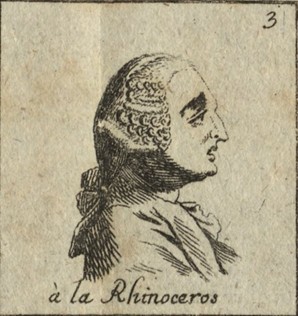
Que je fus aise quand j’appris que le theatre était purgé de blanc-poudrés, coiffés au rhinoceros et à l’oiseau royal!
English translation
How pleased I was when I learned that the theatre was purged of white-powdered people, with hairstyles à la rhinoceros and royal bird headdresses!
Source 4769. Marchand, Encyclopedie perruquière, 1762
Coiffure à la Rhinocéros
Marchand, J.H. 1762. L’ Encyclopedie perruquière. Ouvrage curieux a l’usage de toutes sortes de tetes, enrichi de figures en taille douce par M. Beaumont, coeffeur dans les quinze-vingts. Paris, Hochereau.
Coiffure “à la Rhinoceros”, for Paris fashion of the 18th century. Detail of plate with several hair styles
Literature:
- Clarke 1986: 58
- Clarke, T.H. 1976. The rhinoceros in European ceramics, p. 10
Source 4770. Marquis d’Argenson, Journal
* René-Louis de Voyer, Marquis d’Argenson (1694–1757)
Rathery, E.J.B.; Argenson, R.L. de V. de P., Marquis d’ 1863. Journal et memoires du Marquis d’Argenson, publies pour la premiere fois, d’apres les manuscrits autographes de la Bibliotheque du Louvre. Paris, J. Renouard.
[vol. 5, p. 485]
30 May 1749
On a eu nouvelle que le rhinocéros est mort enragé à Lyon, qu’il a mordu cinq à six personnes qui sont mortes de même. Sa rage venait de chaleur d’amour; on n’a pu trouver de mâle proportionné à cette monstrueuse bête.
[vol. 6, p. 77]
21 November 1749
Le gros rhinocéros que nous avons vu l’hiver dernier à la foire Saint-Germain, vient de périr par les mêmes causes avec son maitre et plusieurs passagers allant de Rome à Naples par mer, et tout l’argent qu’il avait gagné à son propriétaire au fond de la mer.
English translation
30 May 1749. It has been reported that the rhinoceros died of rage in Lyon, that it bit five or six people who also died. Its rage came from the heat of love; no male could be found that was proportionate to this monstrous beast.
English translation
21 November 1749. The large rhinoceros that we saw last winter at the Saint-Germain fair has just perished from the same causes with its master and several passengers going from Rome to Naples by sea, and all the money that it had earned for its owner at the bottom of the sea.
Source 4771. Petrus Camper, visit 1749
* Petrus Camper (1722-1789), Dutch physician, artist
* Gualtherus van Doeveren (1730–1783), Wouter van Doeveren, professor of medicine. He was professor at Groningen at same time as Camper
A terracotta clay model was listed in the collection of G. van Doeveren (in The Netherlands), catalogue of 1785, with a date as “seen in Paris in 1749”. Camper and Van Doeveren were together in Paris in February 1753 when they recorded seeing the rhinoceros. Camper is known to have visited Paris from 15 June 1749 to 30 September 1749 – which is after the departure of Clara towards the south of France.
The information on terracotta models made by Camper is recorded elsewhere on the website.
Doeveren, G. van 1785. Museum Doeveriani catalogus, continentis instructissimam copiam quadrupedem, avium, amphibiorum, insectorum, vermium, & quorandam vegetabilium … ; quae collegit Gualtherus van Doeveren. Horum omnium publica auctio fiet 18 Apr. 1785. Leiden, S. et J. Luchtmans.
Original text (Dutch)
[p. 148] Rariteiten
83. Een Kameel, in pleister geboetseerd door Prof. Camper A. 1770 agter glas in een lyst
84. Een dito Olyphant door denselfden
85. Een dito boetseersel van den Rhinoceros, te Parys gezien A. 1749
English translation
83. A Camel, modelled in plaster by Camper in 1770 , behind glass in a frame
84. An Elephant, modelled in plaster by the same
85. A similar model (in plaster) of the Rhinoceros, seen in Paris in 1749.
Source 4772. Cabinet of Davila – bas relief of 1740 ?
* Pedro Francisco Davila (1711–1786)
Davila, P. 1767. Catalogue systematique et raisonne des curiosites de la nature et de l’art, qui composent le Cabinet de M. Davila. Paris, Briasson. vol. 1, pp. i-xxxvi, 1-571.
In section: Bustes et bas-reliefs en marbre, bois, yvoire, &c.
[p. 80] no. 179 (bis). Le Rhinocéros vu à Paris en 1740 [sic]; bas relief en souffre de sept pouces de largeur, dans une bordure dorée.
English translation
The Rhinoceros seen in Paris in 1740 [sic]; bas-relief in sulphur seven inches wide, in a gilt border.
7 inches = 18 cm
Source 4773. Manuel Lexique, 1750
Prevost, A.F. 1750. Manuel lexique, ou Dictionnaire portatif des mots françois dont la signification n’est pas familiere à tout le monde. Seconde partie. Paris, Didot.
p. 649 Rhinoceros
Un Capitaine de vaisseau Hollandois en a transporté un en France, qui a été vu de tout Paris en 1748.
This passage was reprinted in a review of the Manuel Lexique in the Mercure de France, 1 June 1750, p. 108