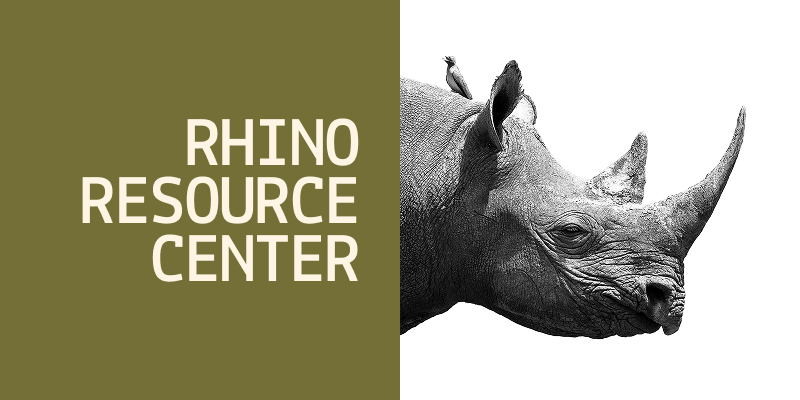


In Koes, on the southern edge of the Kalahari, I was shown bones and horns, found in quicksand, a certain evidence that the animal once lived here. About 1840, the first men had come to live here, Orlam from the Karas mountains and Berseba. They built huts on the dunes, and compelled the game to go away or to be shot. The next water was 70 km away, too far for a rhinoceros.
The white rhinoceros could resist the onslought by firearms even less than the elephant. Its size, 2.5 m height, 4 m length, was no protection and the double horns on its nose was no longer a weapon. It was exterminated without battle. That was a short history. The white rhinoceros was already on the list of extinct animals when the age of the great hunters came to an end. People had hardly taken the trouble to observe it carefully. The name by itself was not really enough. Duncan killed the last white rhino in 1870 near Olifantkloof, the last one that was heard from. In 1910 came the observation by Oberleutnant Kaufmann, who saw the white rhino `in a few examples' in the German Zambezi-Linjanti area, followed by Diplomingenieur Kunz, who found it numerous in the northern Kaokoveld in 1911 and 1912. Once again had the remoteness of the northwest and northeast kept an old family from extinction.
In the north east, along the Okavango, the rhinoceros still lives, in a small number. A few place names are all that we have to remember them. Bteween Otjimbingue and Karibib is Okangava, the place of the black rhinoceros. About this we read in Johanna Gertze, the first Herero author, in 1858 baptized by Hugo Hahn, about her father, who went out, to spear a rhinoceros.
The black rhinoceros battled for life.
The black rhinoceros was regarded as the most dangerous game, had first place among the five deadly enemies of men, and used to attack the locals without reason. But when the white men came, the rhinoceros charged.
2.5 m height
Horns up to 120 cm long
4 m long

