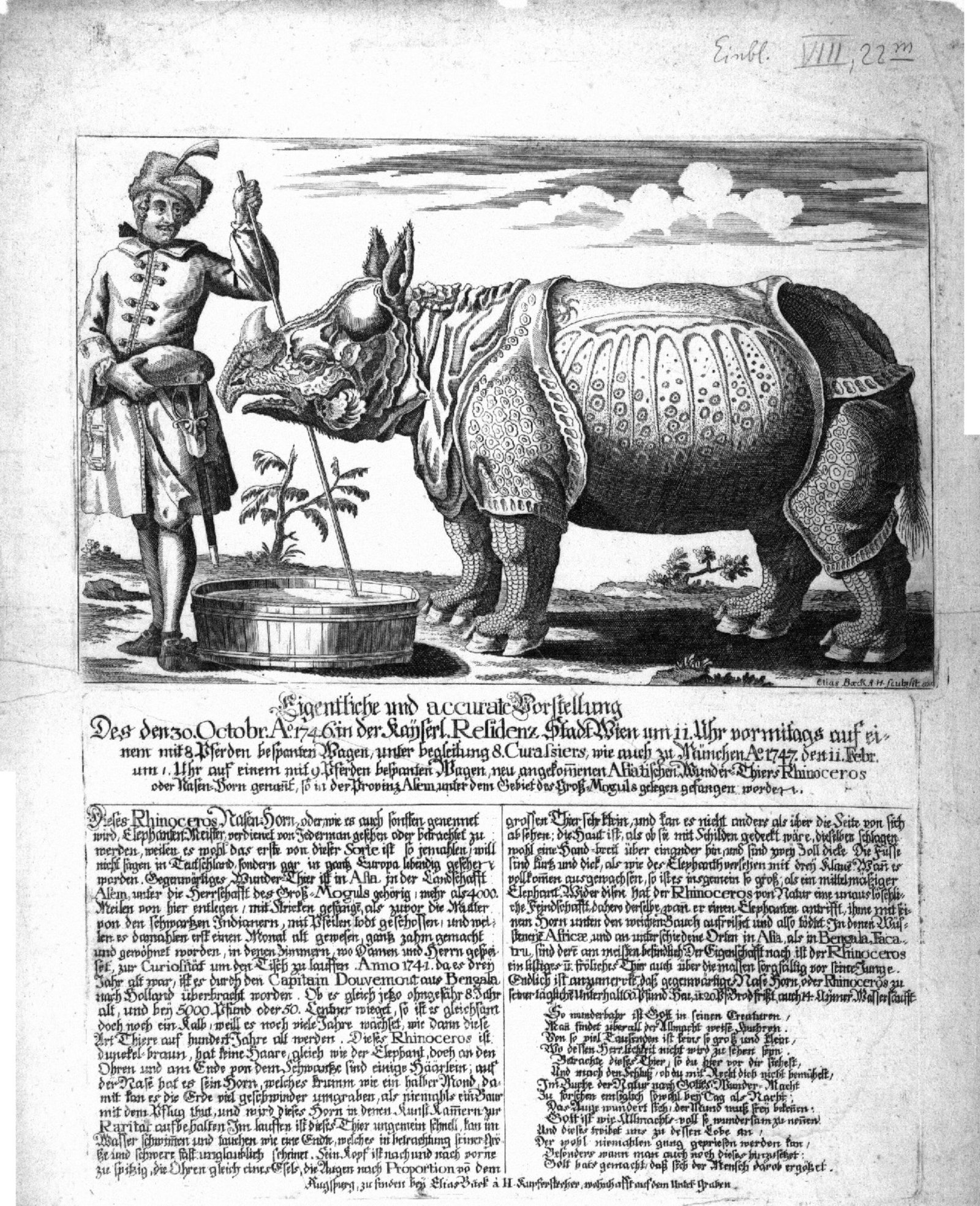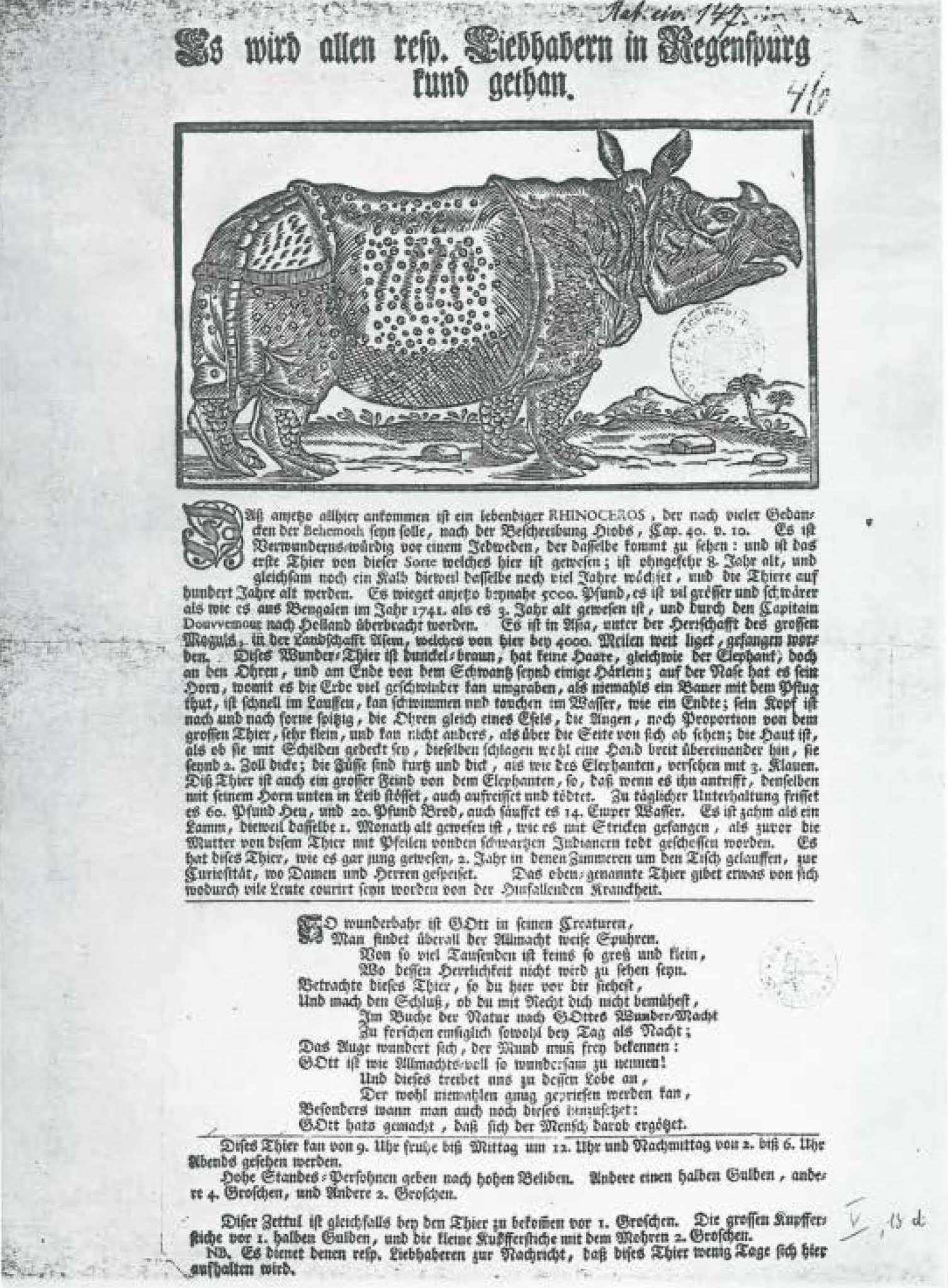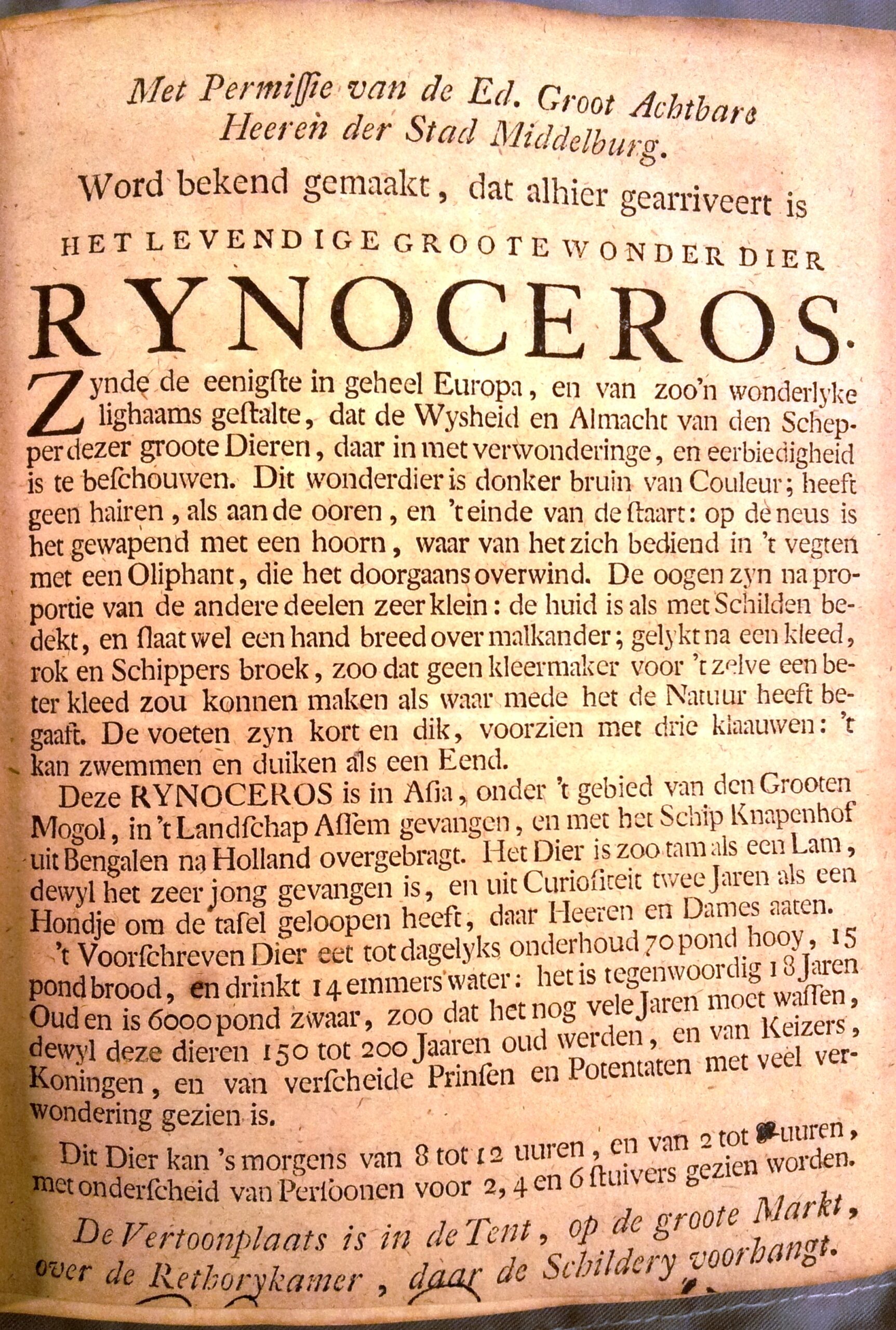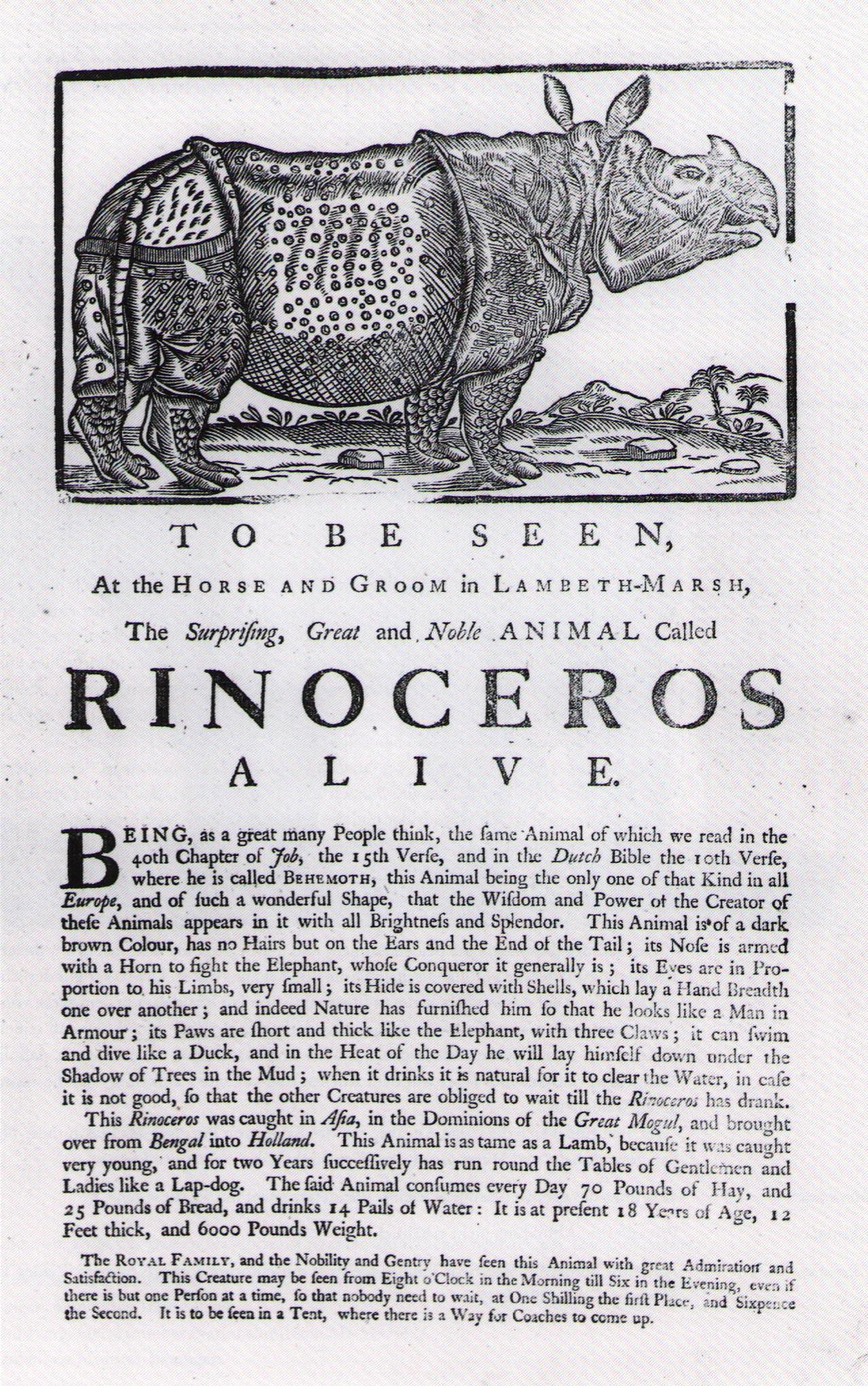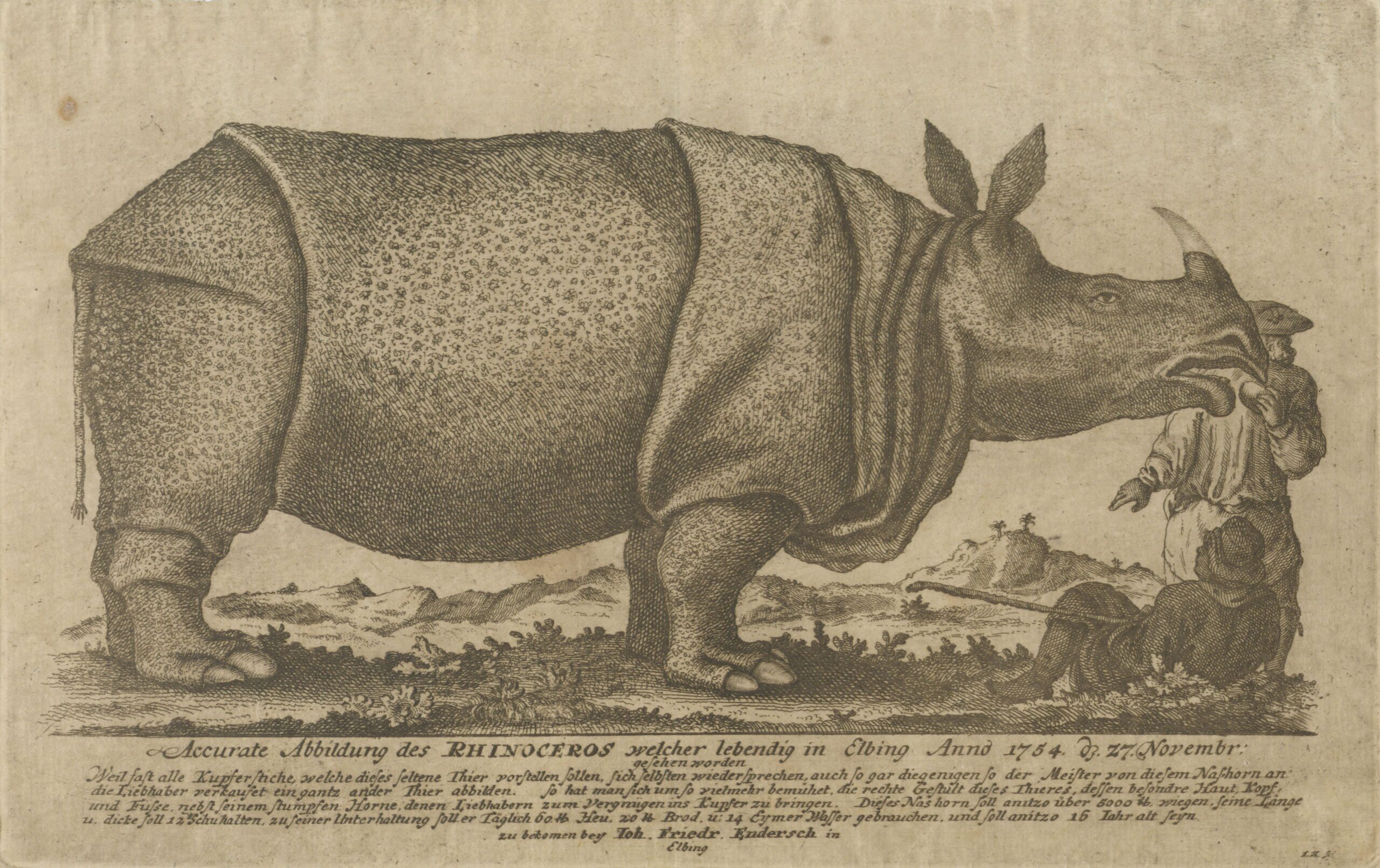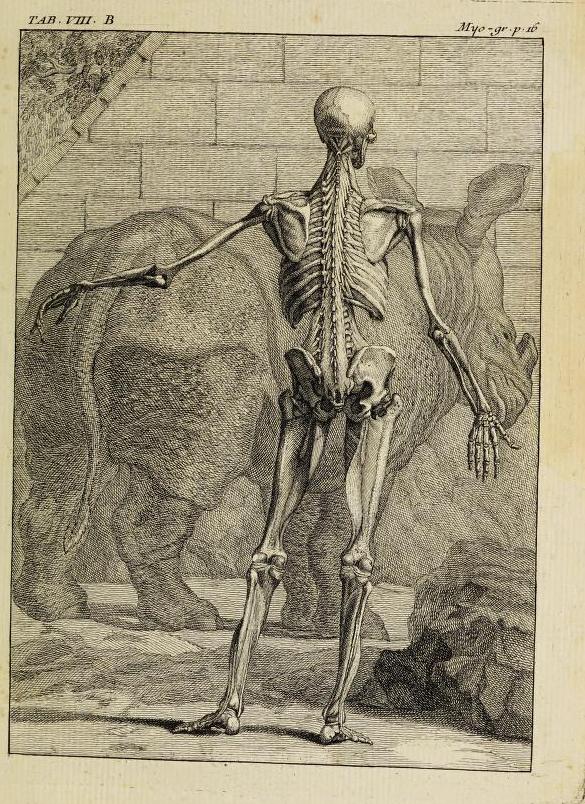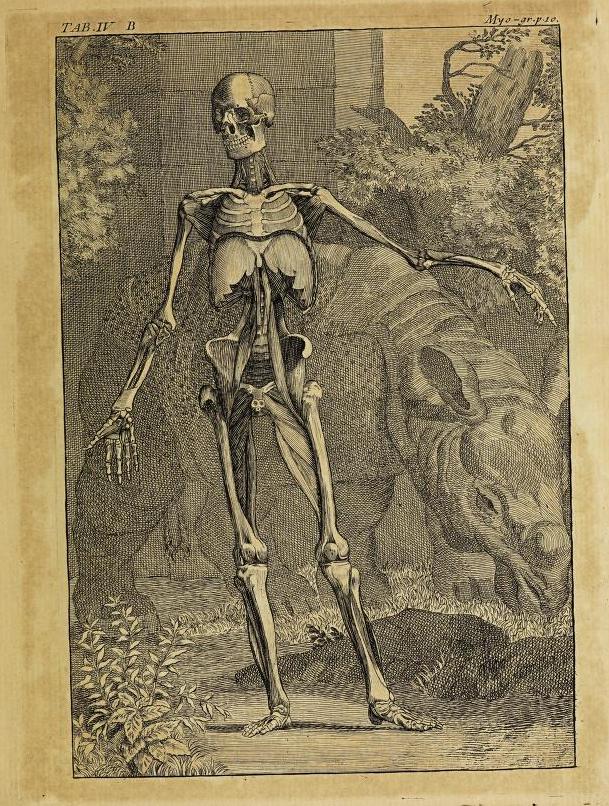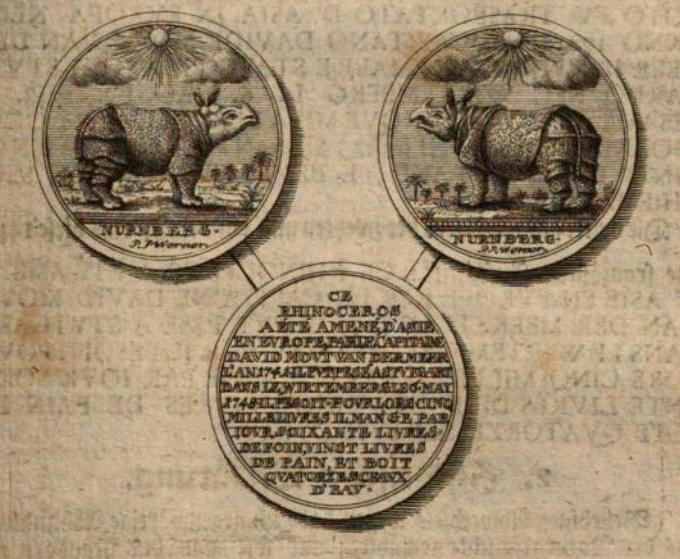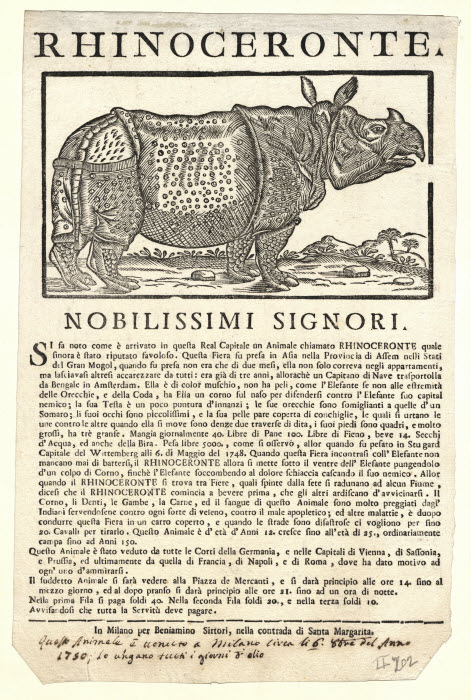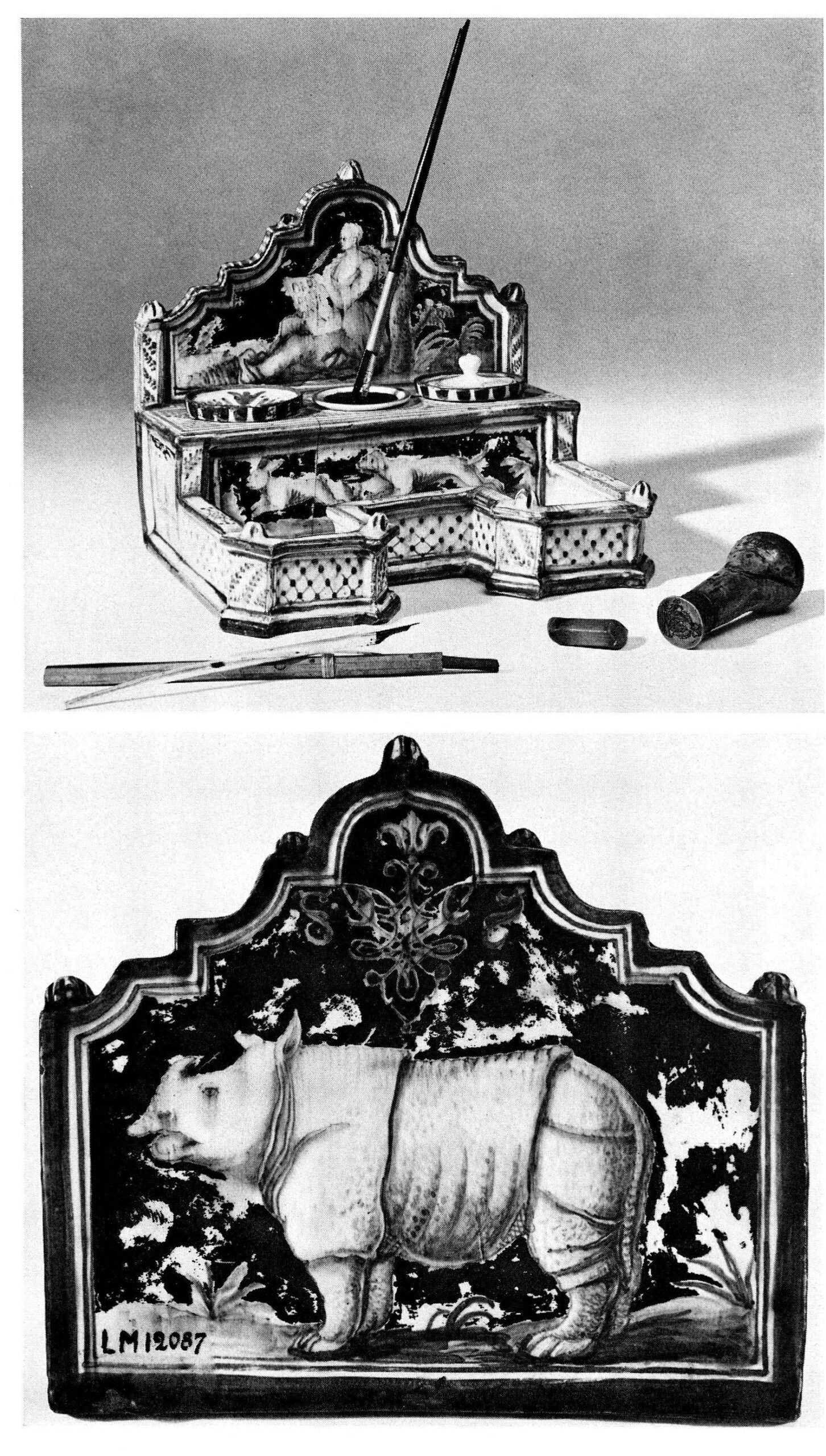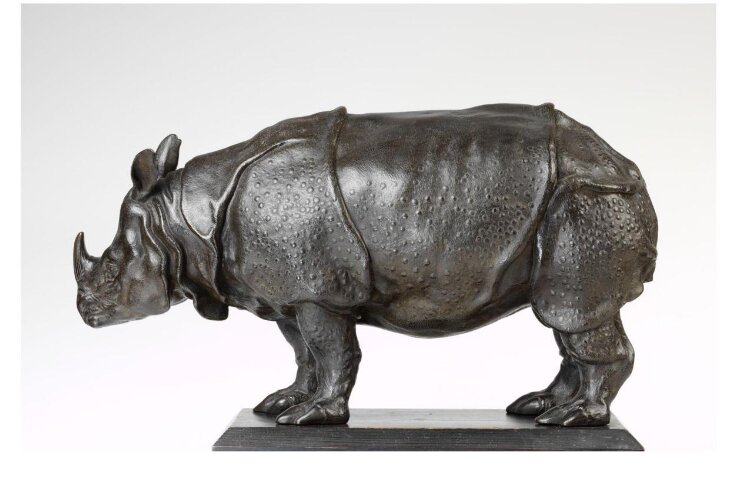


The rhinoceros, 2 ½ years old, was shown to the public near the Witte Poort in Leiden by Fredrik Jurrius on 4 December 1741 (source 1751). She was moved on 1 January to a place on the Garenmarkt in Leiden (source 1752). The rhinoceros was seen in 1742, probably in Leiden, by B. S. Albinus (professor of anatomy), who added a reference to the animal to the Tabulae sceleti et corporis humani musculorum on the human musculature, which first appeared in Leiden with a 1747 imprint (source 1753). The appearance of the rhinoceros in front and hind view was added by the artist Jan Wandelaar to the large engraved plates illustrating the Tabulae Sceleti (source 1754). The plates with the rhinoceros were available in 1742 (source 1755). The volume was translated and the plates copied for an English edition of 1749 (source 1756) and an inferior French edition of 1753 edited by Pierre Tarin (source 1757). The rear-view from the Tabulae was used for a broadsheet on the rhinoceros issued in Germany by Homann in 1747 (source 1758).
* The city of Leiden is 50 km SW of Amsterdam, 25 km NE of The Hague.
* Garenmarkt, Leiden
universiteitleiden.nl
Source 1751. Leydse Courant, 4 December 1741
Leydsche Courant, newspaper published in Leiden since 1719
Leydsche Courant 1741. [Advertisement]. No. 145, Monday 4 December 1741, p. 2.
leiden.courant.nu

Original text (Dutch)
Word bekend gemaakt, dat te Leyden by Fredrik Jurrius, in de Stads Herberg aan de Witte Poort, te zien is een levendige RHINOçEROS zynde twee en een half jaar oud, en over de drie duizend Ponden zwaar; al wie de voorn. Rhinoceros gelieft te komen zien, zal 4 Stuyvers betaalen, maar Kinderen onder 12 Jaaren oud twee Stuyvers.
English translation
It is announced that a living rhinoceros, two and a half years old and weighing over three thousand pounds, can be seen by Fredrik Jurrius at the Stadsherberg at the Witte Poort in Leiden. Anyone who would like to come and see the aforementioned rhinoceros will pay four stuivers, but children under twelve will pay two stuivers.
Source 1752. Leydse Courant, 1 January 1742
Leydsche Courant 1742. No. 1, Monday 1 January 1742.
leiden.courant.nu

Original text (Dutch)
Word bekend gemaakt, dat te Leyden op de Garemarkt, op de hoek van de Raamsteeg, te zien is dezelfde RHINOCEROS, welke Fr. Jurrius, in de Stads Herberg aan de Witte Poort is te zien geweest, en tot meerder genoegen van de Liefhebbers van daar naar de v.m. Plaats overgebragt is: Dezelve is twee en een half Jaar oud, en over de drie duizend Ponden zwaar. Die dit Beest gelieven te zien, zal 4 Stuivers betaalen, maar Kinderen onder de twaalf Jaaren oud twee Stuivers.
English translation
It is being announced that in Leyden on the Garemarkt, on the corner of Raamsteeg, is to be seen the same rhinoceros that Fr. Jurrius exhibited at the Stads Herberg at the Witte Poort. It has been brought from there to the aforementioned location, much to the delight of enthusiasts. It is two and a half years old and weighs over three thousand pounds. Those wishing to see this creature will pay four stuivers, while children under twelve will pay two stuivers.
Source 1753. Albinus, Tabulae of 1747 – Leiden edition
* Bernard Siegfried Albinus (1697–1770), German anatomist. Professor at the University of Leiden from 1721.
* Jan Wandelaar (1690–1759), artist in Leiden.
* Johannes Verbeek (1696–1778) and Hermanus Verbeek (1698–1755), Publishers in Leiden
Albinus, B.S. 1747. Tabulae sceleti et musculorum corporis humani. Lugduni Batavorum, apud Ionannem et Hermannum Verbeek, pp. i-vii, 1–82, plates 1–40; large folio (plano). [The copperplates by Jan Wandelaar.]
Book first published in Leiden 1747 (Latin), translated to English in London 1749. The rhinoceros is shown in the background of plates (muscles) 4 and 8. For plates, see source 1754.
Latin text from edition of Lugduni Batavorum [Leiden], 1747
Caeterum hac in Tabula & in octavo, exhibita quoque figura Rhinocerotis foeminae, quae ineunte hoc anno apud nos fuit, annos habens, ut custodes ferebant, duos cum dimidio. Ob raritatem belluae putavi figuras eius gratiores fore, quam alia quaecumque ornamenta ab arbitrium excogitata. Accuratae sunt, justaeque magnitudinis ad rationem figuram hominis, quae his iisdam Tabulis continentur.
Text on the plates, both plate 4 and plate 8
[top right] B.S. Albini. Musculorum Tabula [IV] [VIII]
[lower left] J. Wandelaar ad ipsa corpora hominum delineavit, idemque incidit
[lower right] Prostat Leidae Batavorum apud J. & H. Verbeek, 1742
English translation
Moreover, in this Plate and in the eighth, there is also exhibited the figure of a female Rhinoceros, which was with us at the beginning of this year, being, as the keepers said, two and a half years old. Due to the rarity of the beast, I thought that its figures would be more pleasing than any other ornaments invented by arbitrariness. They are accurate, and of just the right size to the figure of a man, which are contained in these same Plates.
English translation
top right] B.S. Albini. Musculorum Tabula [IV] [VIII]
[lower left] J. Wandelaar has drawn this after his own human body, and engraved it.
[lower right] Published in Leiden by J. & H. Verbeek, 1742.
Date 1742 on plates – also refer source 1755
Note: The text on the plates gives the date 1742, cf. Rookmaaker 1973 and Clarke 1986. This is confirmed by the text giving the age of Clara as 2 ½ years, and stating that it was exhibited at the start of 1742. Ridley 2022 p. 152 therefore supposes that the plates were available separately in 1742, but she gives no reference to justify this. Faust 2003, p.60 doubts that there was a separate edition before 1747. Some plates were advertised before the whole book was completed (source 1755), so far that for plates 4 and 8 is not found.
Source 1754. Engravings by Jan Wandelaar in the Tabulae of Albinus, 1747
* Jan Wandelaar (1690–1759), artist in Leiden.
The rhinoceros was inserted on Plates 4 and 8 of the series on human muscles in the Tabulae by Albinus, in the Leiden edition dated 1747 on title-page. The artist was Jan Wandelaar (1690–1759). The original sketches or drawings which Wandelaar may have made when he saw the animal have not been found. Identical plates are found in the English edition of 1749, with text changed to “C. Grignion sculp. – Impensis J. & P. Knapton, Londini, 1748” (Source 1756)
Size 56.8 × 40.4 cm.
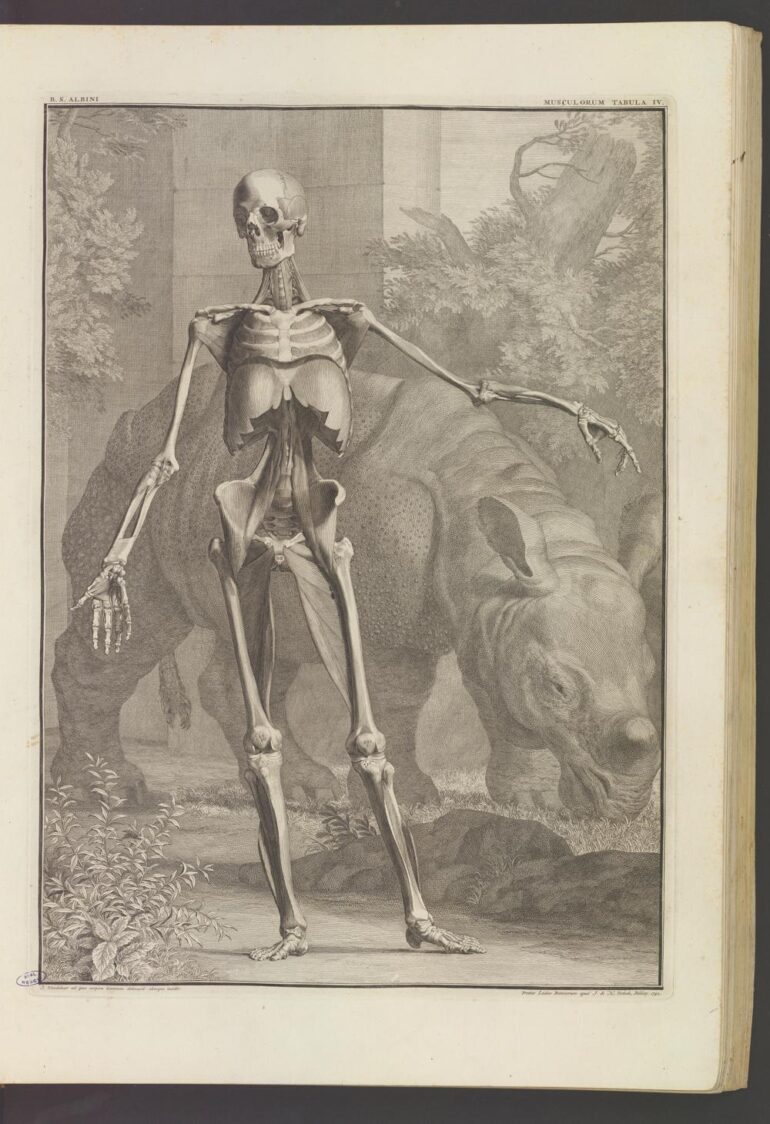
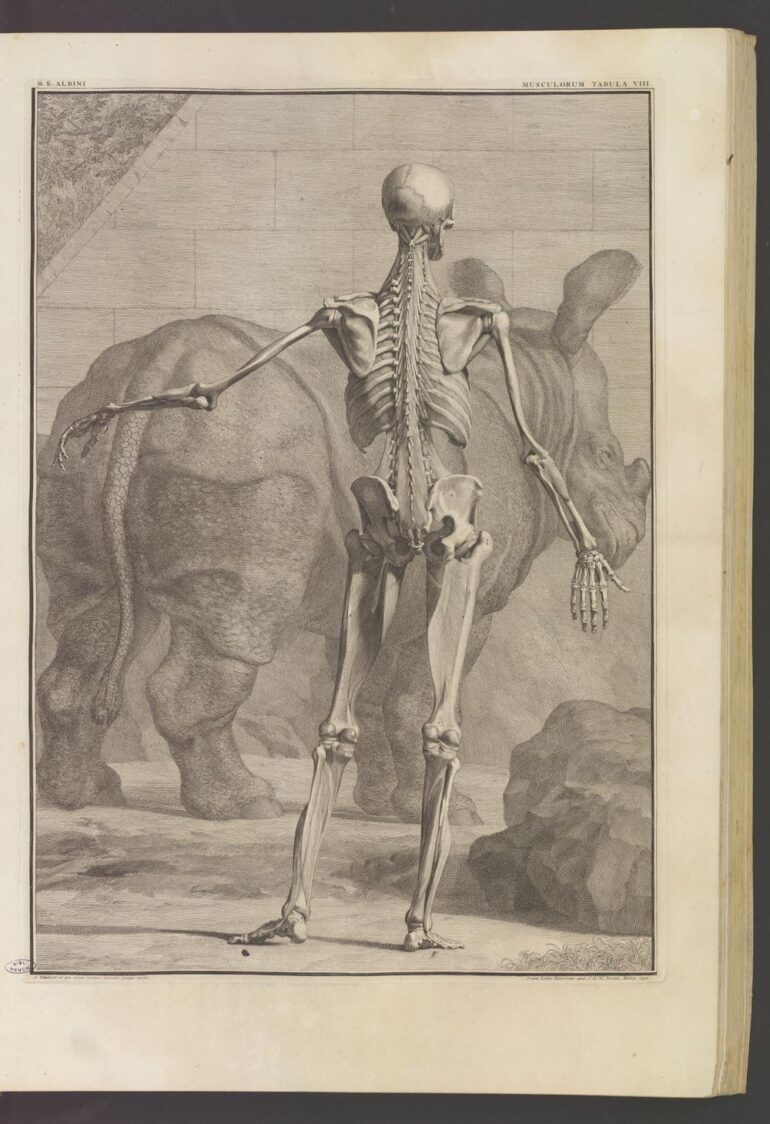
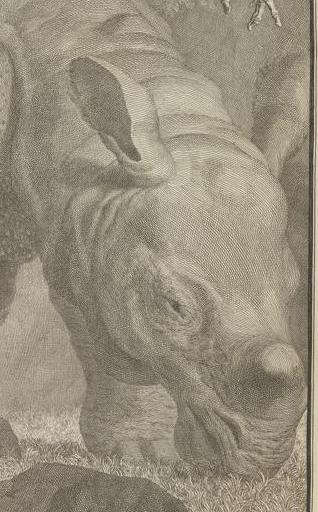
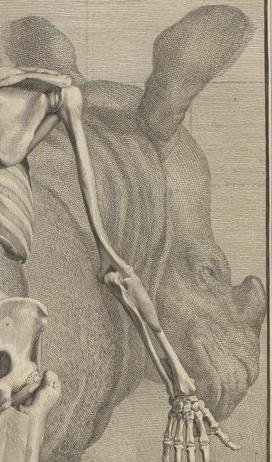
Note small size of horn
Literature:
- Ferguson, J.P.S. 1989. The skeleton and the rhinoceros. Journal of the Royal College of Physicians, Edinburgh 19 (2): 231–232, fig. 1.
- Wilson-Pauwels, L. 2009. Jan Wandelaar, Bernard Siegfried Albinus and an Indian Rhinoceros named Clara set high standards as the process of anatomical illustration entered a new phase of precision, artistic beauty, and marketing in the 18th century. Journal of Biocommunication 35 (1): E10-E17.
- Ridley, G. 2022. Art and merchandise, followers and fragility: creating the blueprint for animal celebrity. In: Nachumi, N.; Straub, K., Making stars: biography and celebrity in eighteenth-century Britain. Newark, University of Delaware Press. pp. 148–176. doi.org/10.2307/j.ctv2v55gms.11 – p. 152 – the plate stands out as being available on its own as early as 1742.
Source 1755. Albinus, Tabulae – Dates of publication of plates 4 and 8
The book was possibly published in sections, or individual plates with text were available separately. The publisher’s advertisement of 28 March 1740 states the availibility of two plates. Followed on 17 July 1741 by 6 further plates. The plates 4 and 8 with the rhinoceros in the background have a date 1742 printed on the plate, and it is likely that they were available in that year (no advertisement found). The Leiden edition was completed in 1748, and for sale for 67–10 guilders, advertised in ‘s Gravenhaegse Courant 28–10–1748, and Leydse Courant 13–11–1748.
Leydse Courant – 28 March 1740
Advertisement for Albinus, Tabulae Sceleti

Original text (Dutch)
By Jan en Herman Verbeek , Boekverkopers te Leyden , word een begin gemaakt met de uytgave van twee uytmuntende, kostbaare en magnifique Werken van den Hooggeleerden wytvermaarden Heere B. S. Albinus, Hoogleeraar in de Medicyne, Anatomie en Chirurgie in ‘s Lands Hoogeschoole te Leyden, het eene genaamt: Bern. Siegf. Albini Tabulae Anatomicae Musculorum Hominis; het andere : Tabulae Anatomicae Sceleti Hominis, beide groot Atlas Formaat, zynde de Prenten overheerlyk geteekend en in ‘t Koper gebragt door den beroemden Konstenaar J. Wandelaar : Van deze twee Werken zyn nu tot gerief van ‘t Publicq te bekomen Tabula prima Musculorum en Tabula prima Sceleti, met de Verklaaringen: De verdere uytgave zal op dezelve wyze spoedig gevolgd worden. Dezelve Zyn mede te bekomen te Groningen by H.Spandaw, Harlingen F. vander Plaats, Utrecht, J, Paddenburg en Vonk van Lynden, Amsterdam Schenk, Covens en Mortier, Hartig en Boussiere, Rotterdam J.D. Beman, in ‘s Hage O. en P. van Thol &c.
Leydse courant– 17 July 1741
Available plates Musculorum tab. 1, 2, 5. Sceleti tab. 1, 2, 3. Soon also Musculorum 3 and 6.
Cannot find advertisement for plates Musculorum tab. 4 and 8.
In 1747 edition, plates have dates in lower right corner:
Front Tab. 1 – 1739
Musculorum 2, 5 – 1740. Also Tabula I. II. III [not musculorum] 1740
Musculorum 3, 6 – 1741
Musculorum 4, 7, 8 – 1742
Musculorum 9 – 1743
Source 1756. Albinus, Tabulae – English edition of 1749
Albinus, B.S. 1749. Tables of the skeleton and muscles of the human body. Translated from the Latin. London, Printed by H. Woodfall for John and Paul Knapton, pp. 1–92, plates 1–40; folio. 1749.
Another edition (1777)
Tables of the skeleton and muscles of the human body. Translated from the Latin. Edinburgh: Printed by Balfour & Smellie, for Andrew Bell engraver, volume 1, pp. i-vi, 1–86; folio. 1777
The British Museum dates the London edition to 1748:
www.britishmuseum.org
English text from the edition of London, 1749
[1749, text to pl. IV]
We conclude this table, and the eighth, by exhibiting in the background the figure of a female Rhinoceros that was shewed to us in the beginning of the year 1742, being two years and a half old, as the keepers reported. We thought the rarity of the beast would render these figures of it more agreeable than any other ornament, resulting from the mere fancy. The figures are just, and of a magnitude proportionable to the human figure contained in those two tables.
Text on the plates
On plate IV
[top right] Tab. IV
[lower left] C. Grignion sculp.
[lower right] Impensis J. & B. Knapton – Londini 1747
On plate VIII
[top left] Tab. VIII
[lower left] C. Grignion sculp.
[lower right] Impensis J. & B. Knapton – Londini 1748
Albinus, B.S. 1749. The explanation of Albinus’s anatomical figures of the human skeleton and muscles. London, for John and Paul Knapton. pp. i-xxiv, 1–332, 1–106.
Original text (German)
[1749, p. 56] We conclude this table, and the eighth, by exhibiting in the background the figure of a female Rhinoceros that was shewed to us in the beginning of the year 1742, being two years and a half old, as the keepers reported. We thought the rarity of the beast would render these figures of it more agreeable than any other ornament, resulting from the mere fancy. The figures are just, and of a magnitude proportionable to the human figure contained in those two tables.
There are two plates of the rhinoceros copied from the original Leiden edition of 1747. They are signed by English artist Charles Grignion (1721–1810) and the publishers John Knapton and Paul Knapton (1703–1755)
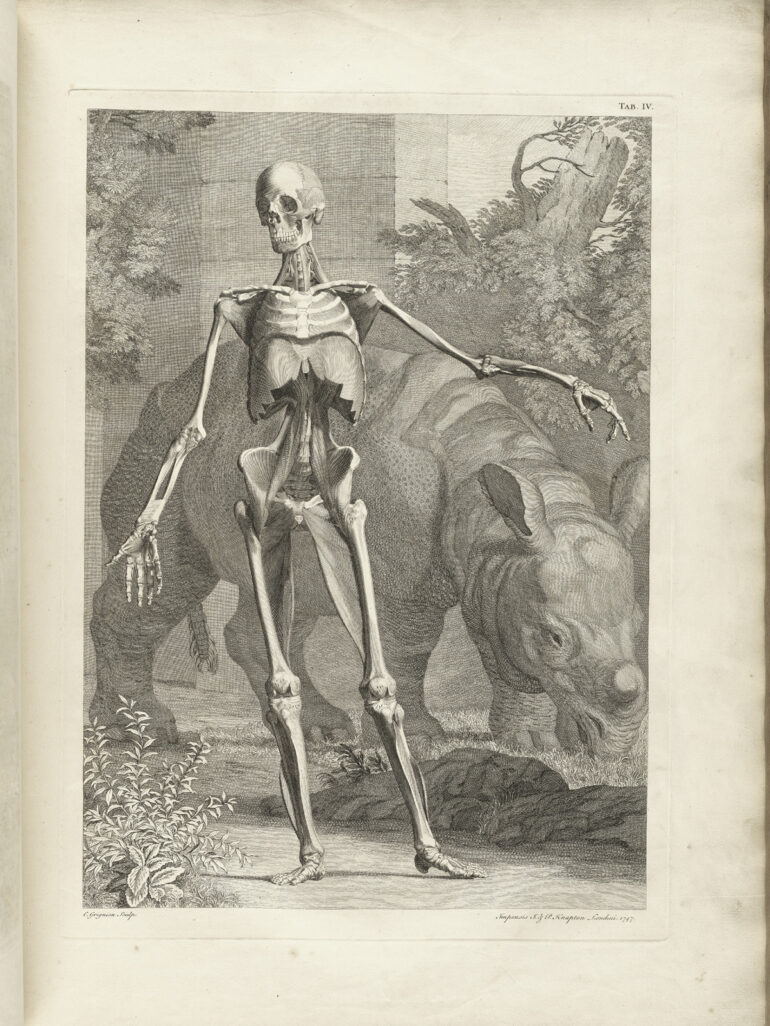
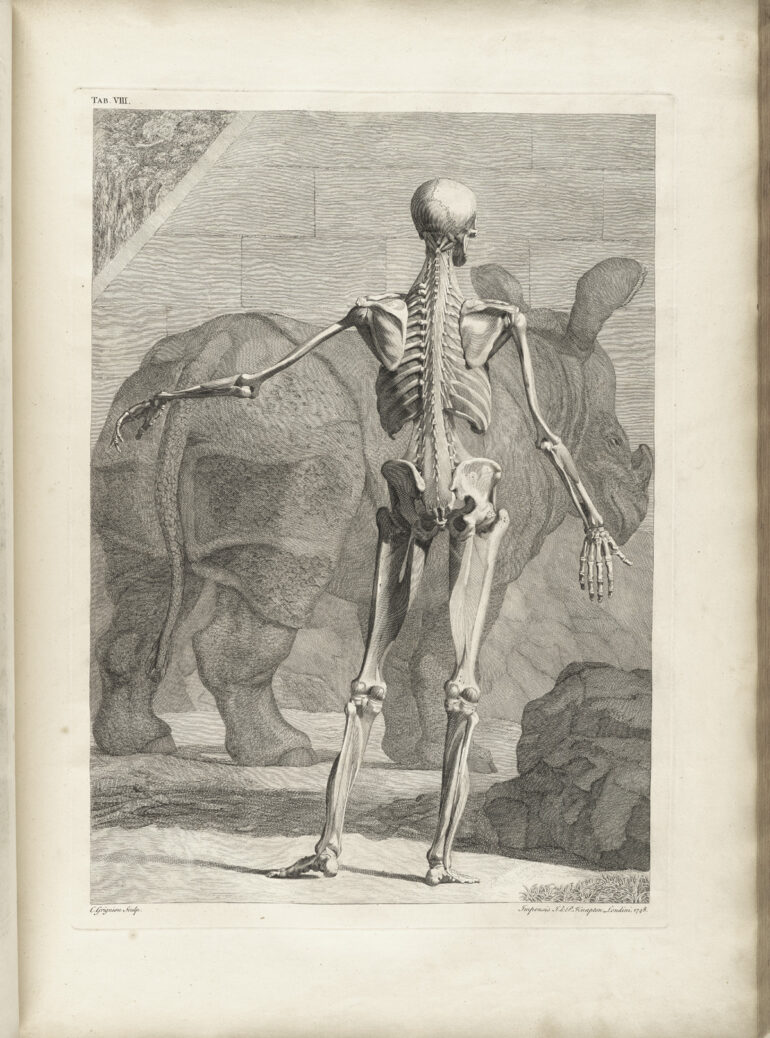
Plate 4 reproduced:
- Bossi, L. 2020. Clara. In: Bossi, L. (ed). Abécédaire: Les origines du monde, l’invention de la nature au XIXe siècle. Paris: Musée d’Orsay, et Gallimard. pp. 36-37.
Source 1757. Albinus, Tabulae – French translation of 1753
* Pierre Tarin (1725–1761).
Tarin, P. 1753. Myo-graphie, ou description des muscles du corps humain. Paris, Briasson. [2 unnumbered pages, 171 pages, 1 unnumbered page, 38 plates ; (4to)]
No reference to rhinoceros in text. Two plates also showing the rhinoceros:
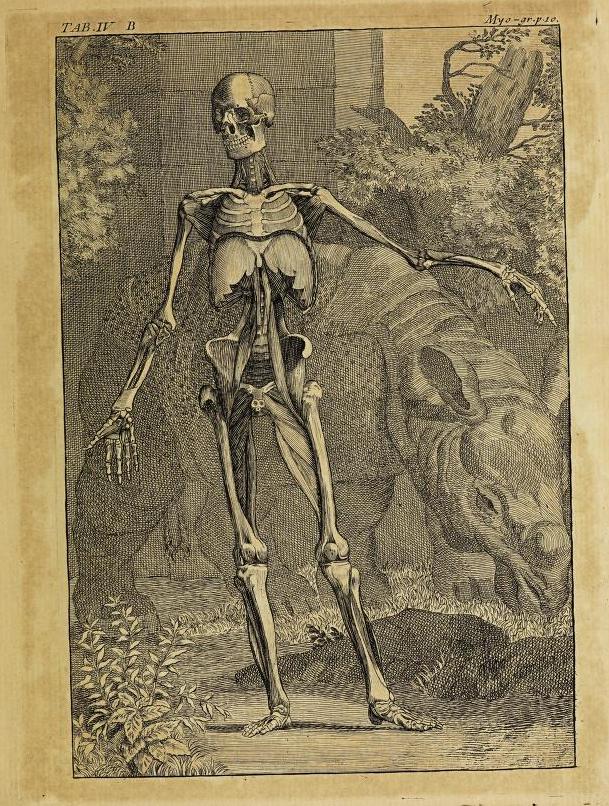
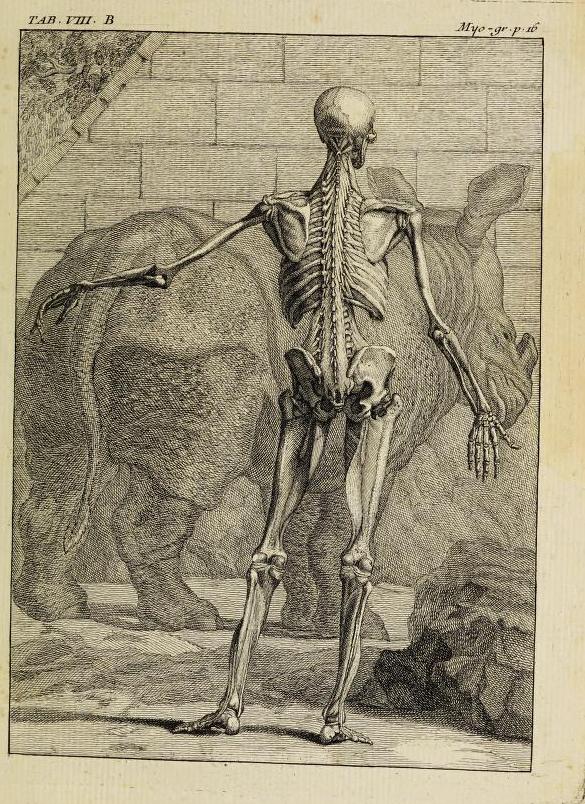
Source 1758. Homann’s Abbildliche Geschichte 1747
Johann Baptist Homann (1664-1724), publisher of maps in Nürnberg
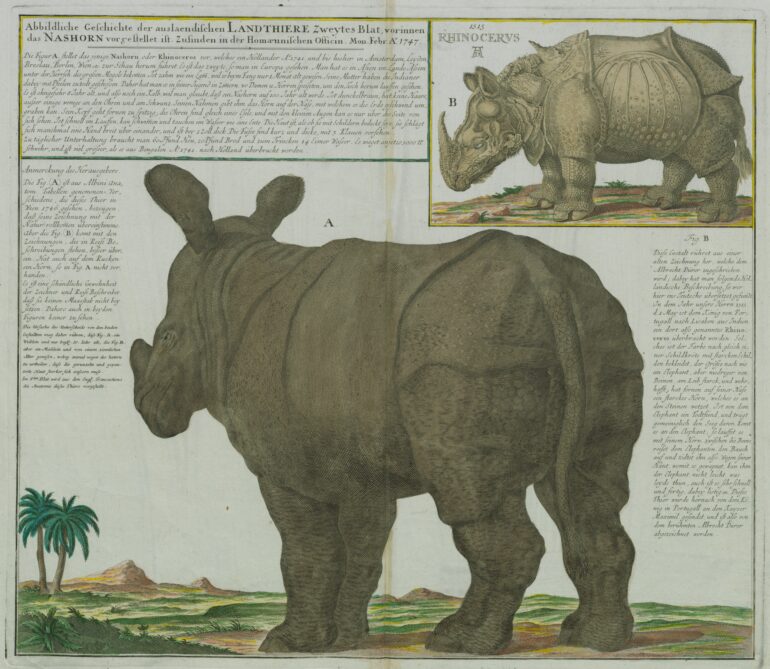
Homann, Joh. Bapt. (Verlag) 1747. Abbildliche Geschichte der auslaendischen Landthiere. Zweytes Blat, worinnen das Nashorn vorgestellet ist.. Nürnberg, Zu finden in der Homaennischen Officin. pp. 1–2. Mon. Febr. Ao. 1747. Engraving, hand-coloured, 42 x 55 cm
Original text (German)
Anmerckung des Herausgebers.
Die Fig. (A.) ist aus Albini anatom. Tabellen genommen. Verschiedene, die dieses Thier in Wien 1746 gesehen, bezeugen daß diese Zeichnung mit der Natur vollkommen übereinstimme. – Die Ursache der Unterscheide von den beiden Gestalten mag daher rühren, dass Fig. A ein Weiblein und nur beyn. 10 Iahr alt.
Die Figur stellet dasjenige Nashorn oder Rhinoceros vor, welches ein Hollander Ao. 1741 und bis hieher in Amsterdam, Leyden, Breslau, Berlin, Wien etc. zur Schau herum führet.
English translation
Notice by Publisher. Fig. (A.) is taken from Albini’s anatomical tables. Several who saw this animal in Vienna in 1746 attest that this drawing corresponds perfectly with nature. The reason for the differences between the two figures may be that Fig. A is a female and only about 10 years old.
The figure represents the rhinoceros that a Dutchman has exhibited since 1741 and continues to exhibit in Amsterdam, Leiden, Breslau, Berlin, Vienna, etc.
Note that the rhinoceros is shown in reverse from original.
Examples:
- Nuremberg, Germanisches Nationalmuseum, inv. no. HB4965 [Faust has: MS514/1427]
- Berlin, Sammlung Sperlich – see Heikamp 1980: 312, fig. 11
- Bingen, Sammlung Ingrid Faust – now München, Bayerische Staatsbibliothek, Res/Slg.Faust 172 – https://www.digitale-sammlungen.de/en/view/bsb00097247?page=,1
- France, coll. Monson-Baumgart – now Nurnberg
- Universitätsbibliothek Bern, MUE Ryh 8303:12 https://doi.org/10.3931/e-rara-133312 – also: https://ryhiner.ub.unibe.ch/de/world/volume/363/image/6271
- Copenhagen, Kungl. Bibliothek, Frederik den Femtes Atlas, Bd. 53, Tvl. – https://digitalesamlinger.kb.dk/maps/kortsa/2012/jul/kortatlas/object78836/da
Literature:
- Faust 2003: 112-113, nos. 719.1 and 719.2 – two versions: (1) without 9 line text next to head of rhino. (2) with 9 line text.
- Van der Ham 2022, p. 166, fig. 65 – copy of Nuremberg, Germanisches Nationalmuseum, inv. no. HB4965.
NB. The first page of this pamphlet is about the elephant
https://rhinoresourcecenter.com/library/images/homann-description-elephant-1747/
Full text:
A [rhino seen half from behind]
Die Figur stellet dasjenige Nashorn oder Rhinoceros vor, welches ein Hollander Ao. 1741 und bis hieher in Amsterdam, Leyden, Breslau, Berlin, Wien etc. zur Schau herum führet. Es ist das zweyte, so man in Europa gesehen. Man hat es in Asien im Lande Assem unter der Herrsch. Des grossen Mogols bekommen. Ist zahm wie ein Lamm, weil es beym Fang nur 1. Monat alt gewesen. Seine Mutter haben die Indianer dabey mit Pfeilen zu todt geschossen. Daher hat man es in seiner jugend in Zimmern, wo Damen u. Herren speiseten, um den Tisch herum lauffen gesehen. Es ist ohngefehr 8 Jahr alt, und also noch ein Kalb, weil man glaubt, daß ein nashorn auf 100 jahr alt werde. Ist dunckelbraun, hat keine Haare, ausser einige wenige an den Ohren und am Schwanz. Seinen Nahmen gibt ihm das Horn auf dr nase, mit welchem es die erde geschwind umgraben kan. Sein Kopf geht fornen zu spitzig, die Ohren sind gleich eines Esels, und mit den kleinen Augen kan es nur über die seite von sich sehen. Ist schnell im Lauffen, kan schwimmen und tauchen im Wasser wie eine Ente. Die haut ist, als ob sie mit Schildern bedeckt seye, sie schlägt sich manchmal eine Hand breit über einander, und ist bey 2. Zoll dick. Die Füsse sind kurz und dicke, mit 3. Klauen versehen. Zu täglicher Unterhaltung braucht man 60 Pfund Heu, 20 Pfund Brod, und zum Trincken 14 eimer wasser. Es wieget anjetzo 3000 Pfund schwer, und ist viel grösser, als es aus Bengalen Ao. 1741 nach Holland überbracht worden.
[left of the rhinoceros]
Anmerckung des Herausgebers.
Die Fig. (A.) ist aus Albini anatom. Tabellen genommen. Verschiedene, die dieses Thier in Wien 1746 gesehen, bezeugen daß diese Zeichnung mit der Natur vollkommen übereinstimme. Aber die Fig. (B.) komt mit den Zeichnungen, die in Reise Beschreibungen stehen, besser überein. Hat auch auf dem Rücken ein Horn, so in Fig. A. nicht vorhanden.
Es ist eine schändliche Gewohnheit der zeichner und Reise Beschreiber, daß sie keinen Maasstab nicht bey setzen. Dahero auch in beyden Figuren keiner zu sehen.[additional text left of rhino head, absent in some copies, cf. Faust 719.1]
Die Ursache der Unterscheide von den beiden Gestalten mag daher rühren, dass Fig. A ein Weiblein und nur beyn. 10 Iahr alt, die Fig. B aber ein Mannlein und von einem ziemlichen Alter gewesen, wobey zumal wegen der lestern zu urtheilen, dass die gerunzelte und gepanzerte Haut staerker sich aussern muss. Im 3ten Blat wird aus den Engl. Transactions die Anatomie dieses Thiers vorgestellt.
B [Durer-rhino, facing left]
Fig. B. Diese gestalt rühret aus einer alten Zeichnung her, welche dem Albrecht Dürer zugeschrieben wird; dabey hat man folgende Holländische Beschreibung, so wir hier ins Teutsche übersetzet gefunde. In dem jahr unsers Herrn 1515 d. 1 may ist dem König von Portugall nach Lisabon aus Indien ein dort also genanntes Rhinoceros überbracht worden. Solches ist der Farbe nach gleich einer Schildkröte mit starcken Schilden bekleidet, der Grösse nach wie ein Elephant, aber niedriger von Beinen, am Leib starck, und wehrhafft, hat fornen auf seiner Nase ein starckes Horn, welches es an den Steinen wetzet. Ist von dem Elephant ein Todtfeind, und trägt gemeiniglich den Sieg davon. Komt es an den Elephant, so lauffet es mit seinem Horn zwischen die Beine, reiset dem Elephanten den Bauch auf und tödtet ihn also. Wegen seiner Haut, womit es gewapnet, kan ihm der Elephant nicht leicht was leyds thun, auch ist es sehr schnell und fertig, dabey listig etc. Dieses Thier wurde hernach von dem König in Portugall an den Kayser Maximil. gesendet, und ist also von dem berühmten Albrecht Dürer abgezeichnet worden.