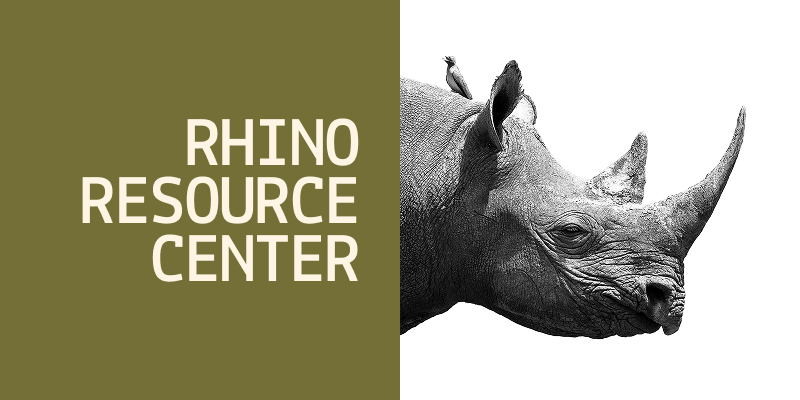


A very interesting question has arisen, whether this last, a huge and powerful animal, is not the Unicorn of Scripture, Monoceros of the Greeks, and the Unicornis of the Latins: the suggestion is very reasonable, and well is worthy of investigation. Stupendous strength is the constant attribute of the Unicorn as it is of the rhinoceros. We read, in the Book of Numbers xxiii.22, that by way of exalting the power of the Almighty, it is written, ' God brought them out of Egypt; He hath as it were the strength of an Unicorn.' I think it is evident that the Unicorn was the most powerful animal known, or this comparison would have no signification. A very beautiful passage in the Book of Job (xxxix. 9-12) shows that the Unicorn was not only an undomesticated animal, but an animal that could not be domesticated; and the contrast with domestic cattle gives its force and beauty to the passage. '9. Will the Unicorn be willing to serve thee, or abide by thy crib. 10. Canst thou bind the Unicorn with his band in the furrow or will he harrow the valleys after thee ? 11. Wilt thou trust him, because his strength is great? or wilt thou leave thy labour to him 12. Wilt thou believe him, that he will bring home thy seed, and gather it into thy barn?' Notwithstanding this passage, commentators have frequently insisted on the identity of the Unicorn with the bullock of some species of Bos, using as an argument that horns in the plural are sometimes mentioned; but the animal now for the first time brought into Englaiid has two horns, and this animal is undoubtedly Asiatic, though distant from Palestine, and we continually observe that distance magnifies an object to the mind's eye just as a fog magnifies it to the natural eye. And though there are passages that support this idea of a two-horned Unicorn, yet there are others which point very decidedly to his characteristic of being one-horned; for instance, in Psalm xcii. 10, 'My horn shalt thou exalt like the horn of the Unicorn'; the words 'horn of the' are added by the translator. It is worthy of remark that in instances where horns is is used in the plural so also is Unicorns: for instance, in Deut. xxxiii. 17, 'his horns are like the horns of Unicorns', Ps. xxii. 21, 'for thou hast heard me from the horns of Unicorns.'. No naturalist, who found in the narrative of a voyage that the captain brought home the horns of narwhals, would conclude that each narwhal had more than one horn: there is no other mode of so simply expressing the meaning as by making both words plural. It is not improbable that many of my readers will consider all this out of place : if so they will please 'skip it' and pass on.
London Zoo. The skin, moreover, appears flexible, arid is covered with coarse hair, which is of a rufous-brown colour as far as the fold, and thence gray to the tail : this coarse hair occurs also on the upper anterior portion of the fore legs, and more sparingly on the belly. There is a fringe of long pendant hair on the margin of the ears, and also a good deal of long wiry hair on the tail.
it differs from R. unicornis in having two horns, one of which, the smallest, seems exactly intermediate between the eyes, and the other, the larger one, occupies the same site on the nose as the single horn of Unicornis.
London Zoo. The skin, moreover, appears flexible, arid is covered with coarse hair, which is of a rufous-brown colour as far as the fold, and thence gray to the tail.
London Zoo. The skin, moreover, appears flexible, arid is covered with coarse hair, which is of a rufous-brown colour as far as the fold, and thence gray to the tail.
London Zoo. The skin, moreover, appears flexible, arid is covered with coarse hair, which is of a rufous-brown colour as far as the fold, and thence gray to the tail : this coarse hair occurs also on the upper anterior portion of the fore legs, and more sparingly on the belly. There is a fringe of long pendant hair on the margin of the ears, and also a good deal of long wiry hair on the tail.
it differs from R. unicornis in having two horns, one of which, the smallest, seems exactly intermediate between the eyes, and the other, the larger one, occupies the same site on the nose as the single horn of Unicornis.
A similar accident is recorded in the 'Zoologist' (S.S. 1915) as having happened to a female rhinoceros at Moscow: the horn is still preserved in the museum in that city, and the animal has developed a new horn on the site of the old one - a remarkable and interesting fact: the similar position or inclination of the horn of the female in the Zoological Gardens was recorded on the same page: this horn has now been removed, as will be seen by the record immediately following this memoir.
Both the horns in the individual now before me have the appearance of having been sawn off, an appearance admirably represented in the masterly figure of the animal published at p.233 of the 'Field' newspaper, a faithful representation of nature which does the artist infinite credit. In this and many other figures by tile same artist, there is a total absence of that sensational exaggeration which often converts a portrait into a caricature.
