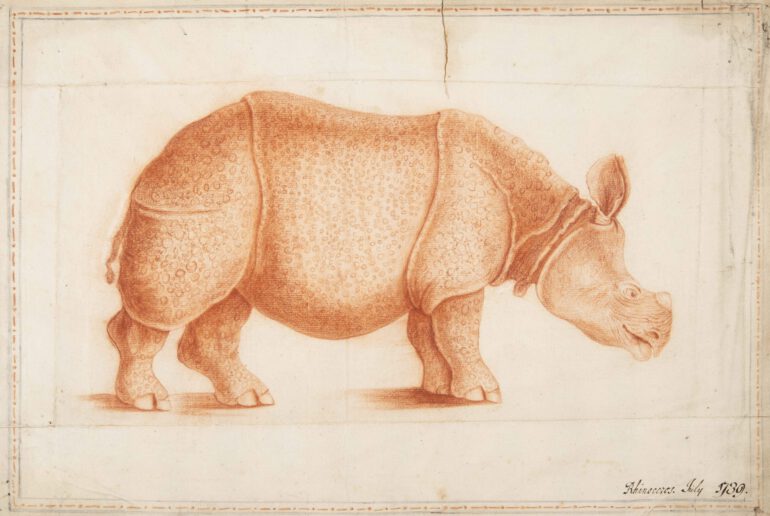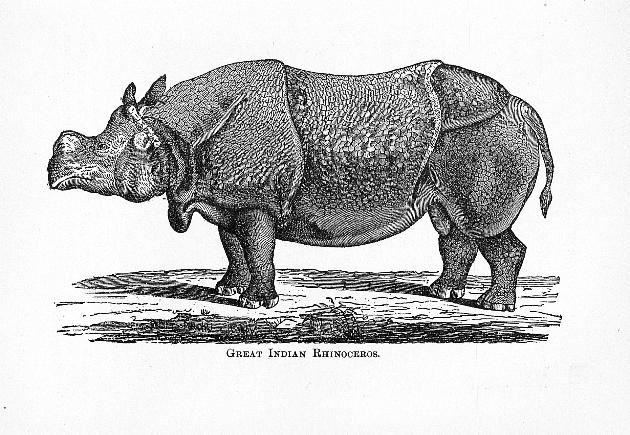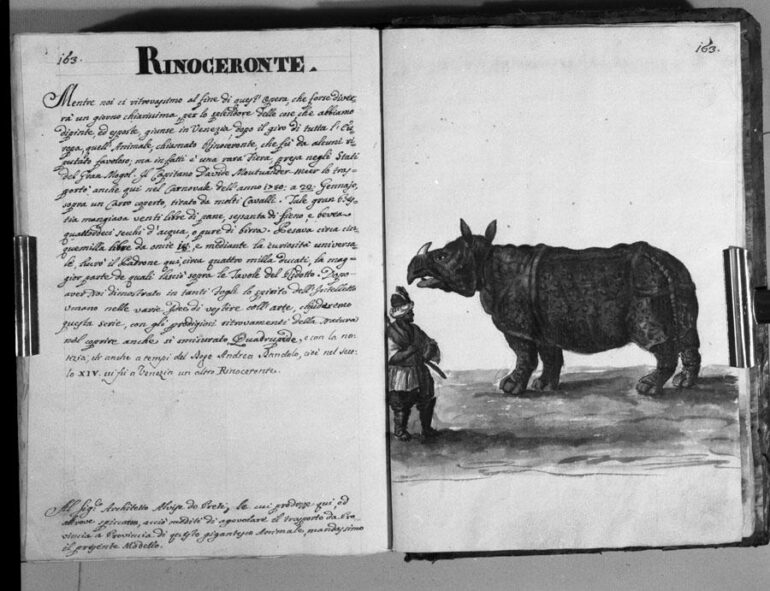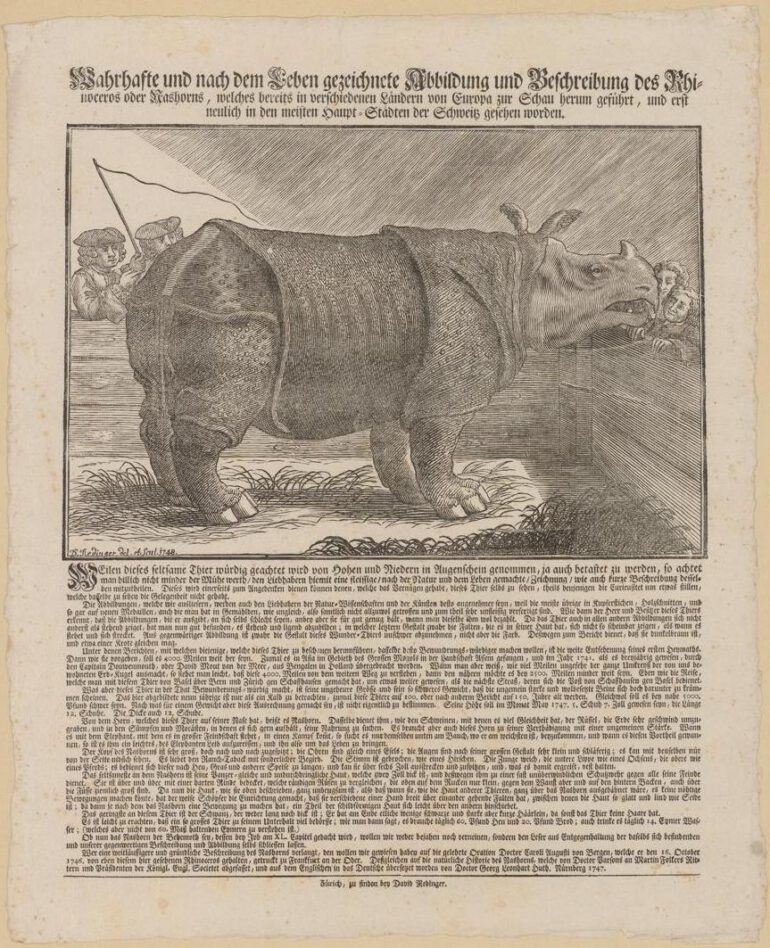


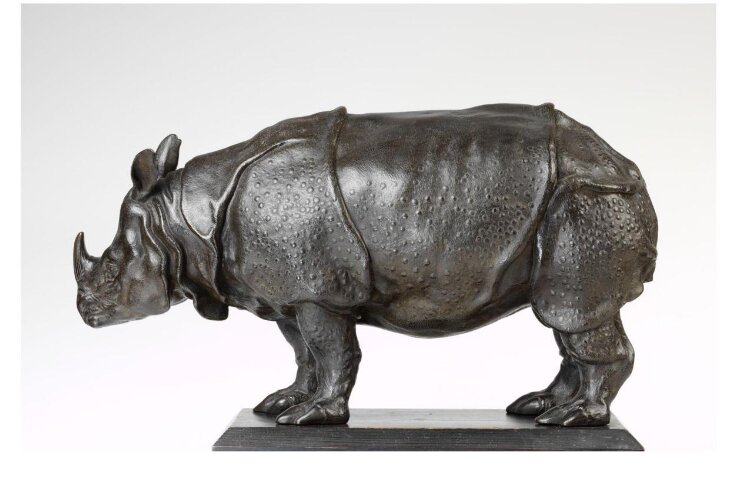

Statuette, bronze, Rhinoceros called Miss Clara, probably German, ca. 1740-1760
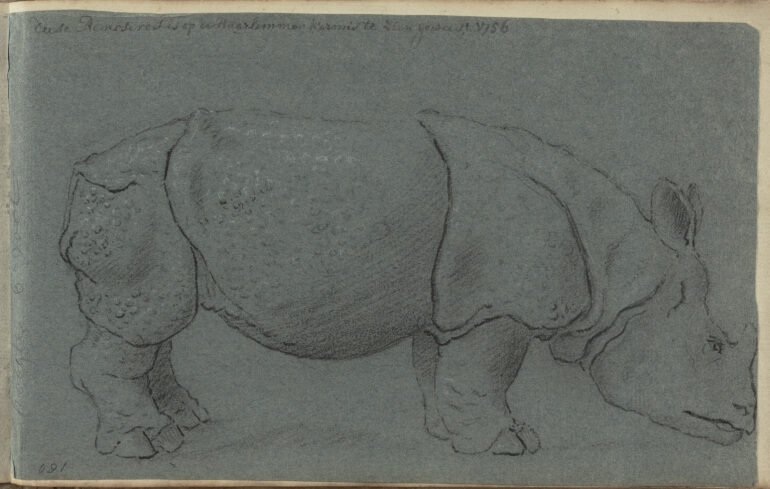
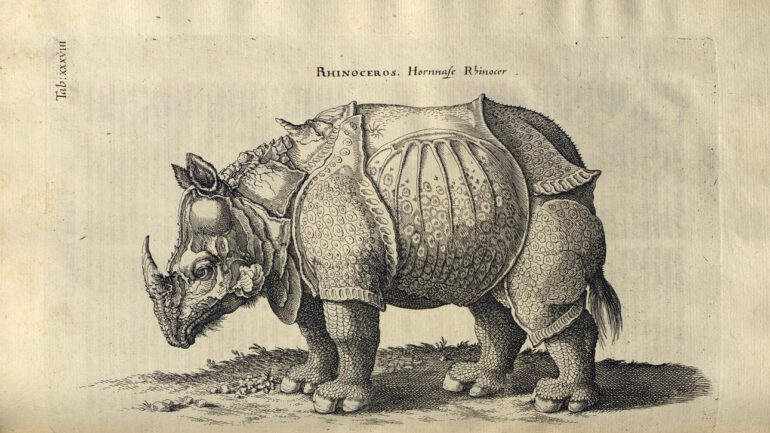
Rhinoceros standing, the head slightly lowered and turned to left.
Height: 25.5cm (Note: Including proper base, but not wooden base). Width: 47.5cm (Note: Including proper base but not wooden base). Depth: 19cm (Note: Including proper base but not wooden base)
The Salting Bequest. Formerly Baring collection. Then Salting collection. Bequeathed to the V&A by Salting.
This bronze, beautifully modelled and cast, is believed to have been made in Germany, maybe after Verschaffelt’s model. Two other versions are known, one in the Barber Institute of Fine Arts (acc. No. 42.9), the other, formerly in the Heseltine Collection (W. von Bode, Italian Bronze Statuettes of the Renaissance, London, 1908, II, pl. 118; current location unknown). Other smaller versions, sometimes of later casts, have appeared recently on the art market (e.g. Sotheby’s, Paris, 14 May 2014, lot 80 [dated 1750-52]; Sotheby’s, London, 3 July 2018, lot 51 [cast probably 19th c.]).
Peter Anton von Verschaffelt (1710-1793), court sculptor to Elector Carl Theodor in the Palatinate, sculpted a large rhinoceros in marble which was documented in his workshop after his death (E. Hoffmann, Peter Anton von Verschaffelt. Hofbildhauer des Kurfürsten Carl Theodor in Mannheim, PhD diss., 1982, p.18). He may have made a smaller version of his sculpture as a model for the Frankenthaler porcelain manufacture (see F. H. Hofmann, Frankenthaler porzellan, Munich, 1911, II, no. 520 and no. 749). In 1799, after the collapse of the Frankenthal factory, the Nymphenburg Porcelain manufacture acquired many of its workmen and moulds, therefore adding Frankenthal designs to its products.
https://collections.vam.ac.uk/item/O311521/a-rhinoceros-called-miss-clara-statuette-unknown/