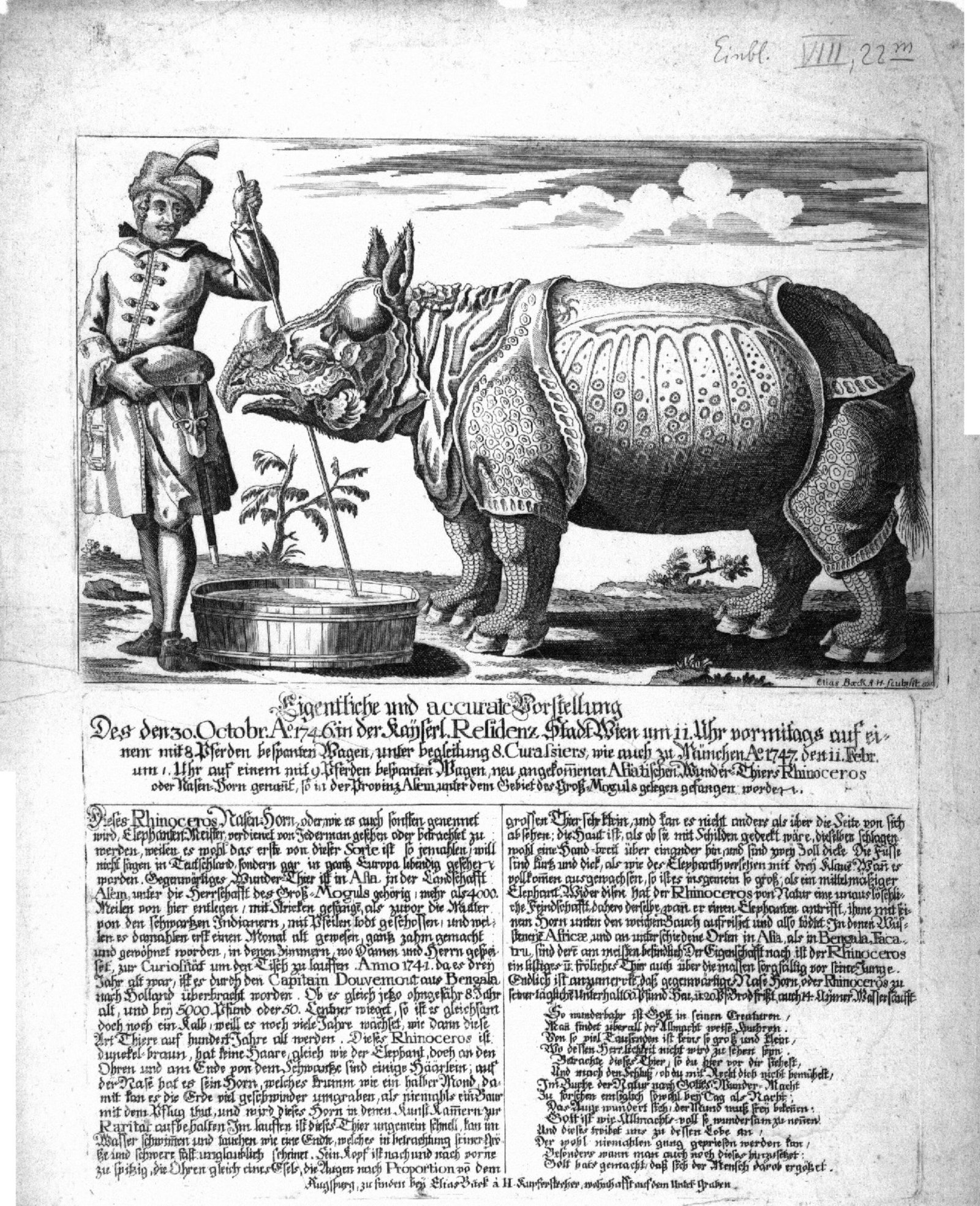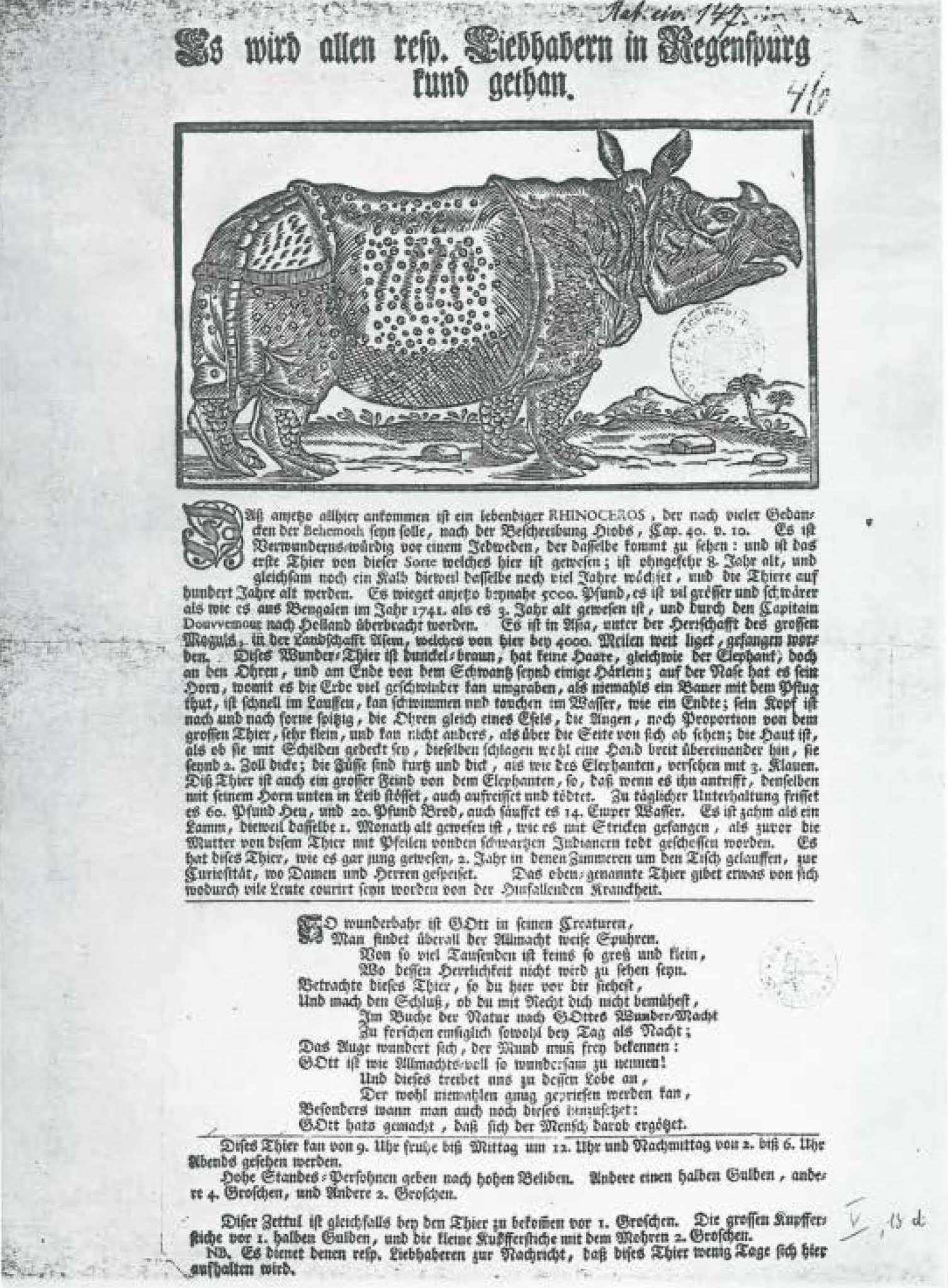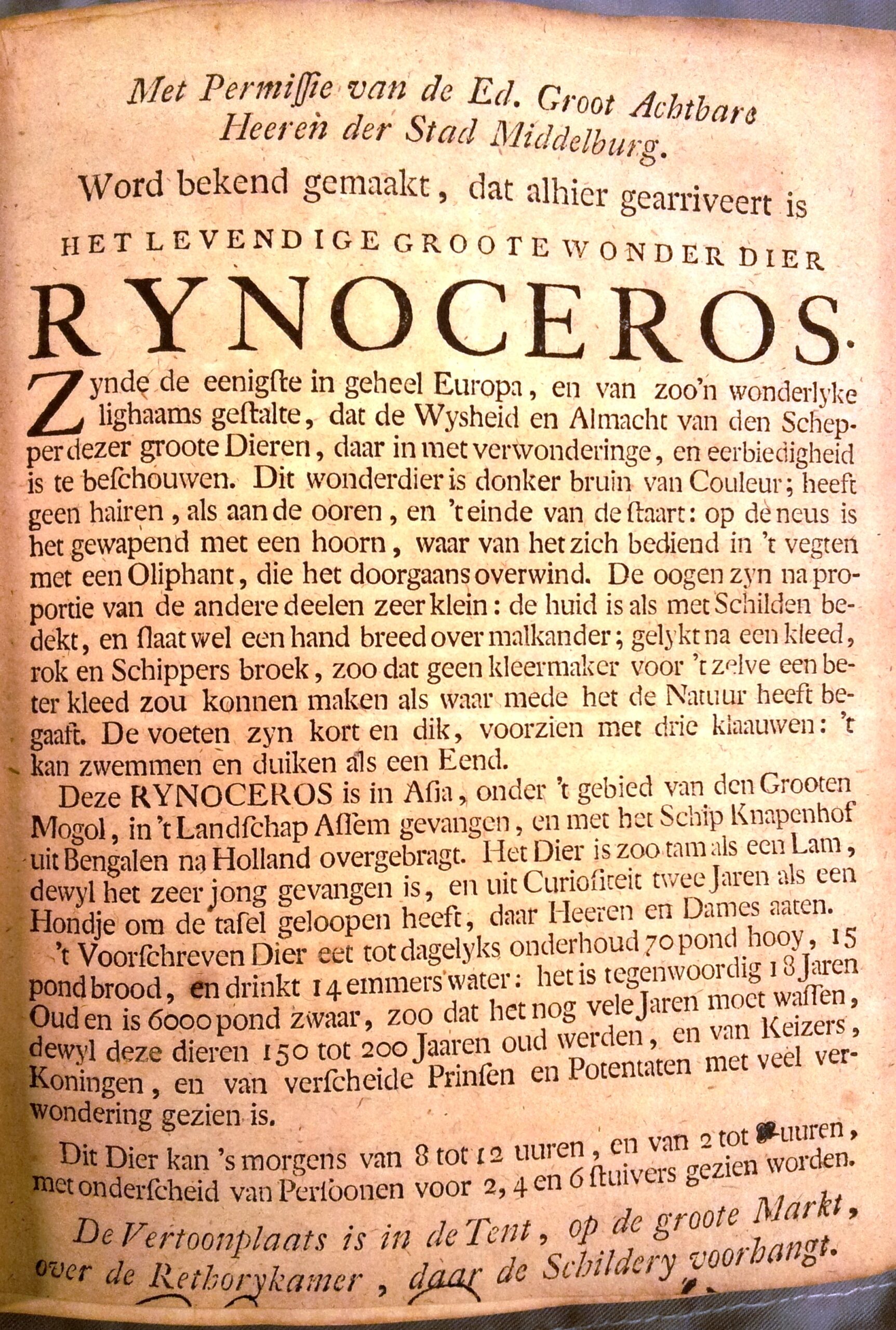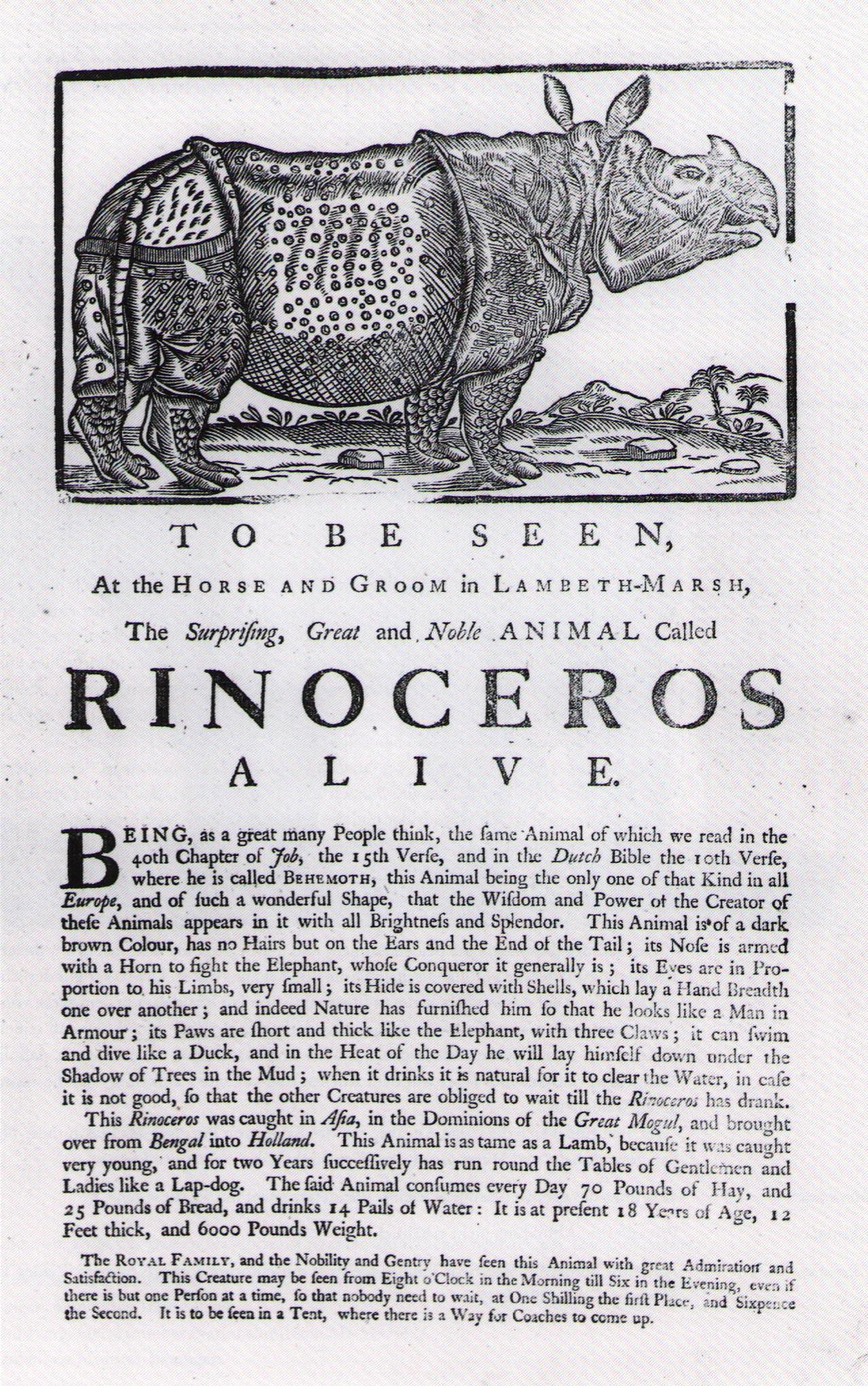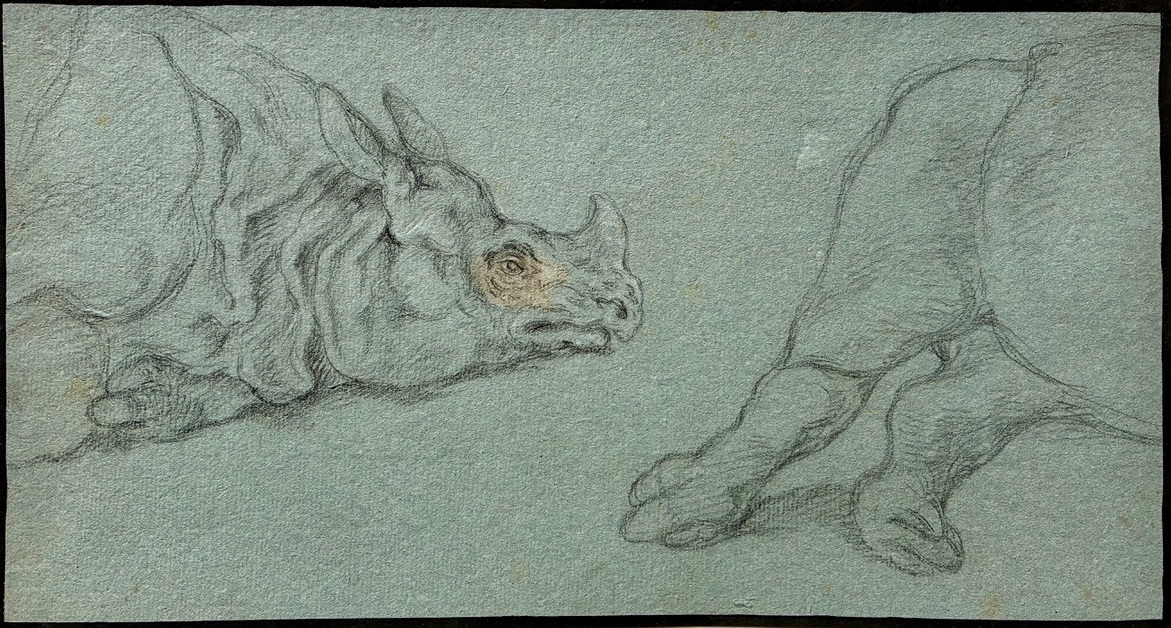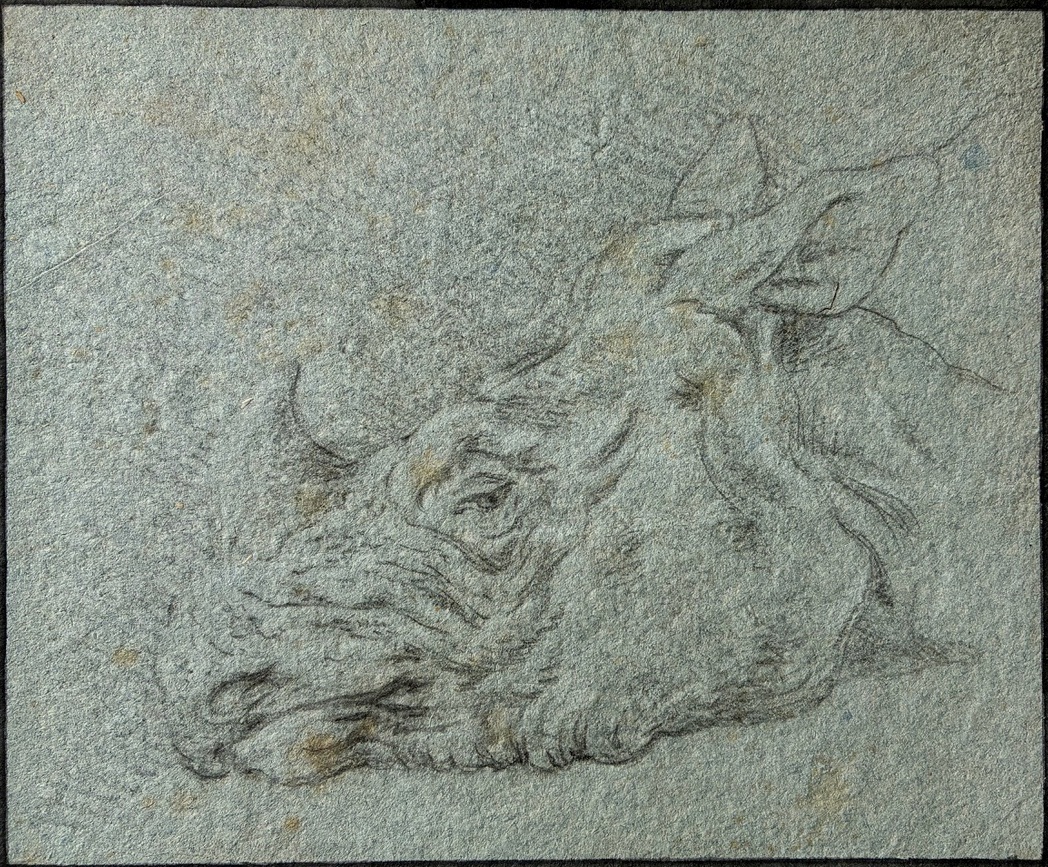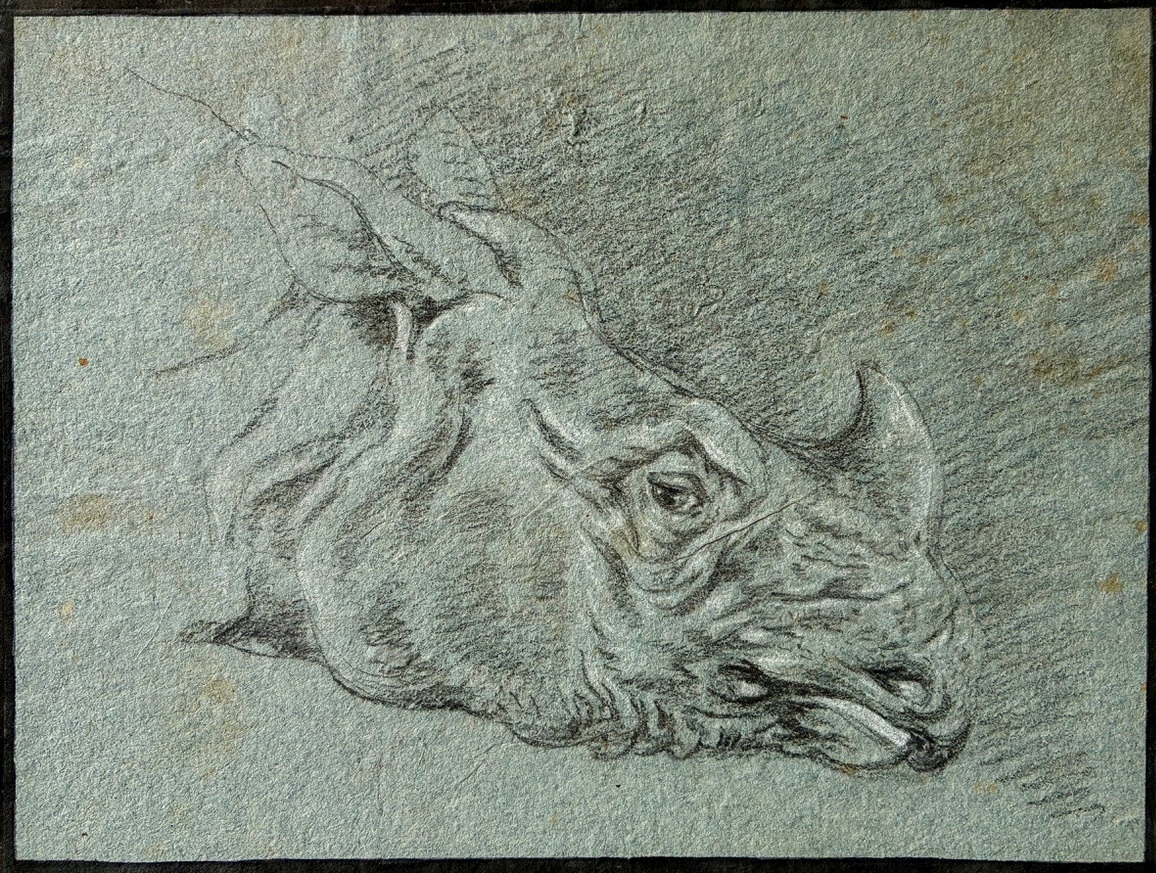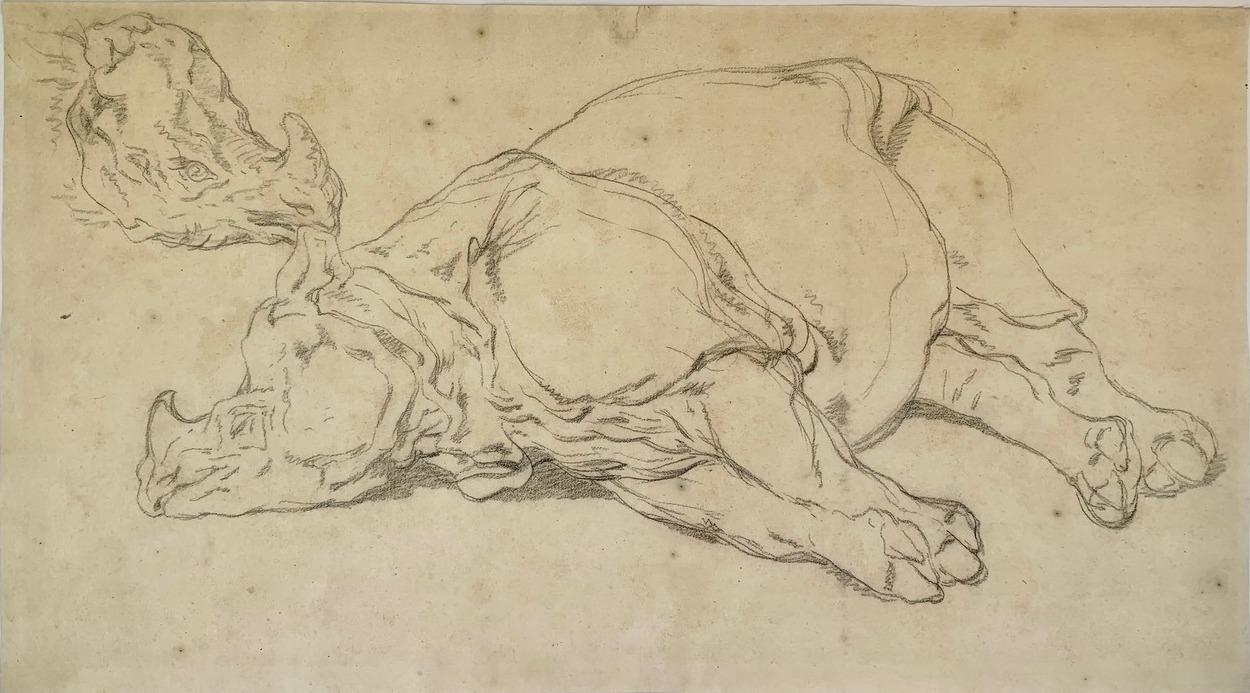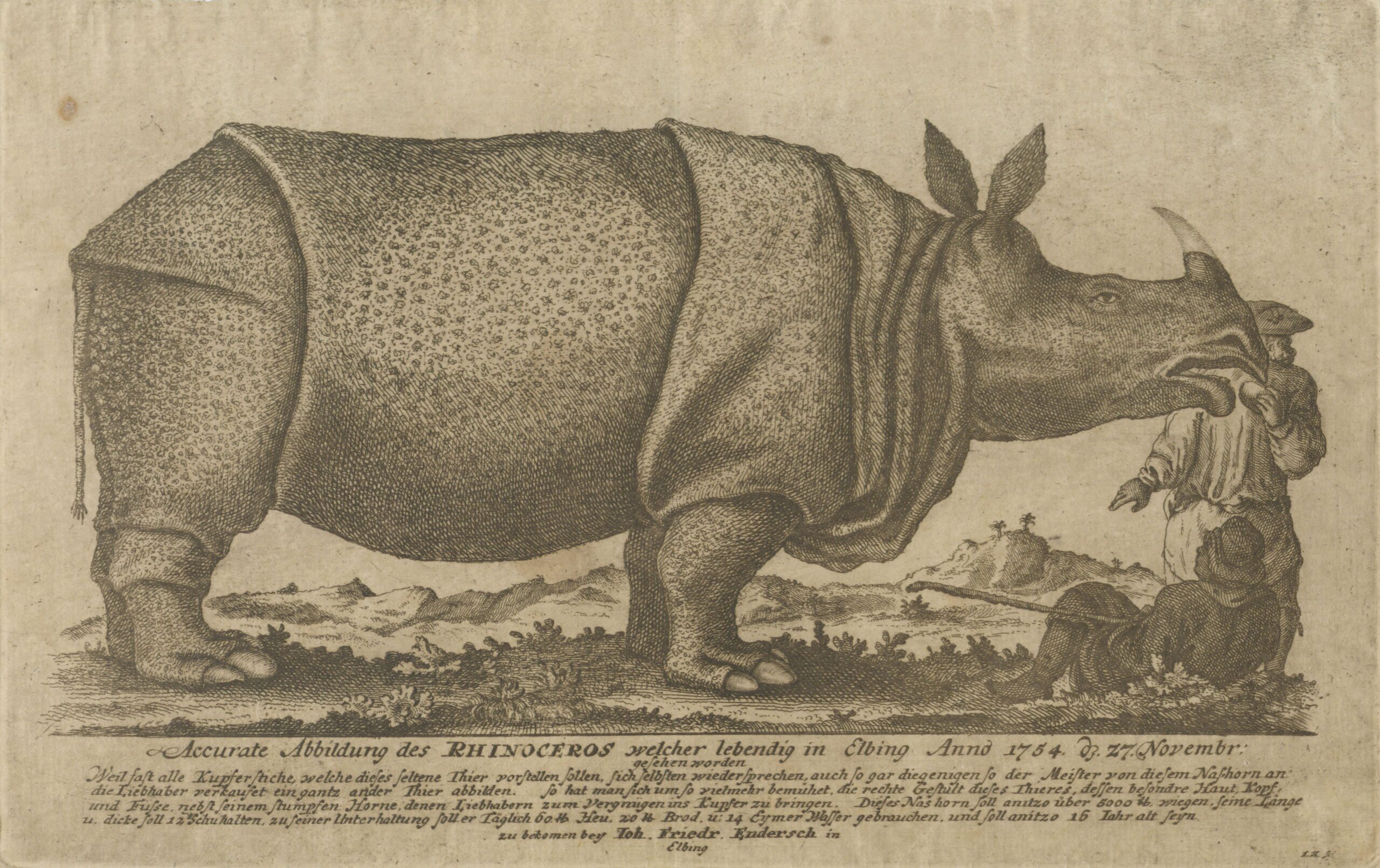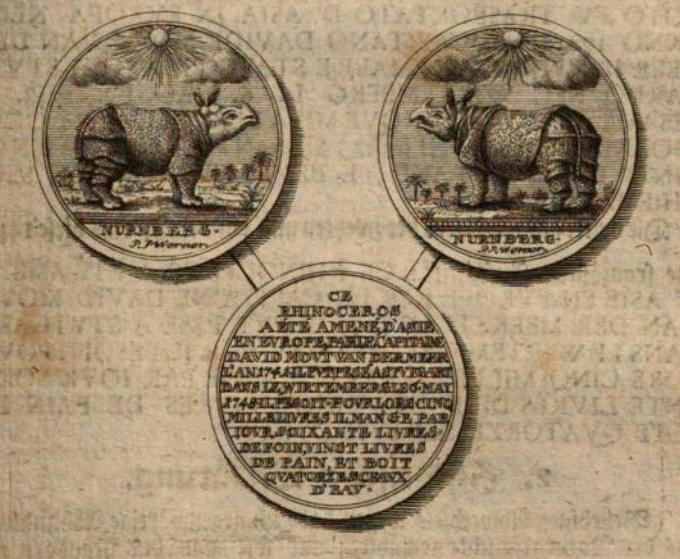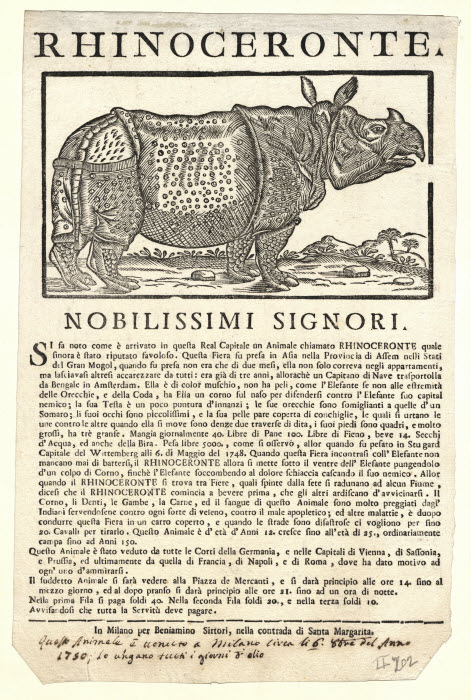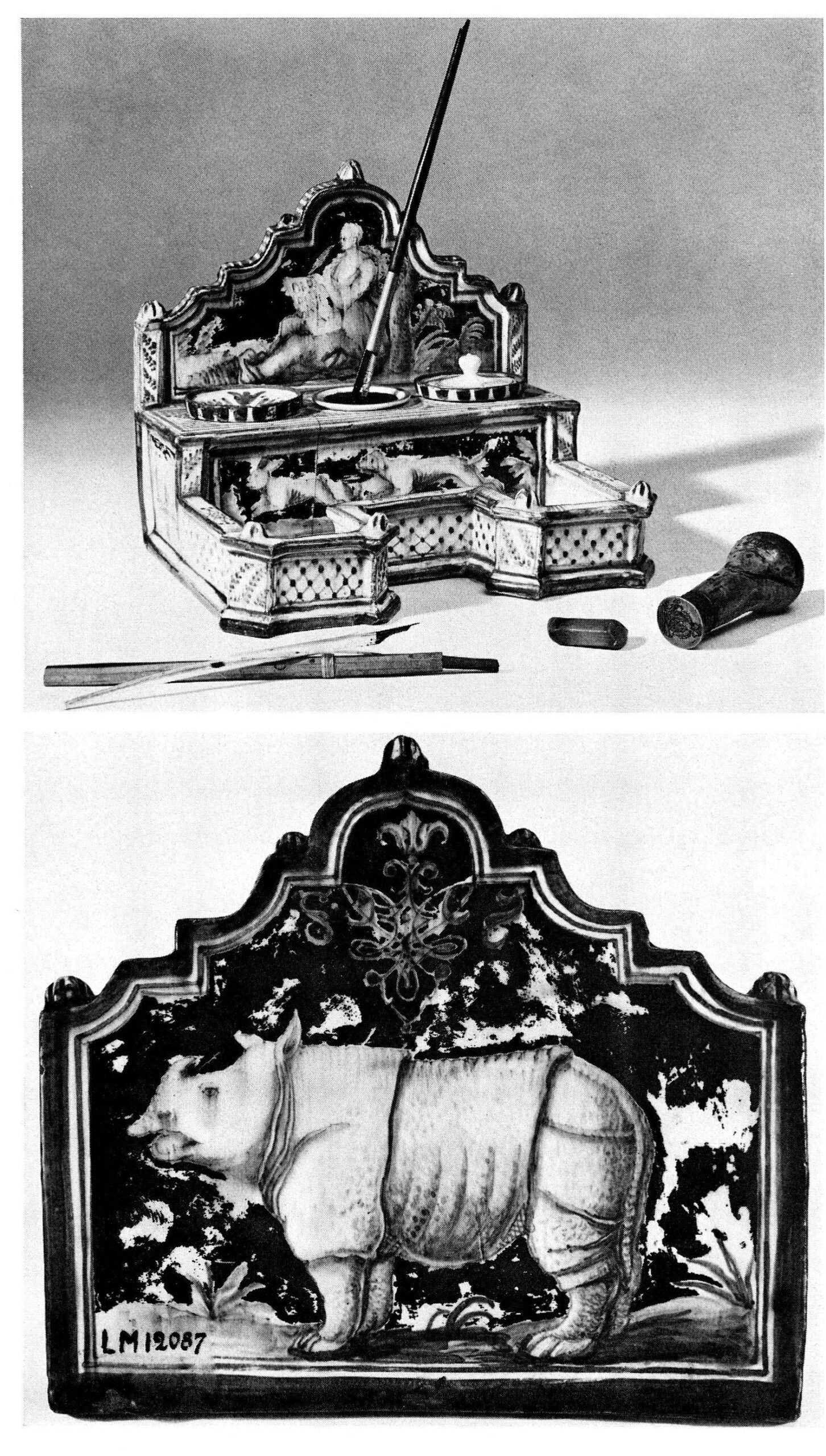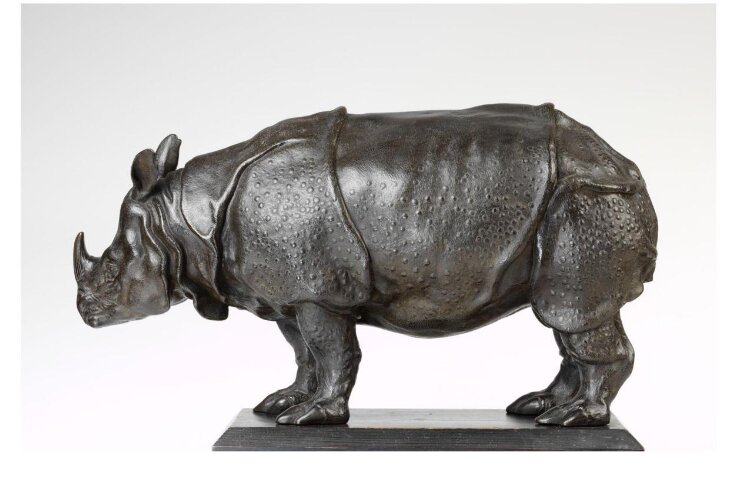


General notices refer to the rhinoceros in Rome in 1749 or 1750 (source 5401; source 5402) or even 1751 (source 5407). More detailed notices state that the animal arrived on 7 March 1750 and was shown in the Piazza della Terme (source 5403; source 5404; source 5405). Clara lost her horn in June 1750 (source 5406). Due to the crowds visiting Rome for the Holy Year, the animal was ordered to leave before the start of the Holy Year which was on 24 December 1749 (source 5401) but, from further history, may have been as late as June or early July 1750. So far no illustrations from Rome have been found.
In the sources for Rimini, Battarra (1773:16) stated that the horn broke off on the way after leaving Rome, on the way to Rimini – which would date the event to July 1750.
Literature
- Verheij 1989: 39
- Heikamp 1980, p. 314
- Clarke 1986: 60
* Holy Year 1750 proclaimed by Pope Benedict XIV (1675–1758) – born Prospero Lorenzo Lambertini – on 5 May 1749, to begin on Christmas Eve, 1749 and to extend throughout the next year until Christmas 1750.
Source 5401. Breviario Istorico for 1749
Douwe Mout 1758. Breviario istorico che restringe quanto di più memorabile contiene la storia sacra e profana dalla creazione del mondo sino all’ esaltazione al som mo pontificato di Clemente XIII. Bassano, A Spese Remondini di Venezia, vol. 2, pp. 477-478
The Italian National Library attributes this to Giuseppe Remondini (1672–1742), part of a publishing house in Bassano del Grappa
The online copy dated Lugano, 1758 has manuscript addition that this is the work of Juan Sianda (1784–1765) Cisterciense, author de el Lexicon Polemicum, etc.
edn 1758, vol. 2, pp. 477-478
edn 1761, vol. 2, pp. 191-192
edn 1796, vol. 2, p. 182
Original text (Italian) – 1758 edition
[p. 477-478] 1749. Nel corrente anno in Italia, un Mostro mai piu quivi veduto detto il Rinoceronte, suvvi condotto da un Capitano Olandese, stato preso a Bengala, provincia appartenente al gran Mogol nell;’Indie vicino al Gange, che ha lesue sorgenti nelle monti del Tibet …
Avvicinandosi sempre piu l’Anno Santo, per togliere ogni motivo di distrazione diedesi ordine che derto Mostro si facesse partire da Roma
English translation
In the current year 1749 in Italy, a Monster never seen there again called the Rhinoceros, led there by a Dutch Captain, was captured in Bengal, a province belonging to the great Mogul in the Indies near the Ganges, …
As the Holy Year approached ever closer, to remove any reason for distraction, orders were given that said Monster be sent away from Rome.
Sianda, G. 1761. Breviario istorico restringe quanto di piu memorabile contiene la storia sacra, e profana dalla creazione del mondo sino all’esaltazione al sommo pontificato di Clemente XIII P.O.M. [2nd edition]. Spese Remondini, Stamperia di Bassano.
Original text (Italian) – 1761 edition
[1761, p. 191] 1749. Nel corrente anno in Italia, un Mostro mai piu quivi veduto detto il Rinoceronte, suvvi condotto da un Capitano Olandese, stato preso a Bengala, provincia appartenente al gran Mogol nell’Indie vicino al Gange, che ha lesue sorgenti nelle monti del Tibet, attraversa molti Regni, siscarica con due bocche nel Golfo di Bengala: è questo uno de’ Fiumi più rinomati per la chiarezza delle sue acque, ricche d’oro, e di pietre preziose, ed abbondante nelle sue spiaggie di Coccodrilli; del Rinoceronte ne fa menzione Giobbe al Capitolo 40. è inimico implacabile dell’ Elefante, [192] ed ha un corno sopra del naso. Nella corporatura raffigura da lontano un Bue di smisurata grossezza, a proporzione di questa mangia 60. libbre di fieno, 20. di Pane il giorno, bevendoſi 14. secchi d’ acqua; è molto mirabile la di lui pelle coperta quasi come di conchiglie di colore cangiante tra il paonazzo, ed il bigio. Avvicinandosi sempre più l’ Anno Santo, per togliere ogni motivo di distrazione diedesi ordine che detto Mostro si facesse partire da Roma.
English translation
In the current year in Italy, a monster never seen before, called the Rhinoceros, brought there by a Dutch captain, was captured in Bengal, a province belonging to the great Mogul in India near the Ganges, which has its sources in the mountains of Tibet, passes through many kingdoms, and empties into the Gulf of Bengal through two mouths: this is one of the most renowned rivers for the clarity of its waters, rich in gold and precious stones, and abundant in crocodiles on its beaches. Job mentions the Rhinoceros in Chapter 40. It is an implacable enemy of the elephant, and has a horn above its nose. In size, from a distance, it resembles an ox of enormous size, consuming 60 pounds of hay and 20 pounds of bread a day, and drinking 14 buckets of water. Its skin, covered almost like shells, is remarkable, its color changing from purple to gray. As the Holy Year approached, to remove any distractions, the order was given for the said monster to be shipped out of Rome.
Source 5402. Beckmann, Historische Beschreibung, for 1750
Beckmann, J.C. 1751. Historische Beschreibung der Chur und Mark Brandenburg nach ihrem Ursprung. Berlin
Original text (German)
. . . ist auch A. 1749. noch in Genua in Italien und 1750. in Rom gezeiget worden
Source 5403. Diario Ordinario, 14 March 1750
Douwe Mout 1750. Diario Ordinario, Roma no. 5094, 1750 March 14.
Newspaper published in Rome: Nella Stamperia del Chracas, presso San Marco al Corso.
Quoted Verheij 1989: 39
see Heikamp 1980, p. 314; Clarke 1986: 60
Arrived last Saturday = 7 March 1750 [14 March is also Saturday]
Original text (Italian)
14 March 1750
Sabato arrivo in Roma in un carro coperto tirato da 4 bovi, un animale chiamato Rhinoceronte, quale è stato già veduto in Germania, in Francia, e ultimamente in Napoli; egli ora si fa vedere in un gran casotto nella Piazza alle Terme, dalle ore 14 fino al mezzo giorno, e dalle ore 20 fino a notte, col pagarsi per i primi luoghi due paoli per testa, per li secondi un pavolo, e per gl’ultimi bajocchi cinque, senza esserne esente la servitù.
English translation
14 March 1750. Saturday arrival in Rome in a covered wagon drawn by 4 oxen, an animal called Rhinoceros, which has already been seen in Germany, in France, and lately in Naples; it is now seen in a large hut in the Piazza alle Terme, from 2 pm until midday, and from 8 pm until night, with the first places being paid two paoli per head, for the second one pavolo, and for the last five bajocchi, without the servants being exempt.
Source 5404. Gazette Bolognesi, for 14 March 1750
Bologna Gazette 1750. Gazette Bolognesi 24 March 1750.
Original text (Italian)
Roma, 14 Marzo [1750]
Grande è il concorso anche di Nobiltà, che si porta ad osservare lo scritto Rhinoceronte, quale è già stato veduto in Germania, in Francia, e ultimammente in Napoli, e che ora si fà vedere in un gran Casotto nella Piazza delle Terme. La detta Fiera dicesi essere stata presa in Asia nella Provincia di Assem nelli stati del Gran Mogol, e che allora non avesse piu che due mesi, ma allorchè poi un Capitano di Nave transportolla da Bengale in Amsterdam ella aveve già trè anni. Il suo colore è di muschio, e non ha peli, se non alle estremità delle orecchie, e della coda. Ha un corno sul naso; la testa un poco puntuta dinanzi; le orecchie simiglianti a quelle di un Sommaro; gli occhi picciolissimi; la pelle coperta a guisa di conchiglie, che si urtano l’una contro l’altra quando si muove; le piedi quadri, e molto grossi, senza due traversi di dita, ed ha trè granfe. Pesa 7500. libre Romane, e angia gionalmente 45. libre Romane di Pane, e 100. libre di Fienn, e beve 14. secchi d’acqua, ed anche della birra; effendosi osservato avere per naturale nemico d’Elefante, con cui incontradosi ferocemene combatte.
English translation
There is also a great attendance of the Nobility, who come to observe the Rhinoceros, which has already been seen in Germany, in France, and lately in Naples, and which is now on display in a large Casotto in the Piazza delle Terme.
Source 5405. Kurtz-gefasster historischer Nachrichten, for March 1750
Douwe Mout 1750. Kurtz-gefasster historischer Nachrichten zum Behuf der neuern europäischen Begebenheiten 1750 (12): 229.
Original text (German)
Merkwürdigen Veränderungen, in Martii 1750.
Nun ist auch das bekannte Rhinoceros von Neapolis allhier angelangt, und ein Hauß von Bretten wird dasselbe gebaut worden.
Source 5406. Mention on Dutch broadsheet – lost horn in June 1750
[1752] – Poster of the Dutch Rhinoceros – In Dutch (Elseviers Weekblad) – refer Amsterdam source 6401
Rookmaaker & Monson 2000, nr. 15
Faust 2003: 108, no. 718.9
Mentions the date June 1750 when she lost her horn in Rome
“op zyn neus wast zyn horen weder, dewyl hy zyn eerste horen in de maent juny 1750 tot Roomen verwisselt heeft:”
Source 5407. Diccionario Castellano (1768) for 1751
* Esteban de Terreros y Pando (1707–1782)
Terreros y Pando, E. de 1768. Diccionario Castellano con las voces de ciencias y artes y sus correspondientes en las tres lenguas Francesa Latina É Italiana. Volume 3. Madrid: En La Imprenta de la Viuda De Ibarra, Hijos Y Compania.
Original text (Spanish)
[p. 379] Rinoceronte, animal feroz, cuadrupedo, mui corpulento y parecido al elefante; llámase así á causa de un cuerno que le sale de la nariz; las piernas son cortas, y las uñas hendidas. Fr. Rhinoceros. Lat. Rhinoceros. It. Rinoceronte. En Roma el año de 1751 se vió un Rinoceronte traido por el Capitan David Mout van Derméer, de la Provincia de Assem á Amsterdam el año de 1741; de aquí pasó á Astutgardo en Bitemberg en 6 de Mayo de 1748; entonces pasaba su peso de cinco mil libras, y si hemos de creer á los que escriben, comía cada dia 60 libras de heno, 20 de pan, y bebia 14 calderos de agua: su color era de café obscuro.
English translation
In Rome in the year 1751, a rhinoceros was seen, brought by Captain David Mout van Derméer from the Province of Assem to Amsterdam in the year 1741; from there it went to Stuttgard in Wurttemberg on May 6, 1748; at that time its weight exceeded five thousand pounds, and if we are to believe those who write, it ate every day 60 pounds of hay, 20 of bread, and drank 14 cauldrons of water: its color was dark brown.