

PORTICI, harbour of Naples, Italy
Reports from Naples below.
The ship carrying Clara arriving in Portici, the harbour of Naples, was announced in a dispatch for a newspaper on 2 December 1749 (source 5351; source 5352) and again in January 1750 (source 5353).
Literature
- Van der Ham 2022:184, note 212
Source 5351. Gazette d’Amsterdam, 26 December 1749
Douwe Mout 1749. Gazette d’Amsterdam No. 103, 1749 December 26, p.6.
Original text (French)
CIII. Suite des Nouvelles d’Amsterdam, du 26 Decembre 1749
De Naples le 2 Decembre [1749]. Il est entré dans ce Port une Gallote Françoise de Marseille ayant à bord un Rhinoceros d’une grosseur extraordinaire. Cet Animal a été mis dans la Menagerie du Roi.
English translation
From Naples on 2 December [1749]. A French Gallote from Marseilles entered this Port having on board a Rhinoceros of extraordinary size. This Animal was placed in the King’s Menagerie.
Source 5352. Haerlemsche Courant, 25 December 1749
Douwe Mout 1749. Opregte Haerlemsche courant 25 December 1749: 2.
Original text (Dutch)
Napels, 3 December. Een Rinoceros is deezer dagen met een Frans Galjoot alhier aangekomen, en na de Koninklyke Menagerie gebragt.
English translation
From Naples on 3 December [1749]. A French Gallote from Marseilles entered this Port having on board a Rhinoceros of extraordinary size. This Animal was placed in the King’s Menagerie.
Source 5353. Gazette de Berne, 3 January 1750
Douwe Mout 1750. Gazette de Berne 1750 January 3, p. 1.
Original text (French)
Le Rhinoceros, don’t on a parlé precedemment, est allé debarquer à Naples, ou il doit etre presenté au Roi des Deux-Siciles, comme il l’a été à plusieurs autres Princes de l’Europe.
English translation
The Rhinoceros, which was previously mentioned, has landed at Naples, where it is to be presented to the King of the Two Sicilies, as it has been to several other Princes of Europe.
Naples – Italy
For arrival in December 1749, see Portici, Italy, the harbour for Naples.
It was said that she was heading to the Menagerie of the King of Naples and Sicily (no information about the menagerie was found) – see also notices for Civita Vecchia.
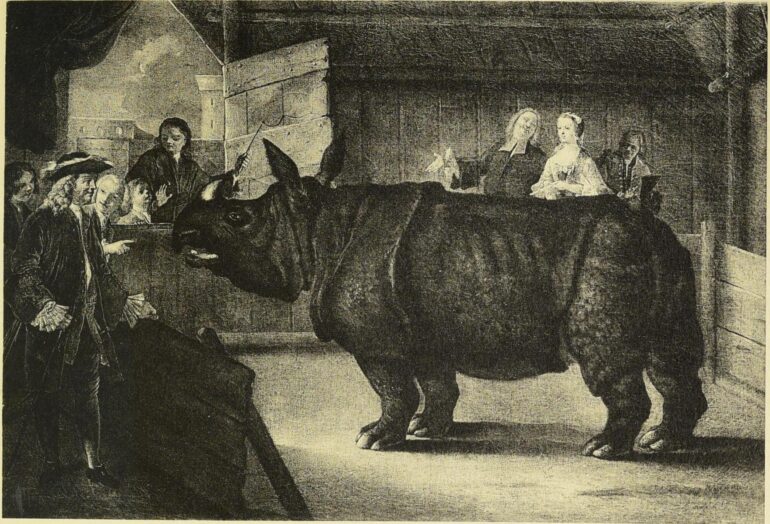
The King was Charles VII, King of Spain, Naples and Sicily 1734–1759. There is one notice that the rhinoceros had been shown in Naples before arrival in Rome (source 5354). A painting attributed to the Neapolitan School shows Clara in a booth near the Castelnuovo, Naples (source 5355).
Literature
- Clarke 1986: 59, pl. VII
- Walter 1994, fig. 9
- Van der Ham 2022:184, note 213 – after Gazette de Berne, see Portici Source 5353
Source 5354. Diario Ordinario 14 March
Douwe Mout 1750. Diario Ordinario, Rome, No. 5094, 14 March 1750, p.5
For full entry, see Rome source 5403
Original text (Italian)
Rhinoceronte, quale è stato già veduto in Germania, in Francia, e ultimamente in Napoli;
English translation
The rhinoceros, which was taken around Germany and France, and lately in Naples.
Source 5355. Painting of Neapolitan School
The Rhinoceros in its Booth near the Castelnuovo, Naples
Neapolitan School, artist unknown – possible attribution to Guiseppe Bonito (1707–1789)
Painting, Oil on canvas, 52 x 70.5 cm
[Former] Collection of the Duke of Wellington
Literature:
- Walter 1994, fig. 9 – illustrated
- Fiocco 1929: 489 – illustrated
- Delorenzi 2010: 305 – illustrated
- Clarke, T.H. 1986. The rhinoceros from Dürer to Stubbs 1515-1799. London, pl. VII – illustrated from a Private English collection
Clarke 1986, p. 59
Painted in its stall by an unidentified artist of the Neapolitan School. Through the booth’s half-door can be seen a tower and battlements of the Castelnuovo. On the far right perhaps Douwe Mout. The person on the left looking at the rhino might be Bernardo, Marquess Tanucci (1698–1783), statesman of the Kingdom of Naples-Sicily
Clarke refers: Exhibition catalogue: Civilta del ’700 a Napoli, 1734–1799 (1980). [not seen]
Note the long horn, which points at execution of the painting before Clara shed her horn in Rome, in 1750.
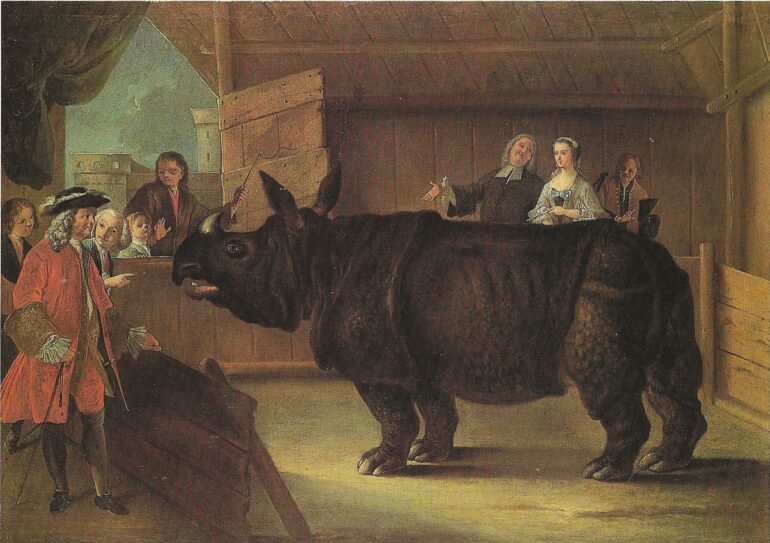
Delorenzi, Paolo. 2010. Alessandro Longhi, pittore e incisore del Settecento veneziano. Thesis presented to Università Ca Foscari di Venezia
[p. 305, no. R226] Painting, collection unknown. Attributed to Alessandro Longhi by Fiocco (1929). Said to be in the style of Lorenzo Gramiccia (d.1796) by Pignatti (1968)
Fiocco, G. 1929. Die venezianische Malerei des siebzehnten und des achtzehnten Jahrhunderts. Firenze
Figure 87 A, p. 77. Attributed to Alessandro Longhi in Venice – as variant of painting in Sammlung Salom, Venice