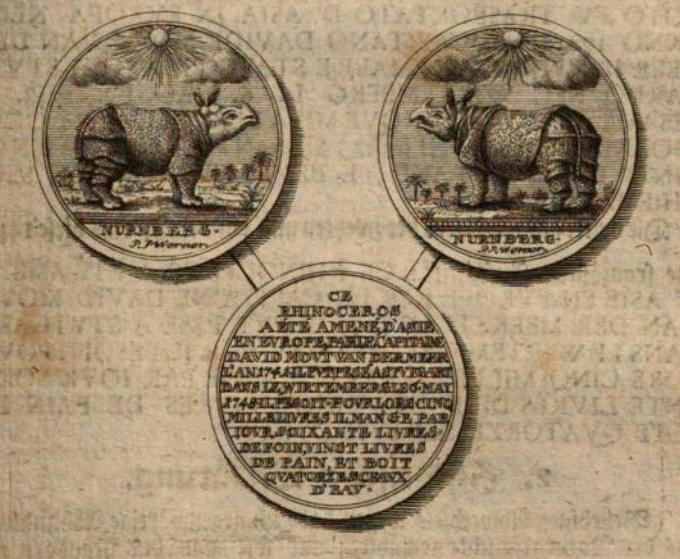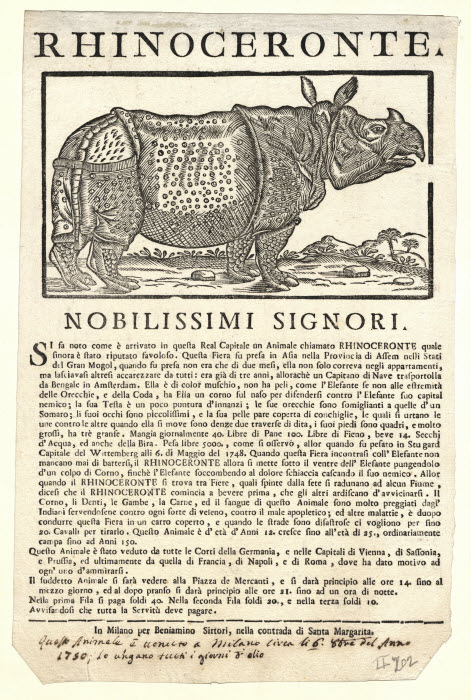


Kennedy examined her mouth in 1748 (source 4101). The size and weight of Clara was given for 1748 (also found 1747) when she was in Stuttgart. This is found on broadsheets (source 4102, source 4103) and medals by P.P. Werner (source 4104) and Veit Schrempf (source 4105, source 4106). The date of taking her weight at Stuttgart is found in the treatise by Ladvocat 1749 (source 4107) and on some of the commemorative medals struck in 1748, both stating 6 May 1748.
Ruler of Stuttgart in 1748 was Carl Eugen (Charles Eugene), Duke of Württemberg (1728–1793), ruled 1737–1793
Zurich to Stuttgart is 220 km towards north. From Stuttgart to Augsburg is 160 km towards east.
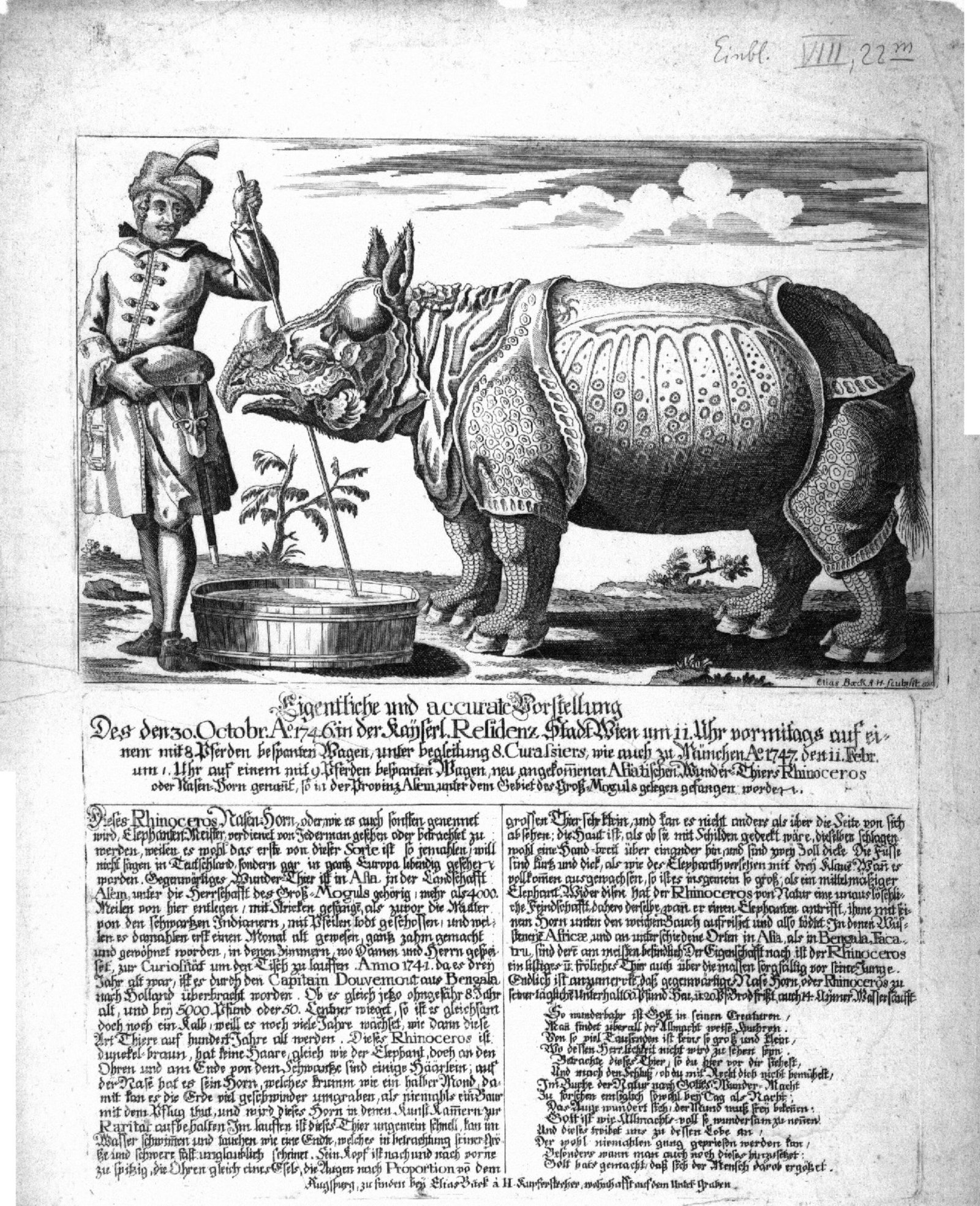
Broadsheet (and other sources) give size of Clara: 8 feet 7 inch high (262 cm), 12 feet long (365 cm), 12 feet circumference (365 cm), weighing 5000 pounds (about 2500 kg).
Literature
- Petzsch, H., 1935. Das erste indische Nashorn in Deutschland. Aus der Heimat 48 (12): 372–374, fig. 1 [medal]
- Rookmaaker 1973: 50
- Rookmaaker 1998: 65
- Clarke 1974: 116
- Emmerig 1978: 21 says maybe from Zurich / Schaffhausen via Strasbourg to Stuttgart. No source give.
Source 4101. Kennedy, Examination of mouth in 1748
*Ildephonse Kennedy (1722–1804), German scientist associated with the Baierische Akademie in Munich.
The author gives the date 1748, but no place.
Kennedy, I. 1785. Abhandlung von einigen in Baiern gefundenen Beinen. Neue philosophische Abhandlungen der Baierischen Akademie der Wissenschaften 4: 1–48, pls. 1–3.
Original text (German)
[p.32] Denn ich erinnere mich sehr wohl, das Maul und die Zähne des Rhinoceros, den man im Jahre 1748 in Europa zur Bewunderung herumgeführt hat, mit vielem Bedacht untersucht zu haben. Hauptsächlich habe ich daran wahrgenommen, daß seine vier vordern Zähne vier ziemlich groffe Würfel vorstellen, und daß seine Backen zahne so scharf und schneidend sind, daß er damit Stroh und etwas dickere Bäumaste so leicht entzwey bricht, als wären sie mit einer Scheere abgeschnitten. Von den Kennzeichen aber, welche wir hier hauptsächlich suchen, war keine Spur anzutreffen, keine hervorragenden Stumpffpigen, keine Höhlungen auf der Oberfläche, mit einem Worte an der ganzen Gestalt keine wahre Aehnlichkeit mit unsern Zähnen, zu geschweigen, daß die Zähne des Rhinoceros viel zu klein sind, als daß zwischen ihnen und den unsrigen nur von weitem eine Vergleichung anzustellen wäre. Der Rhinoceros ist also das Their nicht, welches wir hier aufzusuchen haben.
English translation
For I remember very well having carefully examined the mouth and teeth of the rhinoceros, which was taken around Europe for admiration in 1748. I noticed in particular that its four front teeth resembled four fairly large cubes, and that its cheek teeth were so sharp and cutting that it could easily break straw and somewhat thicker tree branches with them, as if they had been cut with scissors. However, there was no trace of the characteristics we were primarily looking for here: no prominent blunt teeth, no cavities on the surface; in a word, there was no real resemblance to our teeth in their entirety, not to mention that the teeth of the rhinoceros are much too small to allow any comparison to be made between them and ours, even from a distance. The rhinoceros, therefore, is not the animal we are seeking here.
Source 4102. Broadsheet 4 languages, weighing
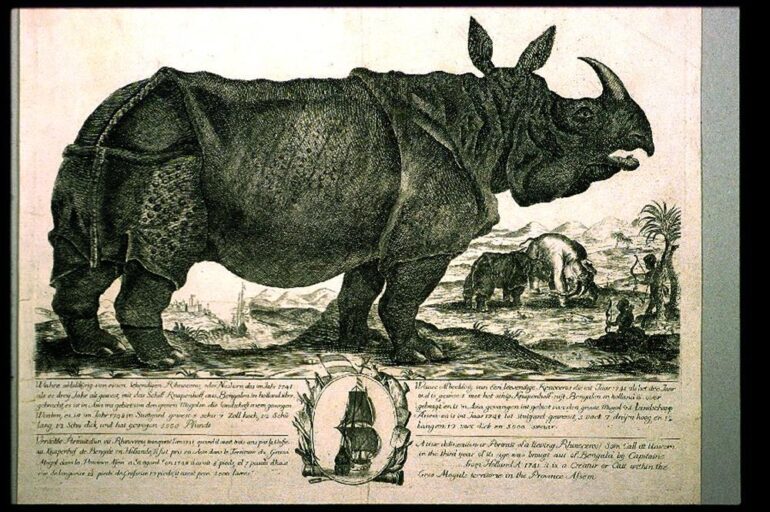
Broadsheet “Wahre Abbildung von einen lebendigen Rhinoceros oder Nashorn”
Large size with vignette and four languages
with details of weighing in Stuttgart in 1748.
Rhino facing right, showing a long horn. Text in four languages: German and French (left) and Dutch and English (right). This is the only example where German replaces the Latin text. Medaillon of ship (Knappenhof ?). In background rhino-elephant fight, and 2 people with arrows
Size 402 x 535 mm
Example:
- Leiden, Museum Boerhaave, P.410 – mmb-web.adlibhosting.com
Literature
- Rookmaaker and Monson 2000, nr. 18
- Faust 2003: 132, nr. 723.5 illustrated – suggests that it was printed after 1758 because no longer portrait of Douwe Mout, and name of captain expunged from English text.
- Verheij 1989, fig.10 – illustrated
- Pieters, F.F.J.M.; Berg, A. van den; Keyser, M., 2002. Menagerieen op de kermis: oorsprong van circus en dierentuin: pp. 58–74, figs. 1–11, In: Jacobs, J. Kennis, kunstjes en kunnen: kermis, de wondere wereld van glans en glitter. Amsterdam, Sun: pp. 1–240 – illustrated p. 65
This broadsheet listed:
Van Marle en De Sille 1908. Catalogus eener fraaie verzameling historie-, spot- en zinneprenten, portretten, topografische afbeeldingen, teekeningen, gravures, boeken en handschriften. Rotterdam, Van Marle.
p.5 no. 49. 1751. “A true delineation or Portrait of a living Rhinoceros (som call itt Unicorn) in the third year of its age, was brought out of Bengala by Capitaine [blank] from Holland Ao 1741” .. “is int Jaar 1748 tot Stuttgard geweest” Afbeelding van het dier, met den kop rechts, onderaan het schip. Anon. kopergravure m. gegrav. onderschrift in duitsch, fransch, nederlandsch en engelsch. Zeer zeldzaam.
https://rhinoresourcecenter.com/library/images/clara-1748-stuttgart/
Broadsheet:
Text below rhinoceros in 4 languages:
[left column, 4 ½ lines]
Wahre Abbildung von einen lebendigen Rhinoceros oder Nashorn, das im jahr 1741 als es dreij Jahr alt gewest, mit das Schiff Knapenhoff aus Bengalen in Holland übergebracht, es ist in Asia ins gebiet von den grossen Mogol in die Landschaft Asem gevangen worden, es ist im Jarhr 1748 in Stuttgard gewest 8 Schu 7 Zoll hoch, 12 Schu lang, 12 Schu dick, und hat gewogen 5000 Pfund.
[left column, 4 lines]
Veritable Portrait d’un vif Rhinoceros transporté l’an 1741 quand il avoit trois ans par le Vaisseau Knapenhof, de Bengale en Hollande. Il fut pris en Asie dans le Territoire du Grand Mogul dans la province Asem. A Stuttgard l’an 1748 il avoit 8 pieds et 7 pouces d’hauteur, de longueur 12 pieds, de grosseur 12 pieds, il avoit pese 5000 livres.
[right column, 4 ½ lines]
Waare Afbeelding van een leevendighe Renoceros die int jaar 1741 als het drie jaar oud is geweest met het schip Knapenhoff uyt Bengalen in Holland is overgebragt en is in Asia gevangen int gebiet van den Groote Mogul in landschapp Assem. En is int Jaar 1748 tot Stuttgard geweest 8 voet 7 duym hoog, en 12 lang en 12 voet dick en 5000 zwaar.
[right column, 4 lines]
A true delineation or Portrait of a living Rhinoceros (som call itt Unicorn) in the third year of its age, was brought out of Bengala by Capitaine [blank] from Holland Ao 1741. It is a Creatur or Catt within the Gros Moguls territorie in the province Assem.
Source 4103. Broadsheet with 8 German cities
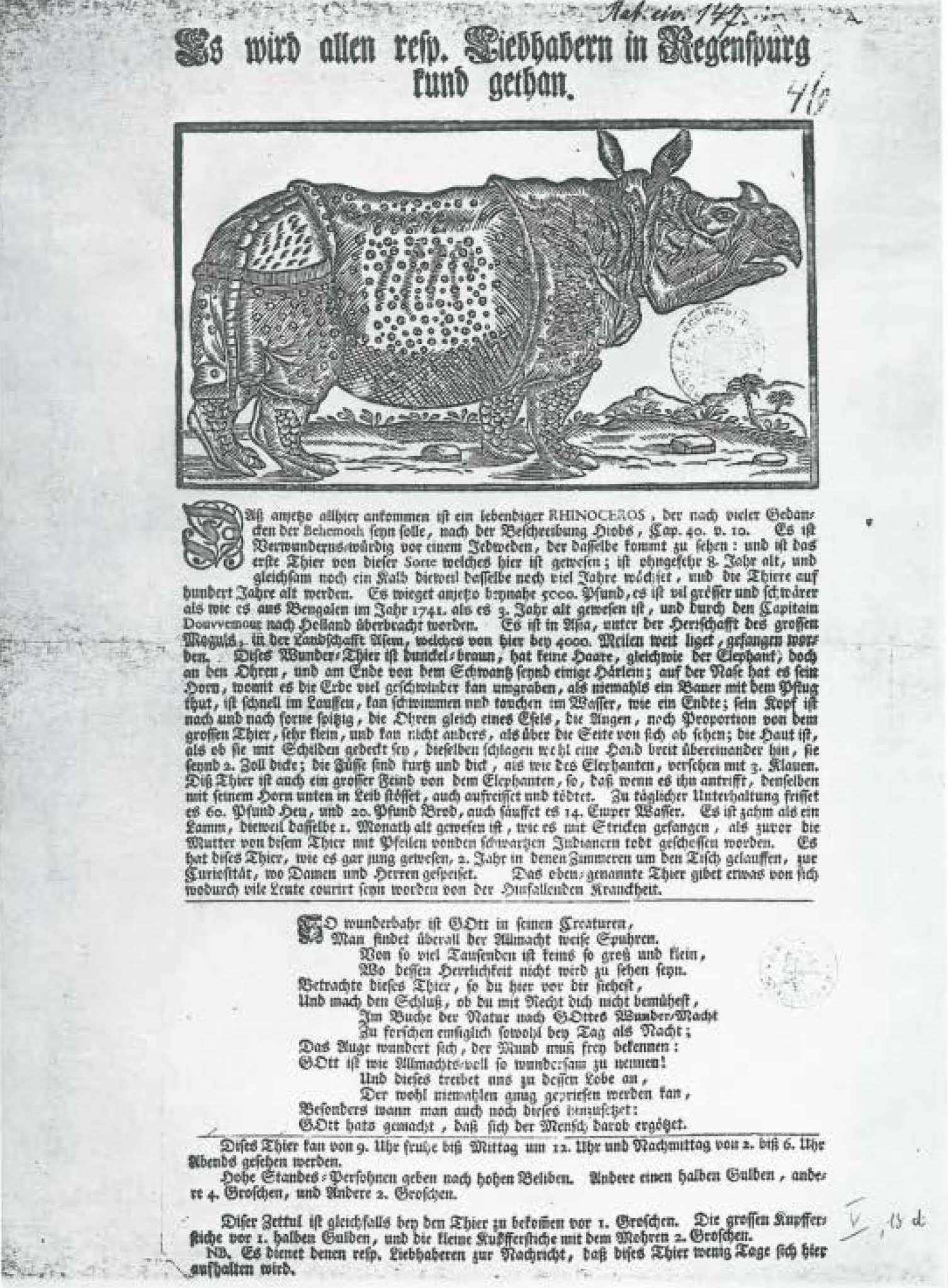
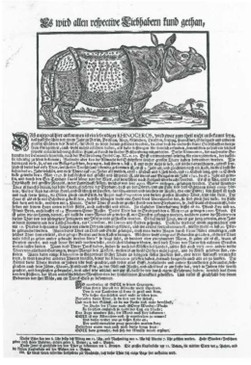
Broadsheet “Es wird allen respective Liebhabern kund gethan,”
Long type, 1748
Broadsheet with Rhinoceros facing right. Text has title of 1 line above rhino. Below rhino is text of 35 lines + 14 lines poem + 5 lines exhibition details. Age of rhino in Bengal here 2 years
Text identical to example in Zürich (including the prices in Batzen)- except the cities of itinerary in second line.
Examples:
- Nürnberg, Germanisches Nationalmuseum, ST IV 10481
- Nürnberg, Stadtbibliothek, Will. Sammlung, IV, 70 (from: Bibliotheca Norica Williana des Altdorfer Professors Georg Andreas Will (1727–1798)). * see Nuremberg
Literature
- Rookmaaker & Monson 2000, sub nr. 3
- Faust 2003 nr. 718.7 – variant with different letter. This has series of 8 German cities, in this order: Berlin, Breslau, Vienna, Munchen, Dresden, Leipzig, Frankfurt (Oder?), Stuttgart.
Here it reads:
— daß dasselbe schon vor einem Jahr zu Berlin, Breßlau, Wien, München, Dreßden, Leipzig, Franckfurt, Stuttgard und andern grossen Städten des Reichs, für geld zu sehen herum geführet worden [etc]
English translation
that it had already been exhibited for money in Berlin, Breslau, Vienna, Munich, Dresden, Leipzig, Frankfurt, Stuttgart and other large cities of the Reich a year ago.
The size is slightly different from elsewhere, also the age when captured:
Und ist dieses das erste Thier, welches in Teutschland lebendig gekommen ist, es ist 9. Jahr alt, und gleichsam noch ein Kalb, dieweil dasselbe bis in das 25. Jahr wächset, und diese Thiere auf 150. Jahre alt werden, es ist 5 Schuh und 8 Zoll hoch und 12 Schuh lang, und 12 Schuh dicke gewesen den 1. May 1747, so daß solches viel grosser und schwerer ist, als wie es aus Bengalen im Jahr 1741 da es 2 Jahr alt gewesen, und durch den See-Capitain David Mout van der Meer, auf dem Meer nach Holland überbracht worden.
English translation
And this is the first animal that has come alive into Germany, it is 9 years old and still a calf, as it grows until the 25th year, and these animals live to be 150 years old, it was 5 feet 8 inches high and 12 feet long and 12 feet thick on May 1, 1747, so that it is much larger and heavier than when it came from Bengal in 1741 when it was 2 years old and was brought to Holland by sea by the sea captain David Mout van der Meer.
Source 4104. Medals from Nuremberg 1748 by P.P. Werner
Refer chapter Neurenberg – source 4356
The medal states that the rhinoceros was weighed in Stuttgart on 6 May 1748.
This date also found on Thevenard broadsheet printed in Paris in 1749. – Source 4805
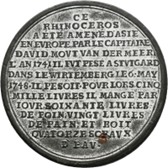
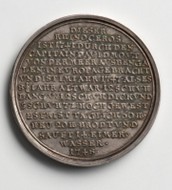
Source 4105. Medal by Veit Schrempf, with locality and date
Veit Schrempf (1716–1773)
Medal, Silver
Weight 21.22 g. – Diameter 39 mm.
Emmerig, H. 1978. Das Rhinozeros in Europa 1741–1758 und seine Medaillen. Money Trend 10 (5): 20–25, 50–52
Emmerig 1978: 24, no. IV – with locality Stuttgardt, and 1748
IV.1
Front: Rhinoceros facing right in landscape.
Front Text: STUTTGARDT
Reverse: German text in 15 lines
Dieser / Rhinoceros / ist 1741 durch den / Capitain David Mout / von der Meer aus Benga / len in Europa gebracht / und ist im Iahr 1747. als es 8 ½ Jahr. Alt war 12 Schuh / lang. Und 12 Schuh dick und / 5 Schuh 7 Z: hoch gewest. / Es frist taeglich 60 Lb. Heu 20 Lb. Brodt. Und / sauft 14. Eimer / Wasser. / 1748
Medal, Silver, 39 mm
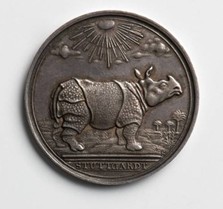
Landesmuseum Württemberg
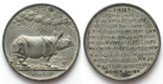
Source 4106. Medal by Anonymous, with date 1748, without place
Emmerig, H. 1978: 24, no. V – with date 1748, but no place
V.1
Front: Rhinoceros facing right in landscape.
Front Text: 1748
Reverse: German text in 12 lines
Dieser / Renoceros / ist 1741 durch den / Cappitein Davit Mout / von der Meer aus Bengalen / in Euroba gebrach und ist / im Iahr 1747. als es 8 ½ Jahr. / Alt war 12 Schu lang gewest / U. 12 Schu dick u. 5 Schu 7 Zol / hoch. Es frisz taeglich 60 / Lb. Hey u. 20 Lb. Brod. U. sauft / 14. Eymer Waser.
Medal: Silver 40 mm – Tin 40 mm.
Source 4107. Ladvocat ‘Lettre’ 1749
Refer Paris source 4752.
Ladvocat, J.B. 1749. Lettre sur le rhinoceros, a M.*** Membre de la Societe Royale de Londres. Paris, Thiboust
Original text (French)
[p. 6] Celui que l’on montre à Paris fut pesé à Stouquarts dans le Duché de Witemberg le 6 Mai 1748. Si l’on croit ceux qui le montrent il pésoit 5000 livres.
English translation
The one shown in Paris was weighed at Stuttgart in the Duchy of Wittenberg on 6 May 1748. If we believe those who show it, it weighed 5000 pounds.