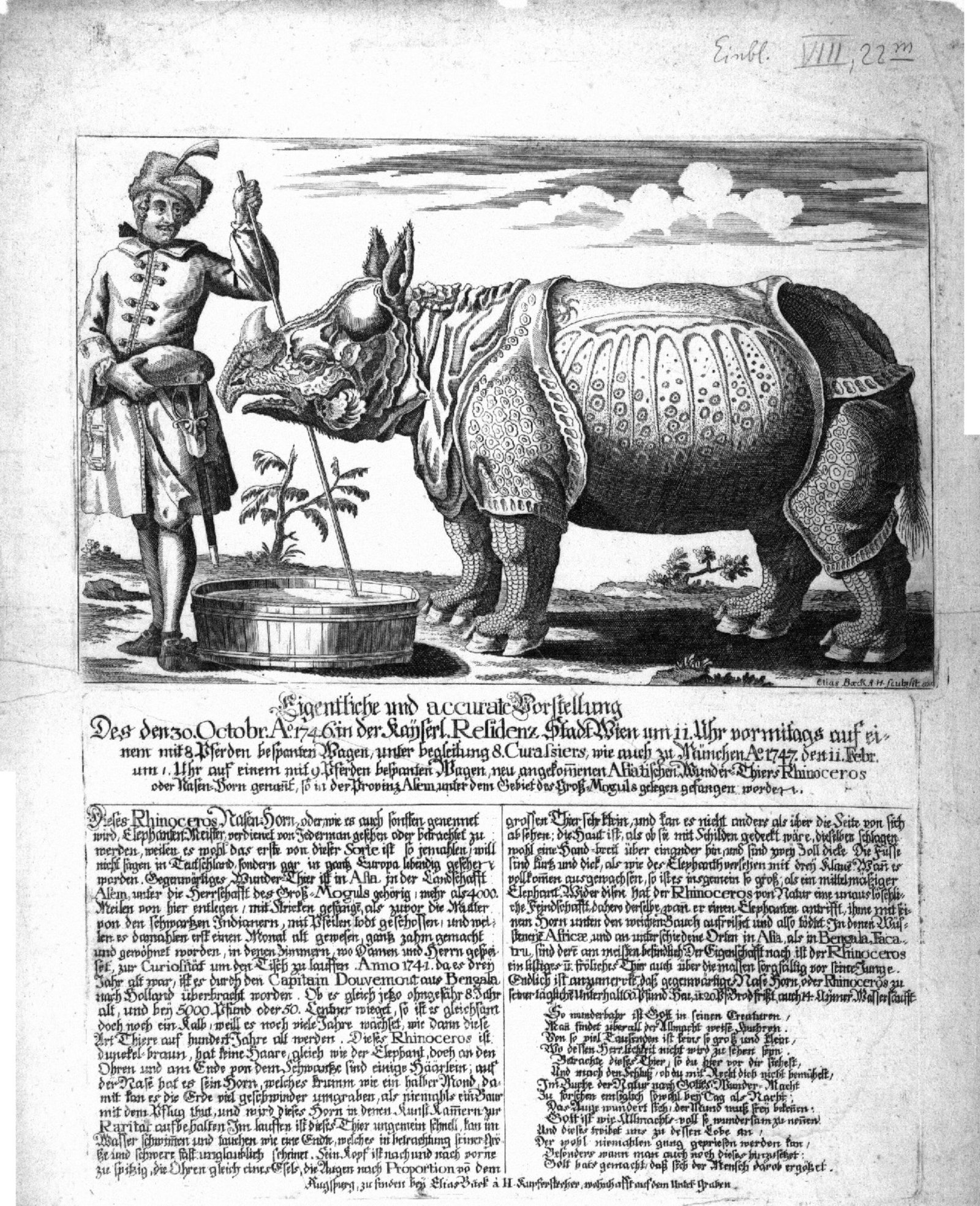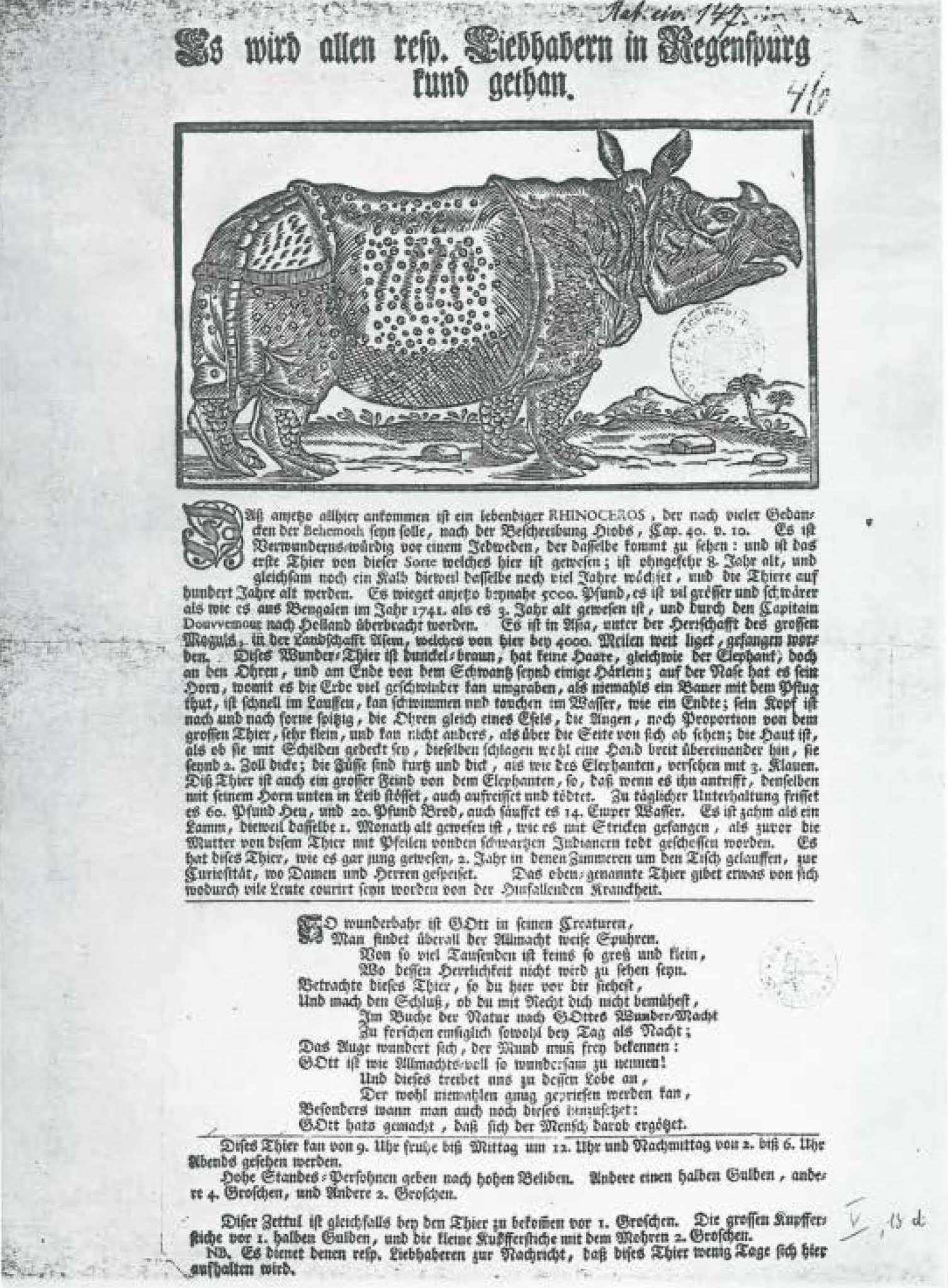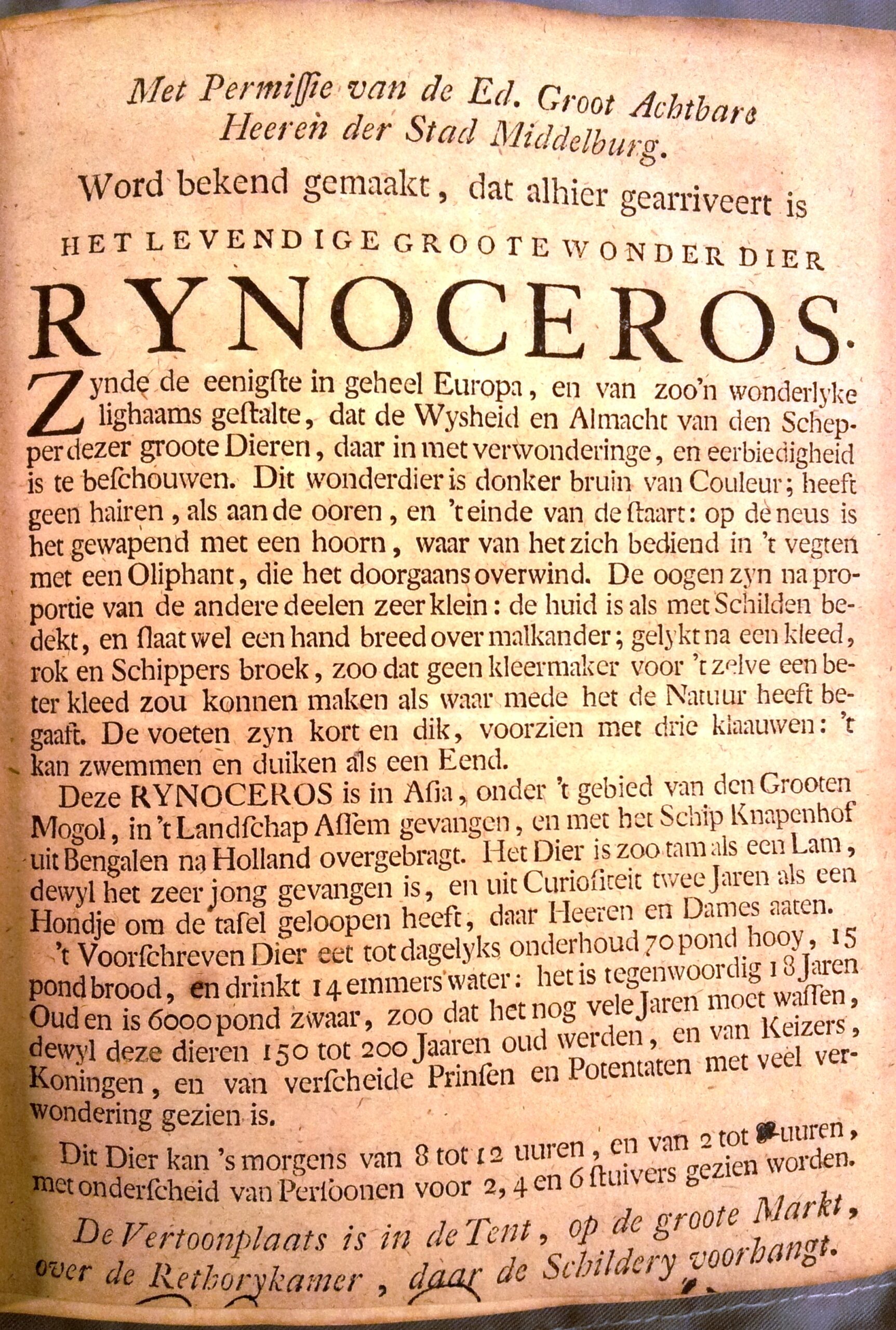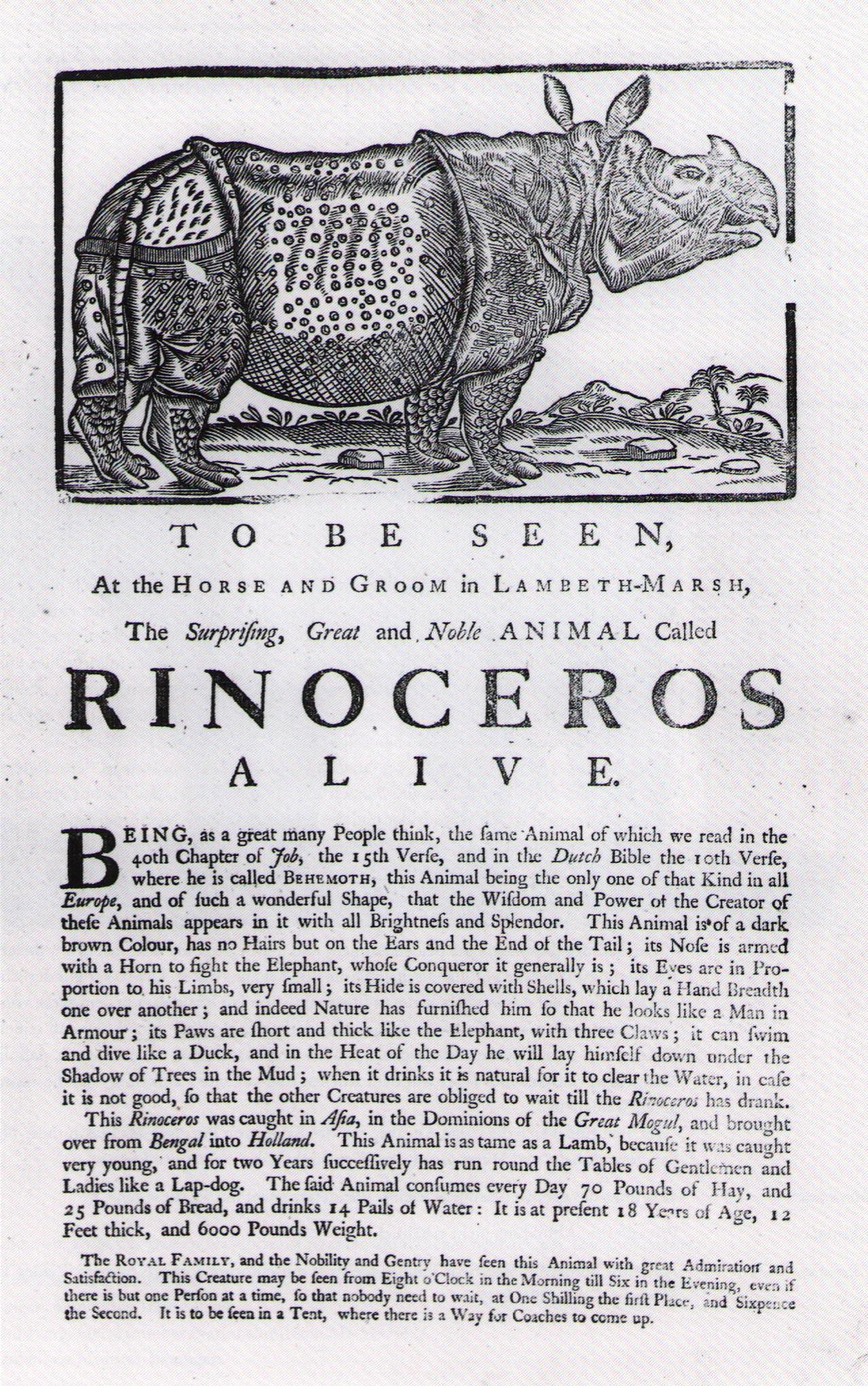


The exhibition in the house of Johan Cordes in the Südstrasse of Braunschweig is advertised on 2 February 1746 (source 2501). The animal was mentioned by Herzogin Philippine Charlotte in March 1746 (source 2502). A drawing was made by Anton August Beck (source 2503), which was then used for two large broadsheets with information in 4 languages (source 2504; source 2505; source 2506). Another broadsheet has an image of a rhino with Dürer-hornlet, with information that it could be seen in the house of Johan Cordes, but without date (source 2507). The length of stay is unknown – Clara reached Berlin in April or May 1746.
Braunschweig is 70 km east of Hanover. Ruled by Charles I, Duke of Brunswick-Wolfenbüttel (1713–1780).
Source 2501. Braunschweigischen Anzeigen, 2 February 1746
Douwe Mout 1746. Braunschweigischen Anzeigen 1746, no. 10, dated 2 February 1746, p. 232.
Newspaper published in Braunschweig from 1745. Copy preserved in Braunschweig, Stadtarchiv, Z1: 1746
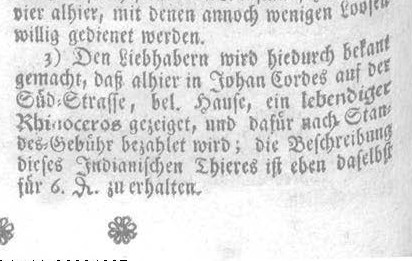
Original text (German)
Den Liebhabern wird hiedurch bekant gemacht, daß alhier in Johan Cordes auf der Süd-Straße, bel. Hause, ein lebendiger Rhinoceros gezeiget, und dafür nach Standes-Gebühr bezahlet wird; die Beschreibung dieses Indianischen Thieres ist eben daselbst für 6 di. [= Dinarius] zu erhalten.
English translation
Enthusiasts are hereby informed that a live rhinoceros is exhibited here at Johan Cordes on the South Street, and a fee is charged for it; the description of this Indian animal can be obtained there for 6 dinars.
Source 2502. Letters by Countess Philippine Charlotte
* Philippine Charlotte (1716–1801), married to the ruler, Charles I.
Droysen, Hans. 1916. Aus den Briefen der Herzogin Philippine Charlotte von Braunschweig 1732–1801. Wolfenbüttel: Zwissler, 1916. pp. 222 (Quellen und Forschungen zur Braunschweigischen Geschichte ; 8).
[partly examined in google snippet]
Original text (French)
(p. 71) [no date] J’ai rendu visite au fameux rhinoceros, qui est la bête la plus hidieuse et laide du monde. Il m’a fait peur en le le voyant et j’ai cru comme Jonas, qu’il m’engloutirait.
(p. 71) Bronsvic 15 février . J’arrêterai avec plaisir le rhinoceros, pour monter sur lui et vous recevoir de cette façon, du moins je me flatte
(p. 73) 25 mars 1746 – J’ai reçu la reponse d’Hannovre du rhinoceros qui partira au premier jour pour Berlin, et il se hatera d’arriver aussitot qu’il sera possible. Je vous avoue que je lui envie son sort.
English translation
(p. 71) [no date] I visited the famous rhinoceros, which is the most hideous and ugly beast in the world. It frightened me when I saw it, and I believed like Jonas that it would swallow me up.
(p.71) Brunswick, 15 February. I will gladly stop the rhinoceros, to mount it and receive you in this way, at least I flatter myself
(p. 73) March 25, 1746 – I received the reply from Hanover that the rhinoceros will leave on the first day for Berlin, and it will hurry to arrive as soon as possible. I confess that I envy its fate.
Source 2503. Drawing by Beck
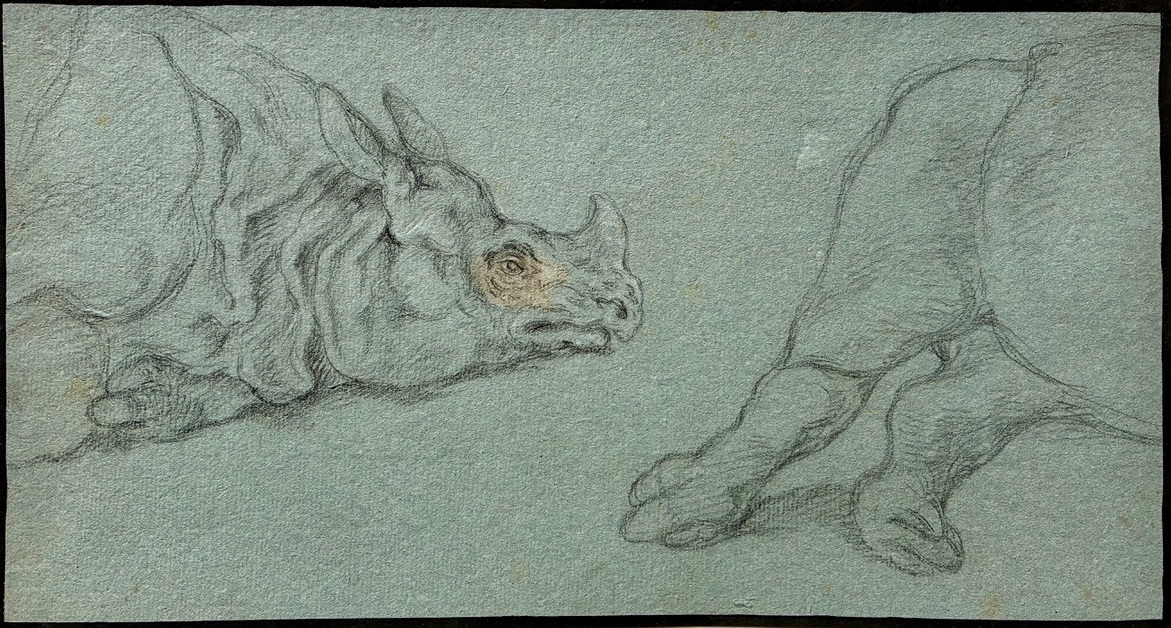
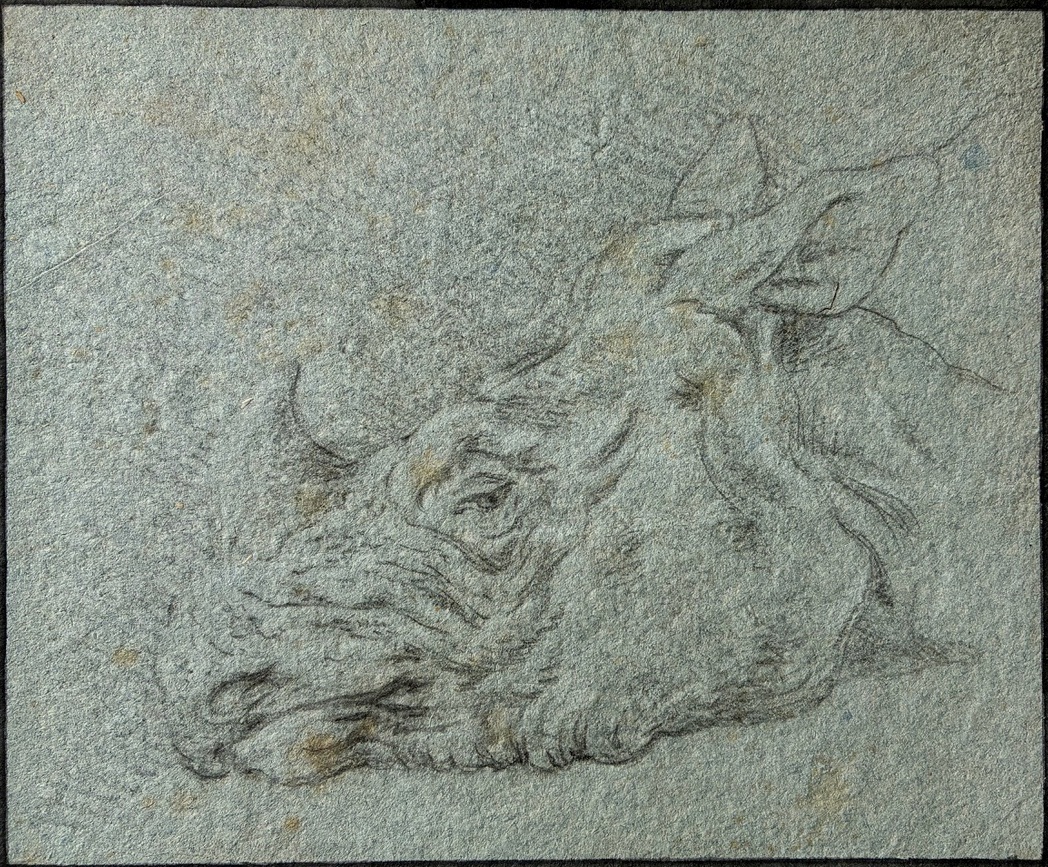
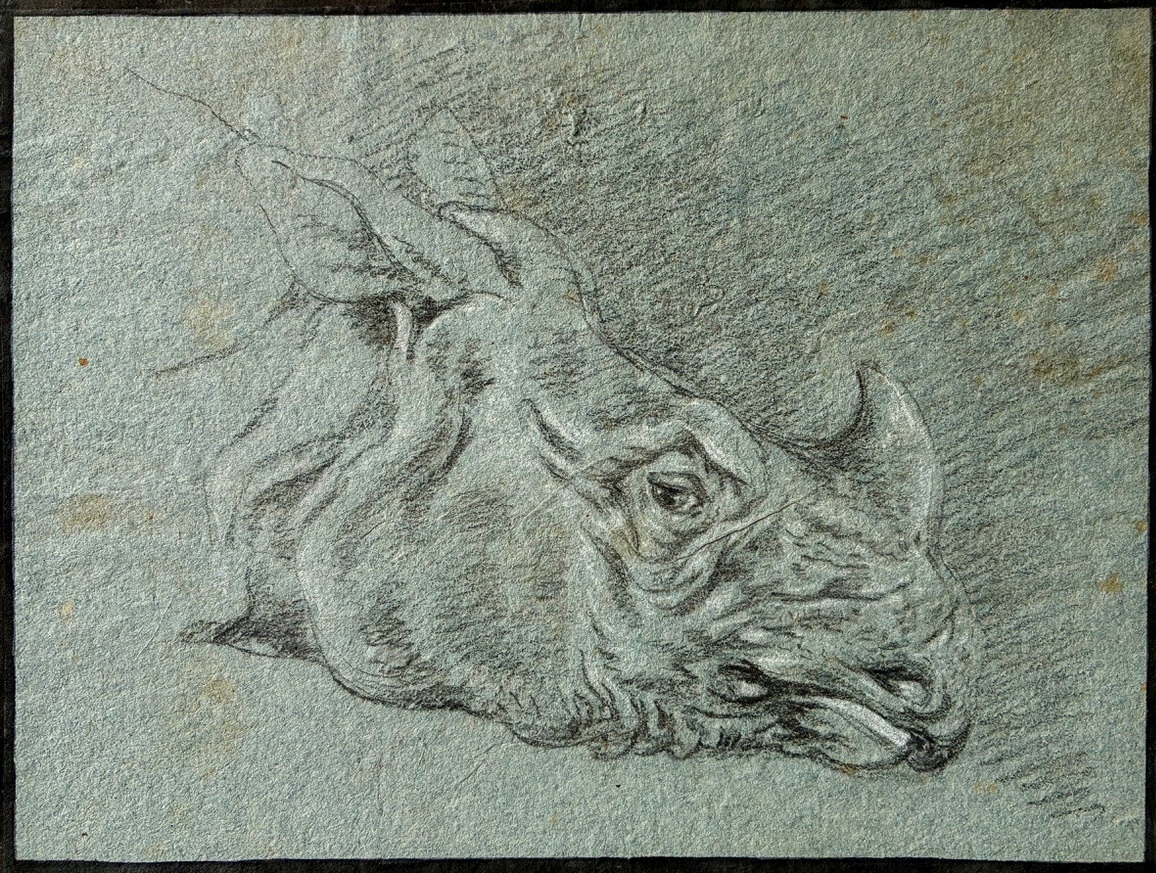
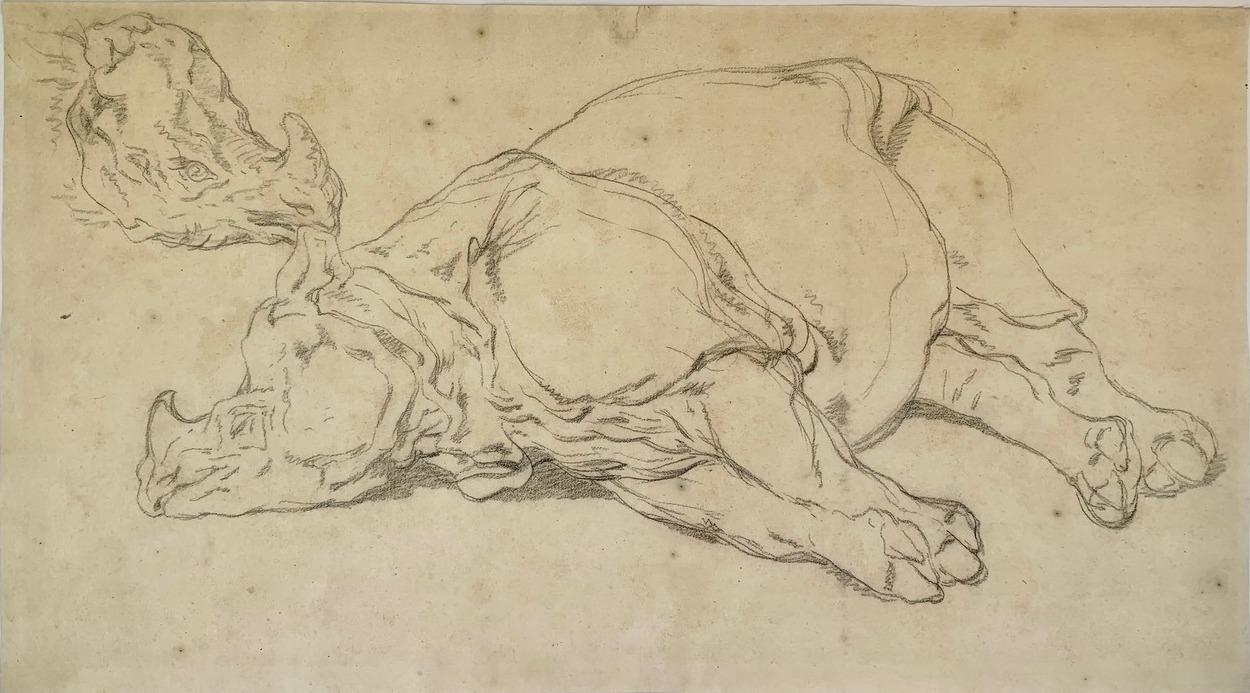
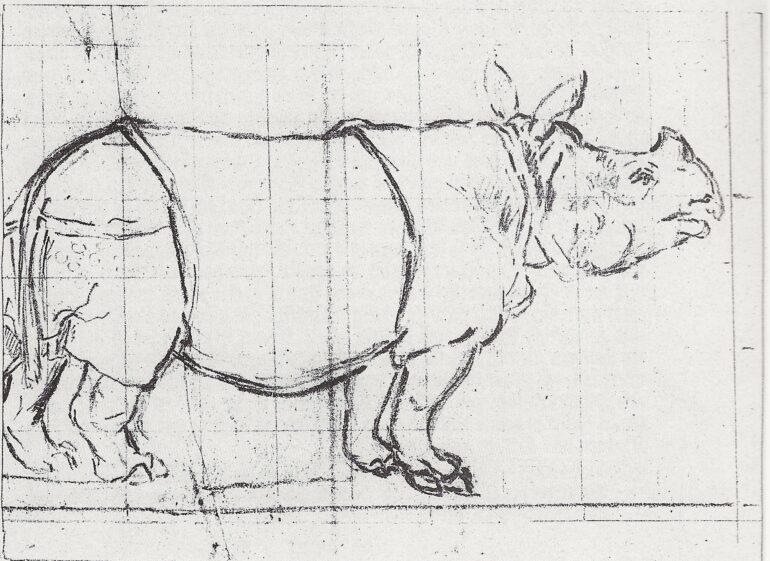
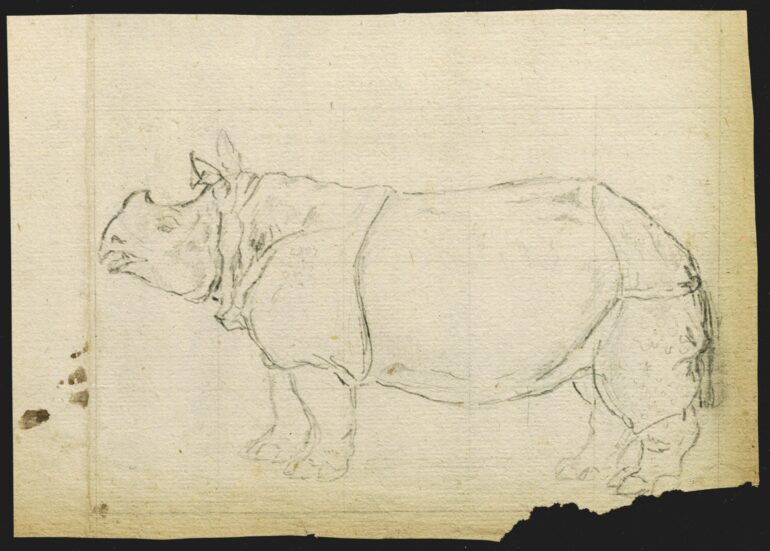
Drawing of Rhinoceros ‘Clara’ in Braunschweig in 1746 by A.A. Beck
* Anton August Beck, 1713–1787, Hofkupferstecher in Braunschweig
Anton August Beck (27 August 1713, Braunschweig – 17 March 1787, Braunschweig) was a German engraver. He was the son of Johann Georg Beck and his wife Anna Elisabeth. On Johann’s death, his student Johann Georg Schmidt married his widow and adopted his business. On Schmidt’s death, Anton took over the business
Example:
Braunschweig, Stadtarchiv, Sign. H V. 82
www.stadtarchiv-braunschweig.findbuch.net
The original drawing, without text, is in the legacy of Johann Schmidt
*Johann Georg Schmidt (1694–1767)
Literature
- Faust 2003:67, no. 707 – illustrated
Source 2504. Broadsheet (A), large size 4 languages, signed by Beck and Schmidt 1746
Anton August Beck (1713–1787), Hofkupferstecher (from 1765) in Braunschweig
Johann Georg Schmidt, Augsburg 1694 – Braunschweig 1767
Engraved by Johann Georg Schmidt
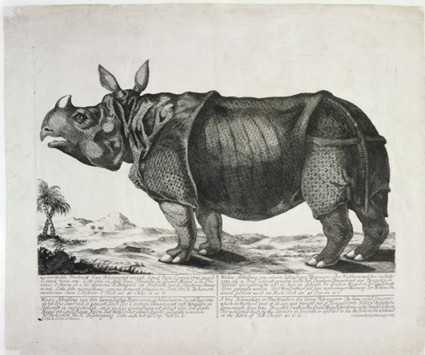
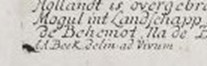
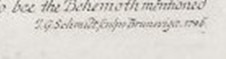
Broadsheet. Rhino facing left. Two palms in landscape. Text in 4 languages (French, Dutch, German, English). Two columns, divided by straight lines (2 horizontal, 1 vertical). Each language text is 5 lines long. No vignet between text. Signed “A.A.Beck delin. ad vivum” and “J.G. Schmidt sculps. Brunsvigae 1746”.
Size 401 x 553 mm
Examples:
- Veste Coburg, Kunstsammlungen, Nr. 10916, Inv. Nr. III. 216.7 – illustrated Faust 2003, no. 707
- Herzog August Bibliothek, Wolffenbüttel, Graph. A3:74 – actually in Herzog Anton Ulrich-Museum, Braunschweig (same inventory number) – illustrated Van der Ham 2022, fig. 25 – diglib.hab.de
https://rhinoresourcecenter.com/library/images/clara-in-braunschweig-1746/
Text below rhinoceros (4 languages: French, Dutch, German, English)
Le veritable Portrait d’un Rhinoceros vivant, lequel dans l’année 1741 quand il avoit trois ans a été pris en Asie dans l’Empire du Grand Mogul à la province d’Assem, et a été amené de Bengale en Hollande par le Capitaine Douwemout. Cette bête est merveilleuse, comme pensent plusieurs, doit être le Behemoth, mentionné dans l’Histoire d’Hiob au 40 Chap. le 10 V.
Waare Afbeelding van een leevendighge Renoceros of Naashooren, die int jaar 1741 als het drie jaar oud is geweest, door den Capteyn Douwemout, uyt Bengalen in Holland is overgebragt; en is in Asia gevanghen int gebiet van den Groote Mogul int Landschapp Assem. Diet Wonderdier souwde zijn na gedaghte van veele de Behemot, na de Beschrijving Jobs aan het 40 Cap. het 10. V.
Wahre Abbildung von einen lebendigen Rhinoceros oder Nashorn, welches im jahr 1741 als es dreij Jahr alt gewesen, durch den Capitain Douwemout aus Bengalen in Holland übergebracht, und in Asia im Gebieth des Großen Mogul in der Landschafft Assem gefangen worden. Diß Wunderthier soll seijn nach einiger Meinung der Behemoth, wovon gedacht wird im Buch Hiob am 40. Cap, im 10 V.
A true delineation or Pourtraicture of a living Rhinoceros (by some called Unicorn) which in the third year of its age, was brought out of Bengala by Capitaine Douwemouth Anno 1741. It is catch’d with in the Grand Moguls territories in the province Assem. This wonderfull beast by the opinion of severals is aßerted to bee the Behemoth mentioned in the Book of Job chapt. 40 v. 10.
[Signed in lower left:] A.A.Beck delin. ad vivum
[Signed in lower right:] J.G. Schmidt sculps. Brunsvigae 1746
Source 2505. Advertisement of broadsheet by Beck
Braunschweigischen Anzeigen, 1746 No. 25, Sonnabend 26 Martii 1746 – Saturday 26 March 1746:
(p. 581) Nachdem die Exemplare der Abbildung des Rhinoceros (Nashorn) vergriffen, und sich unterschiedliche Liebhaber dazu gemeldet; so wird denselben hiemit bekant gemacht, daß der Kupfer-Stecher, Hr. Schmidt alhier, solches Thier auf eigene Kosten, und zwar in vöroger Grösse, nemlich auf einem Royal-Bogen, von neuen in Kupfer gestochen habe, und das Stück auf solchem Papiere für 12, auf schlechterm aber fur 9. mgr. bey demselben zu bekommen sey.
English translation
Since the copies of the image of the rhinoceros (Nashorn) have sold out and various enthusiasts have come forward, it is hereby made known to them that the engraver, Mr. Schmidt here, has re-engraved this animal in copper at his own expense, in the original size, namely on a royal sheet, and that the piece can be obtained from him on this paper for 12 mgr., but on inferior paper for 9 mgr.
Source 2506. Broadsheet, large size, 4 languages, no signatures
Anton August Beck, 1713–1787, Hofkupferstecher in Braunschweig
Johann Georg Schmidt, Augsburg 1694 – Braunschweig 1767
Broadsheet. Rhino facing left. Two palms in landscape. Text in 4 languages (French, Dutch, German, English). Two columns, divided by straight lines (2 horizontal, 1 vertical). Each language text is 5 lines long. No medaillon between text. No signatures. Printed date 1746 lower right.
Size 402 x 548 mm
Literature
- Rookmaaker and Monson 2000, no. 12, fig. 7
- Faust 2003: 68–69, no. 708
- Faust 2003 thinks there are further examples without name or date, of rhino facing left and 4 languages. Because no date mentioned by Drugulin 1867 and Muller 1882.
- Drugulin 1867
- Muller 1882
Drugulin, W.E. 1867. Atlas historique Drugulin: Catalogue d’une precieuse collection de feuilles volantes, estampes allegoriques et satyriques, livres d’entrees, etc. ppur servir a l’histoire publique et intime de tous les pays pendenat les quatres derniers siecles. Leipzig, Drugulin.
(p. 370) – Le veritable Portrait d’un Rhinocerot vivant prise en Asie. Profilansicht nach links. Mit franzosischer, hollandischer, deutscher u. englischer Unterschrift. gr.qu. fol (4321)
Muller, F. 1882. De Nederlandse geschiedenis in platen: beredeneerde beschrijving van Nederlandsche historieplaten, zinneprenten en historische kaarten. Amsterdam, Frederik Muller en Co. vol. 4 (Supplement, aanhangsel, register).
Text:
IV, nr. 3786A. Rhinoceros. – Andere voorstelling, waarop het dier met den kop links gewend staat. Met Holl., Fransch, Duitsch en Engelsch onderschrift. Zonder naam. folio. Drugulin no. 4321. – [Rhino facing left, 4 languages, no name]
Examples
- Paris, Bibliotheque Nationale, Collection Hennin t.100, no. 8631 – illustrated Rookmaaker & Monson 2000, fig. 7
- Gotha, Schlossmuseum, Kupferstichkabinett, 69 [not found in online catalogue, 2025]
- London, British Museum, Print Room, Nat.Hist. Case 244, 1857,0214.445 -https://www.britishmuseum.org/collection/object/P_1857–0214–445
- Nurnberg, Germanisches Nationalmuseum HB 10019/1338
- Zurich, Zentralbibliothek – refer Emmerig 1978, no. 9
- Kunstmuseum Moritzburg Halle (Saale), no. MOIIF00908
- https://st.museum-digital.de/object/107796
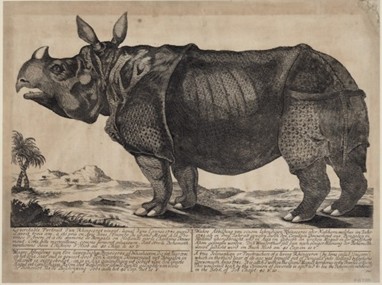
This broadsheet has a small date “1746” in lower right below the english text.
Text below rhinoceros:
Le veritable Portrait d’un Rhinocerot vivant, lequel dans l’année 1741 quand il avoit trois ans a été pris en Asie dans l’Empire du Grand Mogul à la province d’Assem, et a été amené de Bengale en Hollande par le Capitaine Douwemout. Cette bête est merveilleuse, comme pensent plusieurs, doit être le Behemoth, mentionné dans l’Histoire d’Hiob au 40 Chap. le 10 V.
Waare Afbeelding van een leevendighe Renoceros of Naashooren, die int jaar 1741 als het drie jaar oud is geweest, door den Capteyn Douwemout, uyt Bengalen in Hollandt is overgebragt; en is in Asia gevanghgen int Gebiet van den Groote Mogul int Landschapp Assem. Diet Wonderdier souwde zijn na gedaghte van veele de Behemot, na de Beschrijving Jobs aan het 40 Cap. het 10. V.
Wahre Abbildung von einen lebendigen Rhinoceros oder Nashorn, welches im jahr 1741 als es dreij Jahr alt gewesen, durch den Capitain Douwemout aus Bengalen in Holland übergebracht, und in Asia im Gebieth des Großen Mogul in der Landschafft Assem gefangen worden. Diß Wunderthier soll seijn nach einiger Meinung der Behemoth, wovon gedacht wird im Buch Hiob am 40. Cap, im 10 V.
A true delineation or Pourtraicture of a living Rhinoceros (by some called Unicorn) which in the third year of its age, was brought out of Bengala by Capitaine Douwemouth Anno 1741. It is catch’d with in the Grand Moguls territories in the province Assem. This wonderfull beast by the opinion of severals is aßerted to bee the Behemoth mentioned in the Book of Job chapt. 40 v. 10.
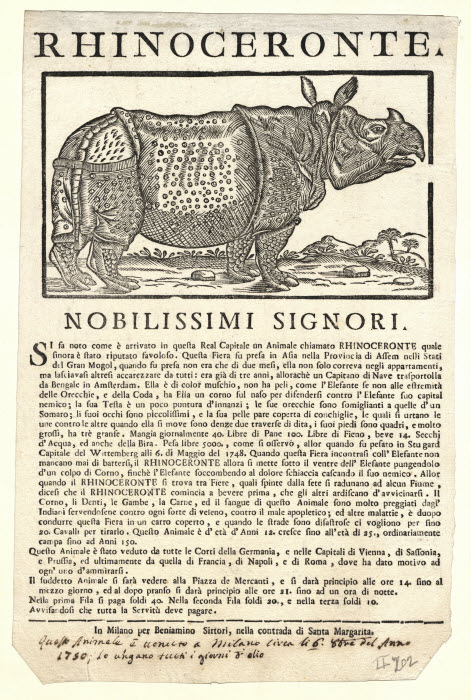
Source 2507. Long broadsheet, medium size with text
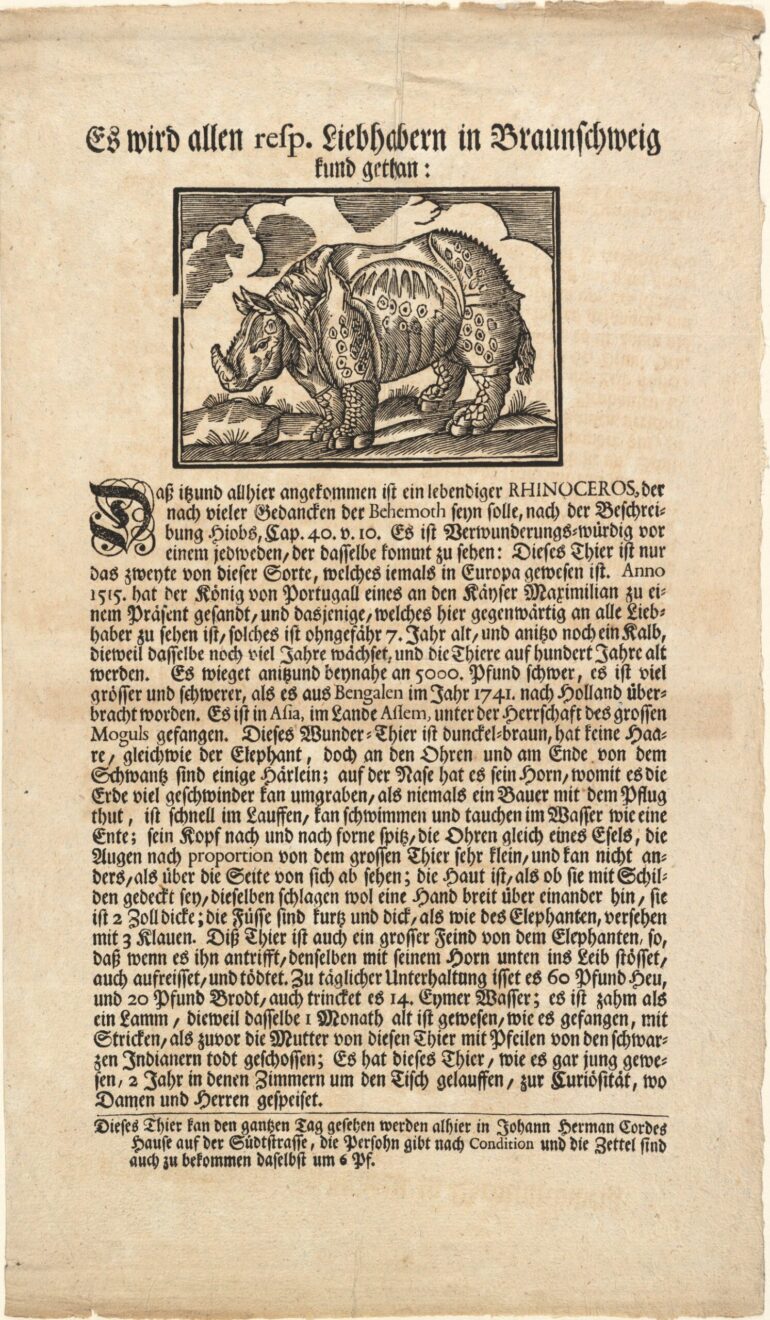
Broadsheet, long type, rhinoceros (after Dürer) facing left. Title in 1½ lines above animal. Text in German below rhino in 31 lines + 3 lines exhibition details.
Size 380 x 226 mm, woodcut of rhino 102 x 141 mm.
Literature
- Faust 2003, nr. 706
Examples:
- Erlangen, Universitätsbibliothek, Flugblätter, A V, 12 or H62/Einblattdruck A V 8 – urn:nbn:de:bvb:29-einblatt-0292–2
Original text (German)
Es wird allen resp. Liebhabern in Braunschweig kund gethan:
Daß itzund allhier ankommen ist ein lebendiger RHINOCEROS, der nach vieler Gedancken der Behemoth seyn solle, nach der Beschreibung Hiobs, Cap. 40 v.10. Es ist Verwunderns- würdig für einen jedweden, der dasselbe kommt zu sehen: Dieses Thier ist nur das zweyte von dieser Sorte, welches iemals in Europe gewesen ist. Anno 1515 hat der König von Portugall eines an den Käyser Maximilian zu einem Präsent gesandt, und dasjenige, welches hier gegenwärtig an alle Liebhabern zu sehen ist, solches ist ohngefehr 7. Jahr alt, und anitzo noch ein Kalb, dieweil dasselbe noch viel Jahre wächset, und diese Thiere auf hundert Jahre alt werden. Es wieget anitzund beynahe 5000 Pfund schwer, es ist vil grösser und schwerer, als wie es aus Bengalen im Jahr 1741 nach Holland überbracht worden. Es ist in Asia, im Lande Assem, unter der Heerschft des grossen Moguls gefangen. Dieses Wunder-Thier ist dunckel-braun, hat keine Haare, gleichwie der Elephant, doch an den Ohren, un am Ende von dem Schwantz sind einige Härlein; auf der Nase hat es sein Horn, womit es die Erde viel geschwinder kan umgraben, als niemahls ein Bauer mit dem Pflug thut, ist schnell im Lauffen, kan schwimmen und tauchen im Wasser wie eine Ente; sein Kopf ist nach und nach forne spitzig, die Ohren gleich eines Esels, die Augen nach Proportion von dem grossen Thier, sehr klein, und kan nicht anders als über die Seite von sich ab sehen; die Haut ist, als ob sie mit Schilden gedeckt sey, dieselben schlagen wol eine Hand breit übereinander hin, sie ist 2 Zoll dicke; die Füsse sind kurtz und dick, als wie des Elephanten, versehen mit 3. Klauen. Diß Thier ist auch ein grosser Feind von dem Elephanten, so, daß wann es ihn antrifft, denselben mit seinem Horn unten in Leib stösset, auch aufreisset und tödtet. Zu täglicher Unterhaltung frisset es 60 Pfund Heu und 20 Pfund Brod, auch sauffet es 14 Eymer Wasser; es ist zahm wie ein Lamm, dieweil dasselbe 1. Monath alt ist gewesen, wie es gefangen, mit Stricken, als zuvor die Mutter von diesem Thier mit Pfeilen von den schwartzen Indianern todt geschossen; es hat dieses Thier, wie es gar jung gewesen, 2 Jahr in denen Zimmern um den Tisch gelauffen, zur Curiosität, wo Dames und Herren gespeiset.
[place]
Dieses Thier kan den gantzen Tag gesehen werden alhier in Johann Herman Cordes Hause auf der Südtstrasse, die Persohn gibt nach Condition und die Zettel sind auch zu bekommen daselbst um 6 Pf.
English translation
It is announced to all enthusiasts in Braunschweig:
That a live rhinoceros has now arrived here, which many believe to be the Behemoth, according to the description of Job in Chapter 40, verse 10. It is astonishing for anyone who comes to see it: This animal is only the second of this kind that has ever been in Europe. In 1515, the King of Portugal sent one to Emperor Maximilian as a present, and the one that can currently be seen here by all enthusiasts is about seven years old and is still a calf, since it will continue to grow for many years, and these animals live to be a hundred years old. It now weighs almost 5,000 pounds, and is much larger and heavier than when it was brought to Holland from Bengal in 1741. It was captured in Asia, in the land of Assam, under the army of the Great Mogul. This marvelous animal is dark brown and has no hair, like an elephant, but it does have a few hairs on its ears and at the end of its tail. It has a horn on its nose, with which it can dig the earth much faster than a farmer can with a plough. It is fast in running and can swim and dive in the water like a duck. Its head is slightly pointed at the front, its ears like a donkey’s, and its eyes are very small, in proportion to the large animal, and it can only see from its side. The skin looks as if it were covered with shields, which overlap one hand’s breadth and are 2 inches thick. The feet are short and thick, like those of an elephant, equipped with three claws. This animal is also a great enemy of the elephant, so that when it encounters one, it jabs it deep in the body with its horn, tears it open, and kills it. For daily sustenance, it eats 60 pounds of hay and 20 pounds of bread, and also drinks 14 buckets of water. It is as tame as a lamb, having been only a month old when it was caught with ropes, after the mother of this animal had been shot dead by the Black Indians with arrows. When it was very young, this animal ran around the table in the rooms where ladies and gentlemen dined for two years, as a curiosity.
[place]
This animal can be seen all day long here in Johann Herman Cordes’ house on Südtstrasse. The person gives the condition and the tickets can also be obtained there for 6 Pf.