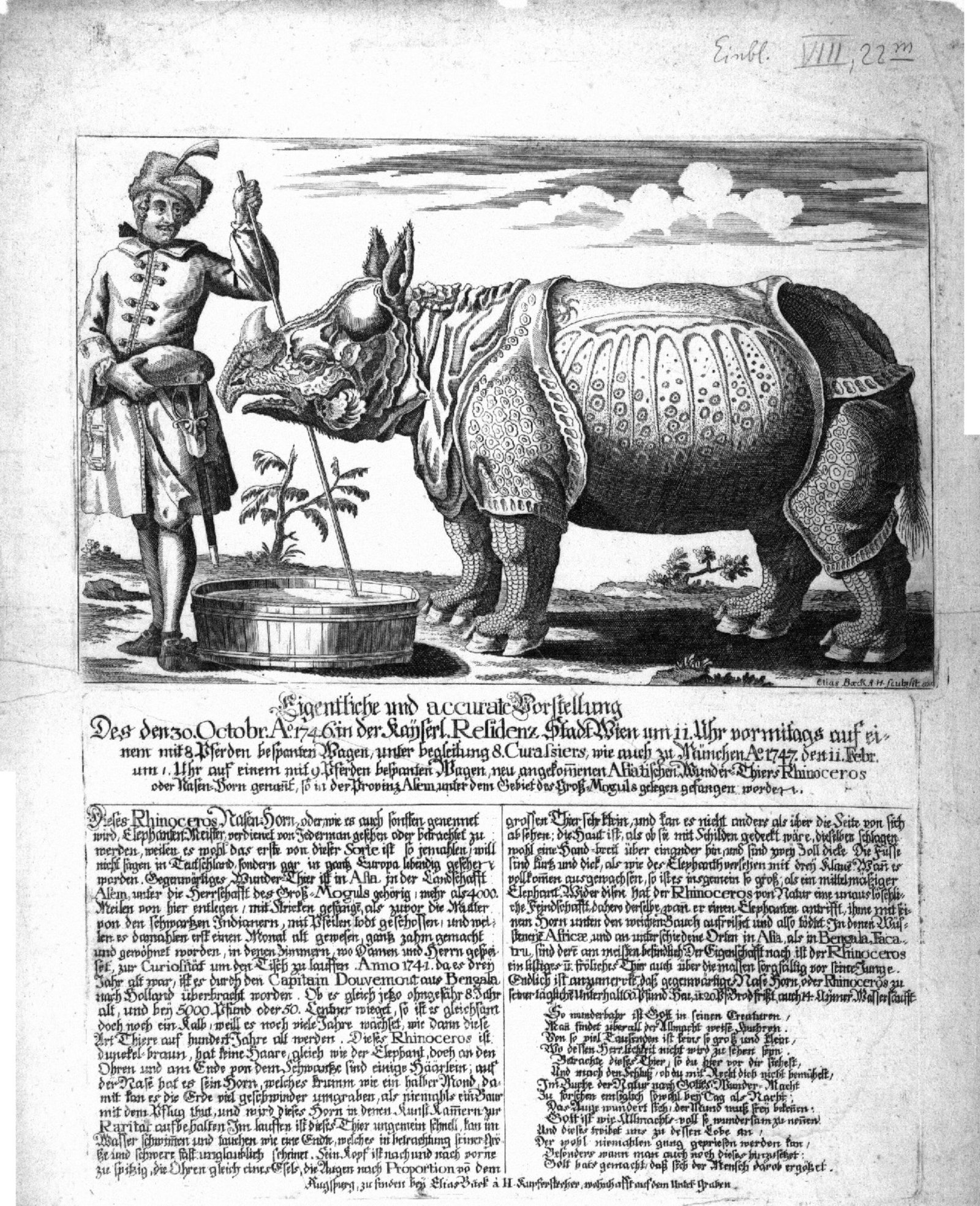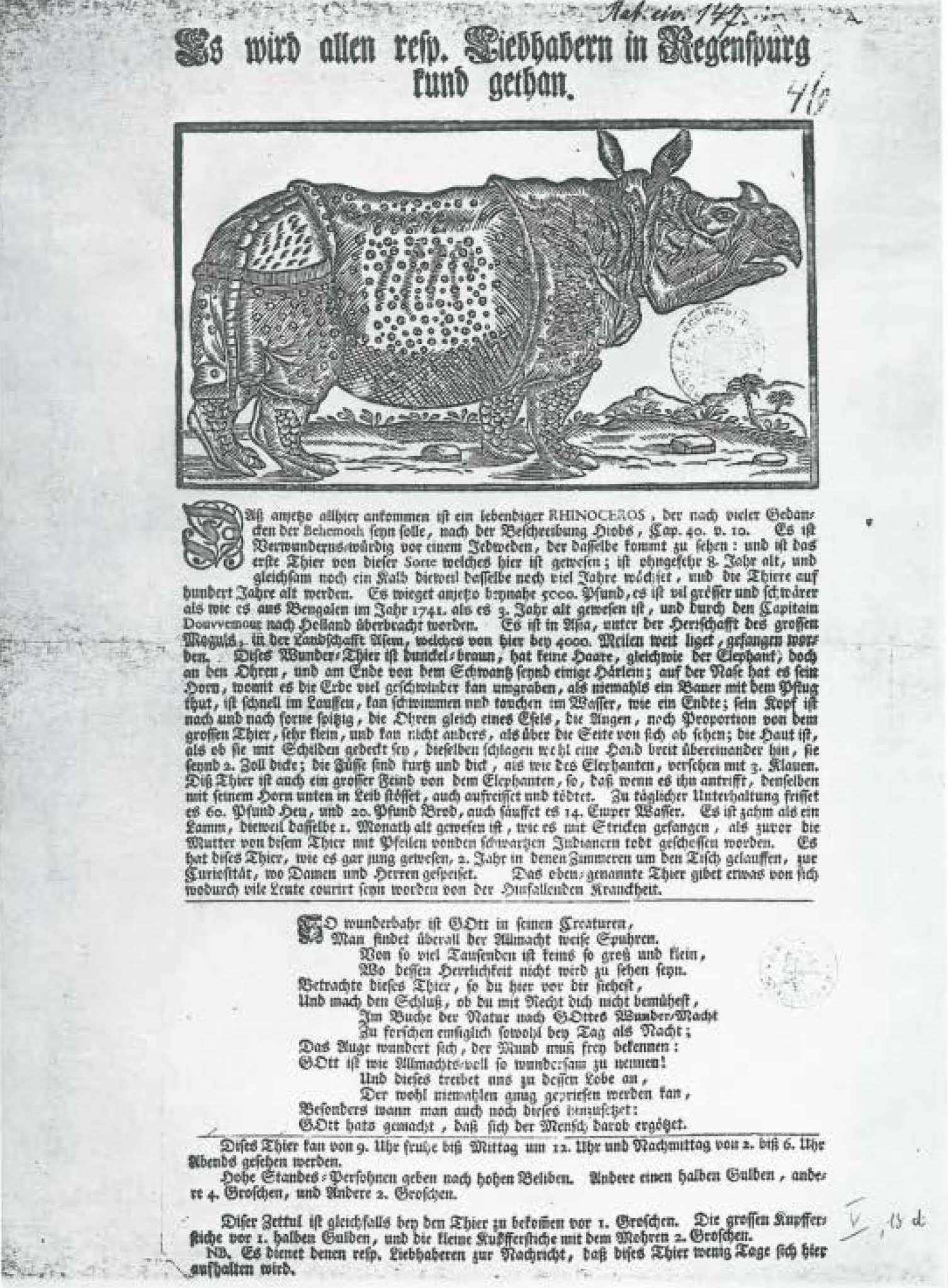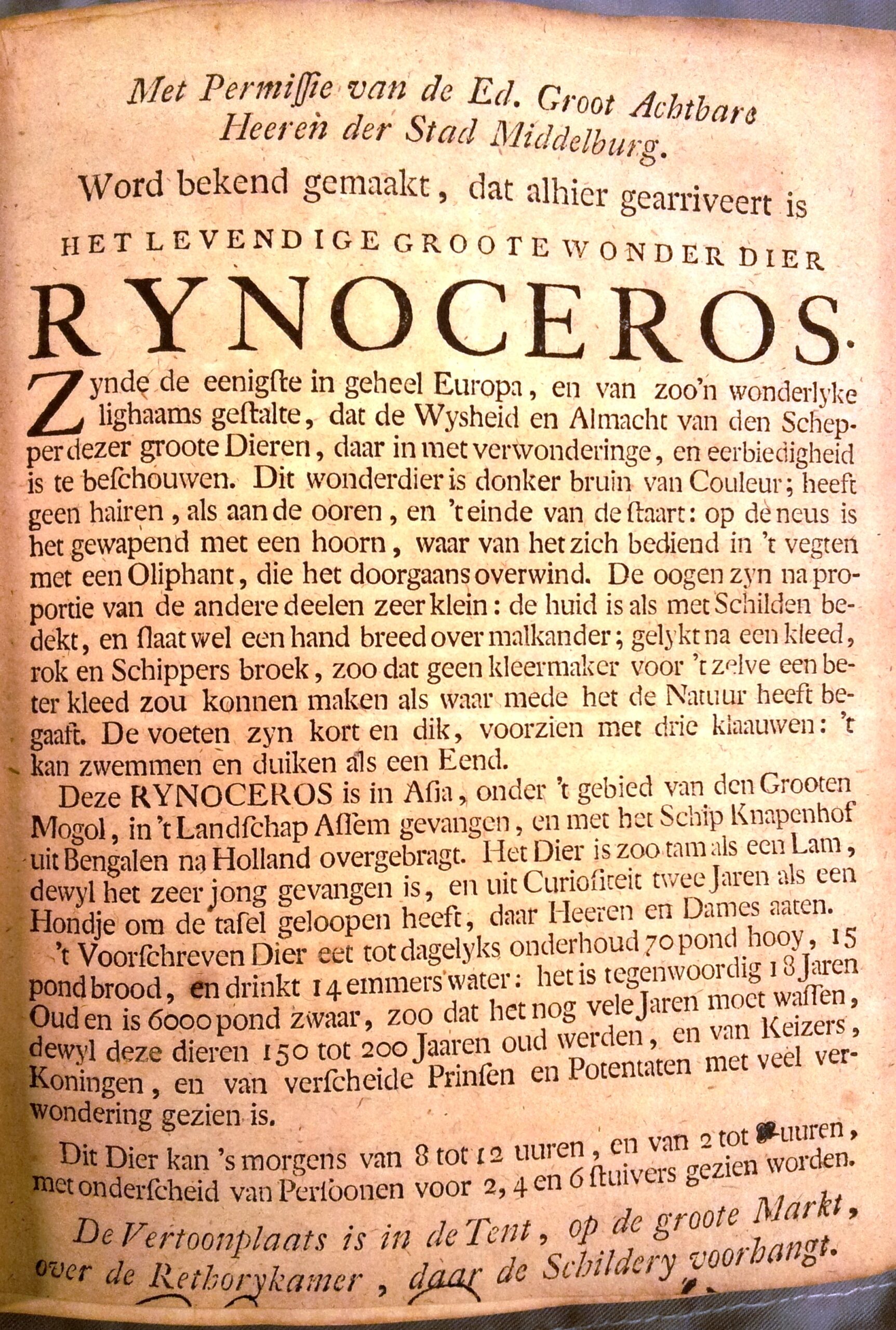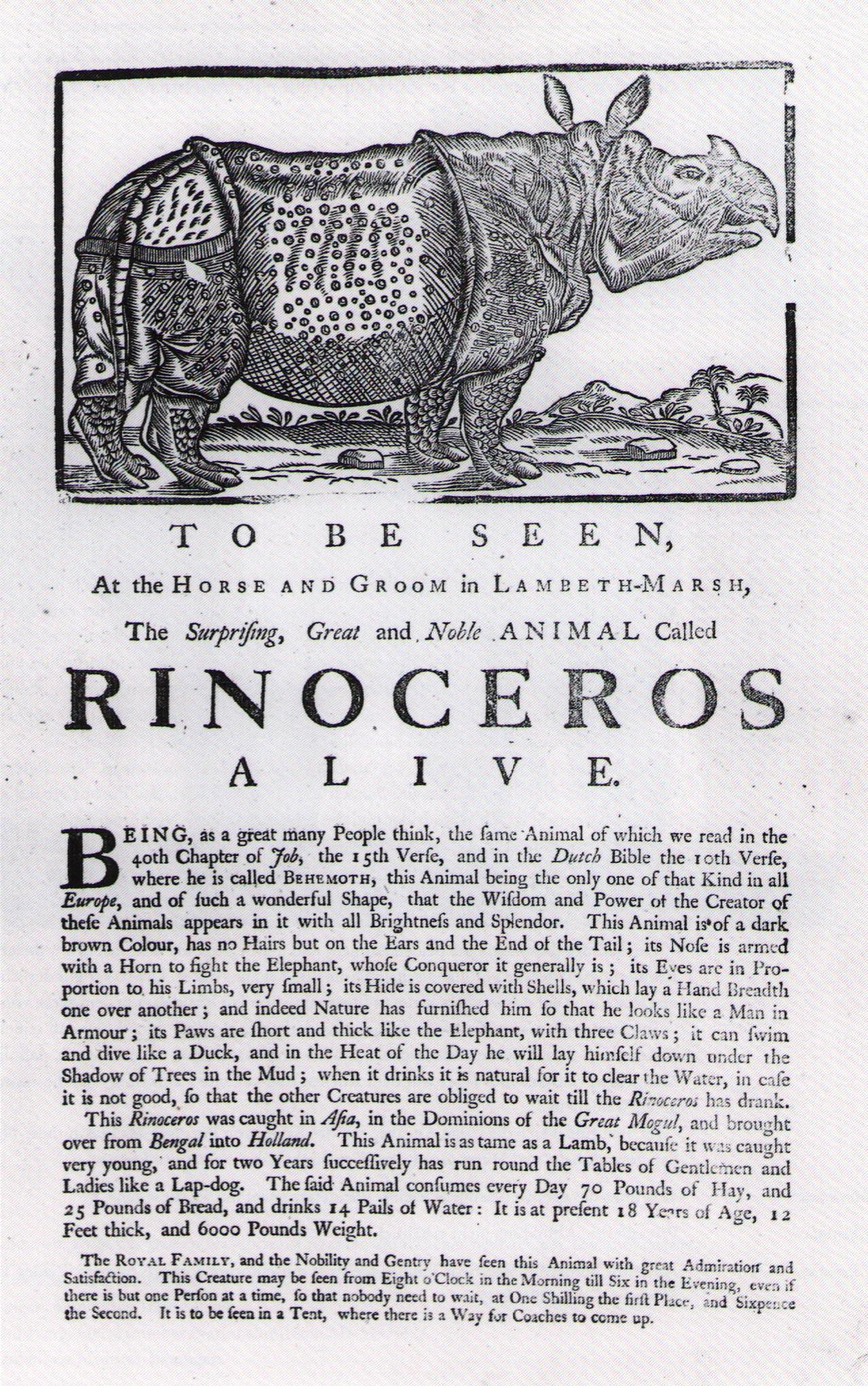


A notice by Johann Peter Kohl specifies arrival in November 1743 (source 2151). There are two broadsheets with the date 1744, one with a long text (A, source 2152), the other with a short text (B, source 2153). The rhino in these two broadsheets is modelled after the woodcut of Dürer, not after Clara. In broadsheet (A) the rhino is shown together with an unidentified man. The date of departure is unknown, although February 1744 has been suggested.
Literature
- Van der Ham 2022, p. 183, n. 164 – says exhibition Early November 1743 to end February 1744. * His sources (Kohl, Faust) do not specify the month of February
Source 2151. Kohl in Hamburgische Berichte
Kohl, Johann Peter 1744. Hamburgische Berichte von neuesten Gelehrten Sachen, No. 14 (18 February) and No. 15 (21 February): 105–112, 113–116 [no plate]
No. 14, for 18 February 1744
Original text (German)
[p.105] Hamburg. Im abgewichenen Jahr 1743 im Monat November, kam dieselbst ein sogenanter Rhinoceros oder Nasehorn mit einem Schiffe aus Holland bei uns an, von welchem der Eigener unter andern dieses meldet, daß es in dem Gebiet des grossen Mogols über Bengalen gefangen worden, und zu der Zeit nur einige Tage alt gewesen, da es hetzo wenigstens fünftehalb Jahr alt sey. Wiewol nun dergleichen Their bereits vor vielen hundert Jahren in Rom bekant gewesen, woselbst sie in den grossen Schauspeilen und andern …
[106–116] – [continues about knowledge of Romans about rhinos, and later authors. Also gives a description of the animal. There is no illustration]
English translation
Hamburg. In the past year 1743, in the month of November, a so-called rhinoceros or nose-horn arrived here on a ship from Holland, of which the owner reports, among other things, that it was caught in the territory of the Great Mogol in Bengal, and was at that time only a few days old, whereas it is now at least five and a half years old.
Source 2152. Broadsheet A issued in Hamburg
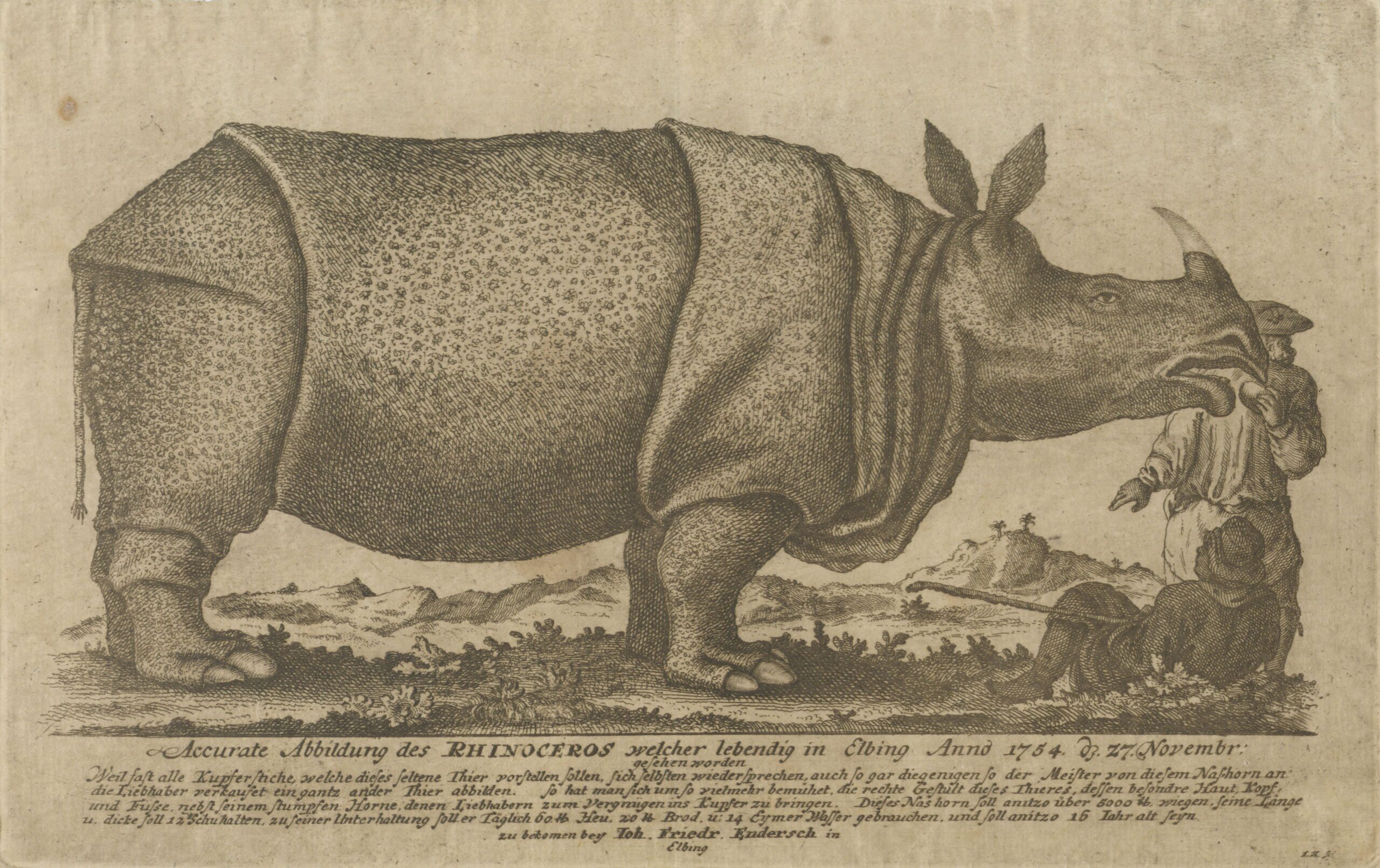
Copper engraving [Kupferstich], size 125 x 255 mm, paper size 130 x 285 mm
Rhino faces right, man with hay on a fork. The engraving shows a rhinoceros after Dürer, but without hornlet on the shoulder, and showing a man on the right.
Examples:
Hamburg, Staatsarchiv, Plankammer, Naturgeschichte, Zoologie, Mappe 282–15, 4. Aus der Sammlung [From the collection] Gaedeckens-Grimer, Dezember 1908.
London, British Museum, Print Room, Foreign History, reg. 1873,0712.190 – here
Bingen, Sammlung Ingrid Faust, no. 704 – now: München, Bayerische Staatsbibliothek, Res/Slg.Faust 166 – here
Literature
- Heikamp 1980: 310, fig. 9 – illustrated
- Verheij 1989: 17
- Faust 2003: 60–61, no. 704
- Mueller, C.G. 1791. Verzeichnis von Nurnbergische topographisch-historischen Kupferstichem und Holzschnitten. Nurnberg – Refers p. 178: “Wahre Abbildung des Rinoceros oder Nasenhorns, welches zu sehen ist, 4o. 1744. Dieses ist etc. etc. Ein Bogen.”
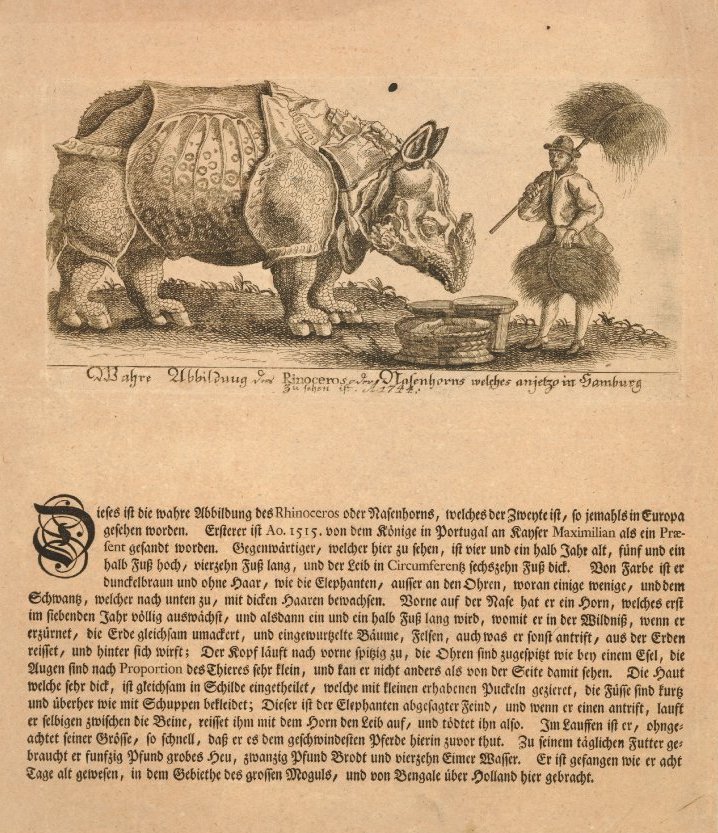
https://rhinoresourcecenter.com/library/images/clara-1744/
German Text on the engraving:
Wahre Abbildung des Rinoceros oder Nasenhorns welches anjetzo in Hamburg zu sehen ist. Ao. 1744.
Dieses ist die wahre Abbildung des Rhinoceros oder Nasenhorns, welches der zweyte ist, so jemahls in Europa gesehen worden. Ersterer ist Ao. 1515 von dem Könige in Portugal an Kayser Maximilian als ein Praesent gesandt worden. Gegenwärtiger, welcher hier zu sehen, ist vier und ein halb Jahre alt, fünf und ein halb Fuß hoch, vierzehn Fuß lang, und der Leib in Circumferentz sechzehn Fuß dick. Von Farbe ist er dunckelbraun und ohne Haar, wie die Elephanten, ausser an den Ohren, woran einige wenige, und dem Schwanz, welcher nach unten zu, mit dicken Haaren bewachsen. Vorne auf der Nase hat er ein Horn, welches erst in siebenden Jahr völlig auswächst, und alsdann ein und ein halb Fuß lang wird, womit er in der Wildniß, wenn er erzürnet, die Erde gleichsam umackert, und eingewurtzelte Bäume, Felsen, und was er sonst antrift, aus der Erden reisset, und hinter sich wirft; der Kopf läuft nach vorne spitzig zu, die Ohren sind zugespitzt wie bey einem Esel, die Augen sind nach proportion des Thieres sehr klein, und kan er nicht als anders als von der Seite damit sehen. Die Haut welche sehr dick, ist gleichsam in Schilde eingetheilet, welche mit kleinen erhobenen Puckeln gezieret, die Füsse sind kurtz und überher wie mit Schuppen bekleidet; Dieser ist der Elephanten abgesagter Feind, und wenn er einen antrift, lauft er selbigen zwischen die Beine, reisset ihm mit dem Horn den Leib auf, und tödtet ihn also. Im Lauffen ist er, ohngeachtet seiner Grösse, so schnell, daß er es dem geschwindesten Pferde hierin zuvor thut. Zu seinem täglichen Futter gebraucht er funfzig Pfund grobes Heu, zwanzig Pfund Brodt und vierzehn Eimer Wasser. Er ist gefangen wie er acht Tage alt gewesen, in dem Gebiethe des grossen Moguls, und von Bengale über Holland hier gebracht.
English translation
This is a true representation of the rhinoceros, or nose horn, which is the second ever seen in Europe. The former was sent in 1515 by the King of Portugal to Emperor Maximilian as a present. The present one, which is seen here, is four and a half years old, five and a half feet high, fourteen feet long, and the body sixteen feet thick in circumference. He is dark brown in color and hairless, like an elephant, except for his ears, where there are a few, and his tail, which is covered with thick hair towards the bottom. On the front of his nose he has a horn, which only grows fully after seven years and then becomes a foot and a half long, with which he uses it in the wild, when angry, to plow the earth, as it were, and to tear up rooted trees, rocks, and whatever else he finds, and throws them behind him. His head tapers to a point at the front, his ears are pointed like a donkey’s, his eyes are very small, in keeping with the animal’s proportions, and he can only see from the side. His skin, which is very thick, is divided into shields, which are decorated with small raised mounds, his feet are short and covered all over as if with scales. This elephant is the sworn enemy of the elephant, and when he encounters one, he runs between its legs, tears open its body with his horn, and thus kills it. Despite his size, he is so fast at running that he can outrun even the fastest horse. For his daily food, he needs fifty pounds of coarse hay, twenty pounds of bread, and fourteen buckets of water. He was captured when he was eight days old in the territory of the Great Mogul and brought here from Bengal via Holland.
Source 2153. Broadsheet B issued in Hamburg
Hamburg, second broadsheet, undated
Rhino faces left, short title only.
[note absence of hornlet on shoulder]
Examples:
Hamburg, Staatsarchiv, Plankammer, Naturgeschichte, Zoologie, Mappe 282–15, 4. Aus der Sammlung Gaedeckens-Grimer, Dezember 1908.
Literature
- Faust 2003, no. 705
- Clarke 1986: 45,
- Heikamp 1980:311, fig. 10 – illustrated
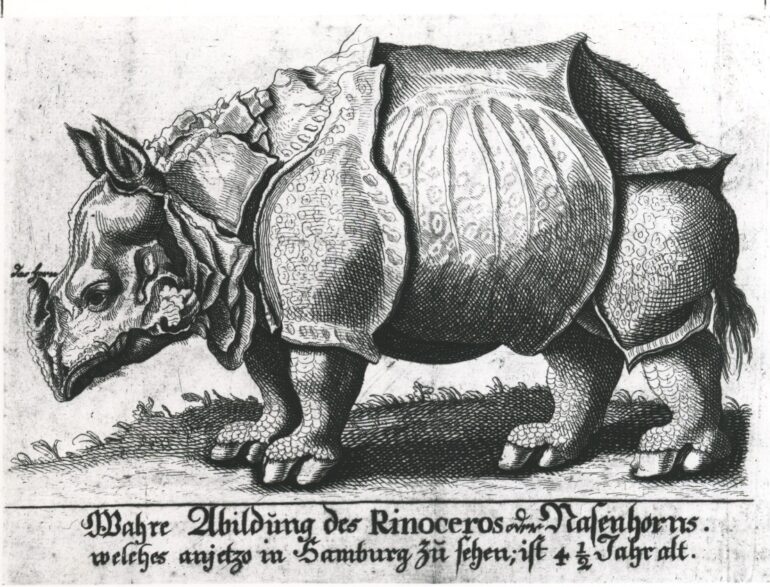
https://rhinoresourcecenter.com/library/images/clara-visits-hamburg/
Original text (German)
Wahre Abildung des Rinoceros oder Nasenhorns. welches anjetzo in Hamburg zu sehen; ist 4 ½ Jahr alt.
[above the horn is written] das horn
English translation
True depiction of the rhinoceros, or nose horn, currently on display in Hamburg; is 4 ½ years old.